8 Montessori Christmas Activities for Preschoolers: Real Little Jobs, Each With a Short Read-Aloud
Montessori Christmas activities for preschoolers are small, real jobs with simple things from home, like two bowls, a big spoon, and a few cotton balls. Here are eight of them from my Montessori-Inspired Christmas Advent Calendar, from spooning snowballs on Day 1 to setting the holiday table on Day 24. Each one takes a few minutes and starts with a short read-aloud.
- 8 little jobs
- Ages 3–6
- A few minutes each
- Simple things from home
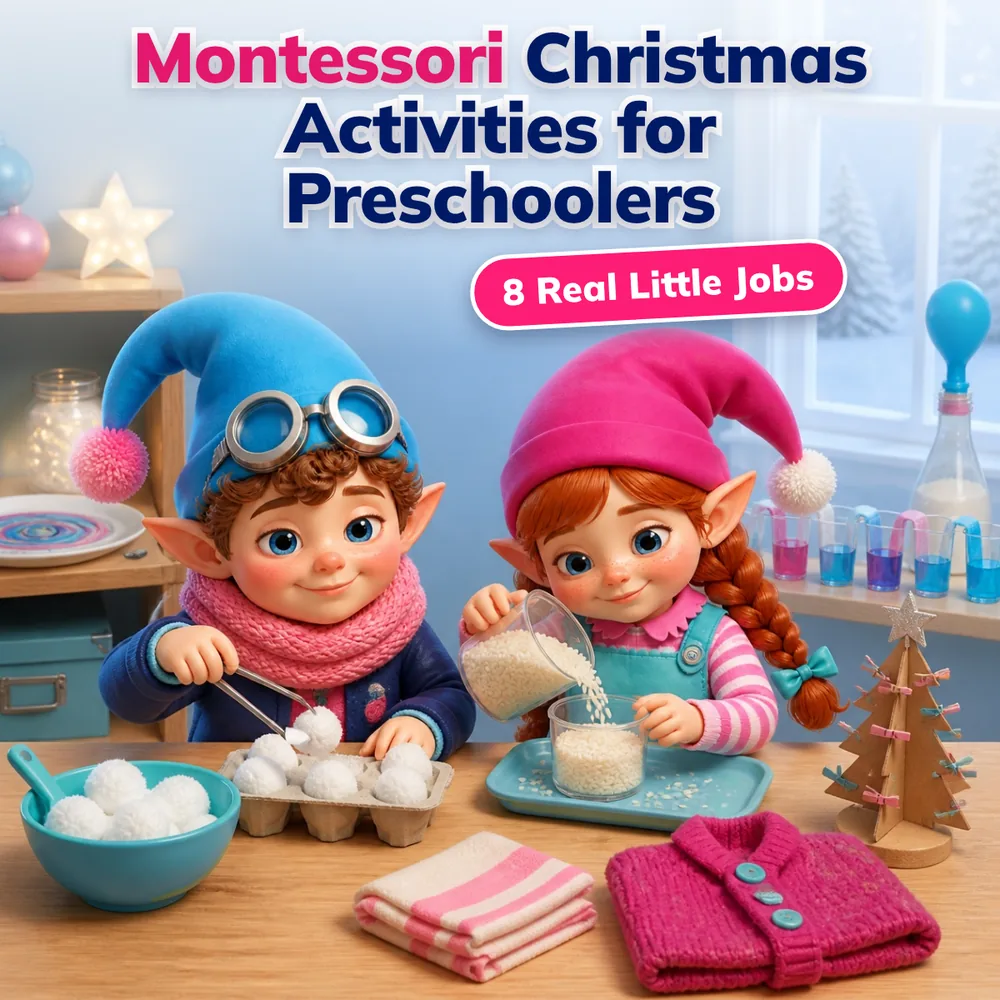
Save this for a calm December afternoon with your little helper, or send it to a friend whose preschooler wants to do everything by themselves.
Let Them Do It by Themselves
These 24 little jobs are small on purpose. A jug of rice, a pair of mittens, a pine cone, a few cotton-ball snowballs. Almost everything you need is already in your home.
Let your little one do each job by themselves, slowly, with you close by, even if it takes longer and a few grains of rice end up on the floor. Watch their hands. You will see how much they can do.
I hope these little jobs give you a slower, calmer moment every day of December, and lots of shared FUN.
Ask your child tonight: What would you like to do all by yourself this Christmas? Day 24, the last little job, is near the end of this page.
Know a preschool teacher or a Montessori family who could use eight calm Christmas jobs? Send this to them. Share it
What are Montessori Christmas activities for preschoolers?
Montessori Christmas activities for preschoolers are small, real jobs a 3- to 6-year-old can do with their own hands: spooning, pouring, transferring with tongs, buttoning, folding, and setting the table. In a Montessori classroom these are called Practical Life activities.
The American Montessori Society says Practical Life activities teach real skills and build independence and fine- and gross-motor coordination. At Christmas, they are real help, too. A child who folds the napkins or sets the table for the holiday dinner is helping the whole family.
You don’t need special Montessori materials. Every job below uses simple things from home: bowls, a big spoon, cotton balls, rice, kitchen tongs, clothespins, a cardigan, and napkins.
How do you show a Montessori activity to a preschooler?
Show it once, slowly, with few or no words. Then step back and let your child try, as many times as they like.
- 1Each evening, read tomorrow’s page and put the things on a tray.
- 2Look at the picture together, read the short text aloud, and say the word of the day.
- 3Show the little job, then let your child take over.
- 4Check the “Mission complete” box, color that day’s star on the countdown page, and write the day’s letter in its box.
How do you set up a Montessori spooning and pouring activity?
Put two bowls or two small plastic jugs on a tray, one full and one empty. In the calendar, spooning comes first, then pouring something dry like rice, then pouring water. The tray catches the spills, so your child can clean them up, too.
Day 1: Spoon the Snowballs

READ IT TOGETHER · DAY 1
These snowballs will never melt!
They are cotton balls, soft and light. Today your hands have a quiet job. Hold the big spoon. Scoop up one snowball and carry it slowly to the other bowl. Then the next one, and the next. When the first bowl is empty, carry them all back again.
TODAY’S LITTLE JOB · PRACTICAL LIFE
You need: 2 bowls, a big spoon, 10 cotton balls, a tray
- Show it once, slowly, without talking.
- Your child spoons every “snowball” into the other bowl.
- Then all the way back.
Try this: Count the snowballs out loud as they land.
SMALL PARTS · not for kids under 3 · a grown-up stays closeIF THEY ASK WHY
Why won’t these snowballs melt? Real snow is frozen water, and it melts when it warms up to 32°F (0°C). Your room is much warmer than that. Cotton balls aren’t frozen water at all. They are made of soft fibers, and a warm room can’t melt them.
For grown-ups: Grows: independence and hand coordination. Practical Life activities build both.
Day 4: Pour the Rice
READ IT TOGETHER · DAY 4
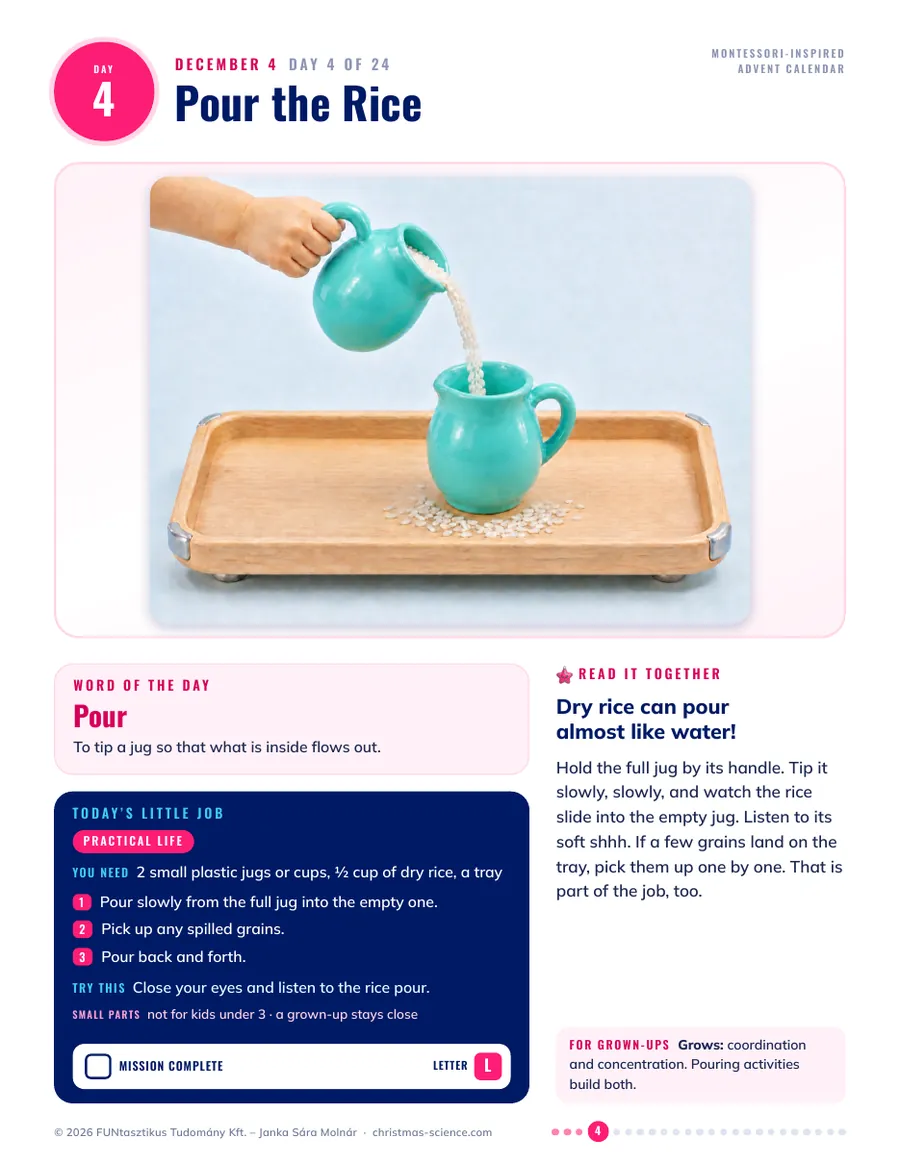
Dry rice can pour almost like water!
Hold the full jug by its handle. Tip it slowly, slowly, and watch the rice slide into the empty jug. Listen to its soft shhh. If a few grains land on the tray, pick them up one by one. That is part of the job, too.
TODAY’S LITTLE JOB · PRACTICAL LIFE
You need: 2 small plastic jugs or cups, ½ cup of dry rice, a tray
- Pour slowly from the full jug into the empty one.
- Pick up any spilled grains.
- Pour back and forth.
Try this: Close your eyes and listen to the rice pour.
SMALL PARTS · not for kids under 3 · a grown-up stays closeIF THEY ASK WHY
Is rice a liquid, then? No, but it acts a bit like one. Rice is lots of small, hard grains that slide and roll over each other, so a jug of rice can pour. Now look at the grains that land on the tray. Rice can pile up into a little hill. Water can’t pile up like that. It runs and spreads out into a puddle.
For grown-ups: Grows: coordination and concentration. Pouring activities build both.
Day 15: Pour the Water
READ IT TOGETHER · DAY 15
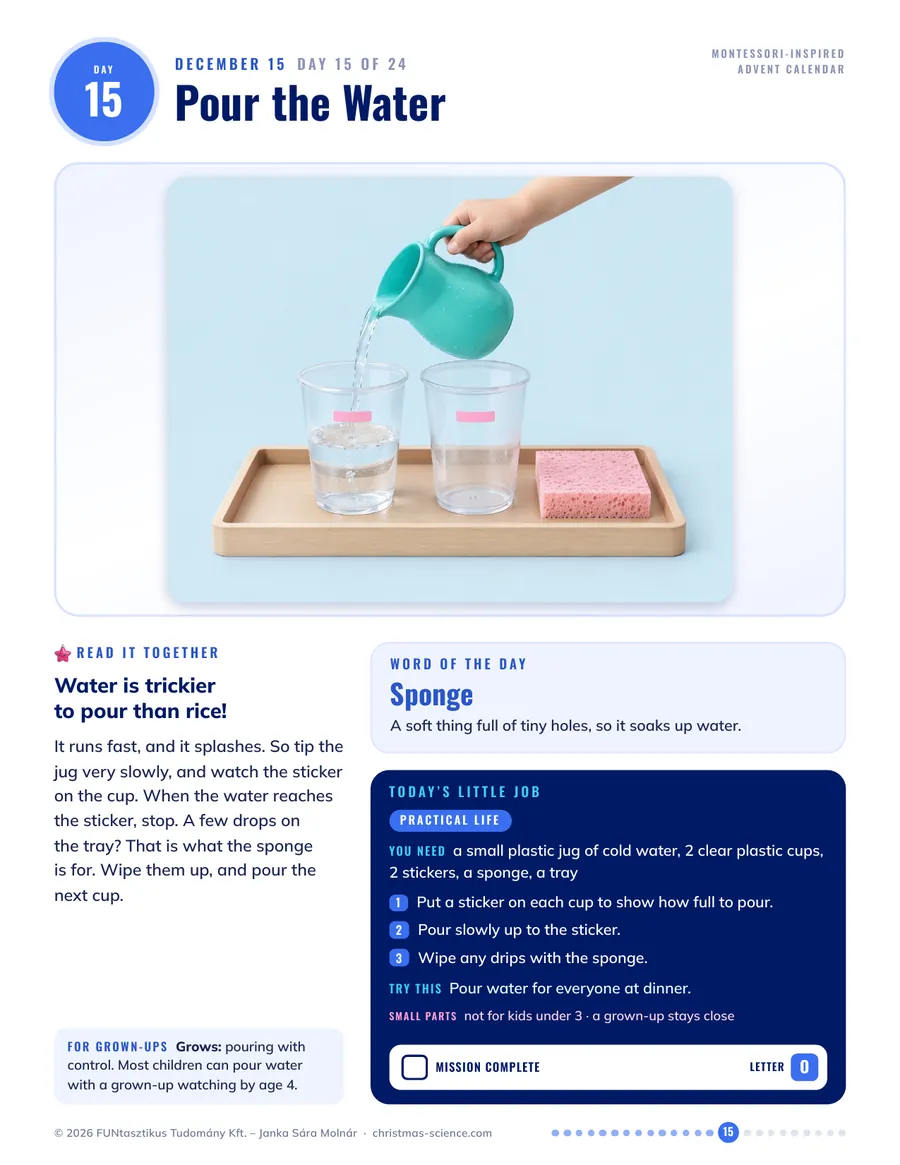
Water is trickier to pour than rice!
It runs fast, and it splashes. So tip the jug very slowly, and watch the sticker on the cup. When the water reaches the sticker, stop. A few drops on the tray? That is what the sponge is for. Wipe them up, and pour the next cup.
TODAY’S LITTLE JOB · PRACTICAL LIFE
You need: a small plastic jug of cold water, 2 clear plastic cups, 2 stickers, a sponge, a tray
- Put a sticker on each cup to show how full to pour.
- Pour slowly up to the sticker.
- Wipe any drips with the sponge.
Try this: Pour water for everyone at dinner.
SMALL PARTS · not for kids under 3 · a grown-up stays closeIF THEY ASK WHY
How does the sponge drink up the drops? Water likes to creep into narrow spaces. A sponge is full of tiny holes, so the water climbs right into them. Scientists call this capillary action, and a paper towel cleans up a spill the same way.
For grown-ups: Grows: pouring with control. Most children can pour water with a grown-up watching by age 4.
Know a 3-year-old who insists on pouring their own water? Send this to their grown-up. Share it
Which Montessori activities build fine motor skills at Christmas?
Tongs and clothespins are two easy ones. Both ask small fingers to squeeze, hold, and let go at the right moment, and both make a simple Christmas game: catching snowballs or dressing a cardboard tree.
Day 8: Snowball Tongs
READ IT TOGETHER · DAY 8
Tongs are like long fingers that pinch!
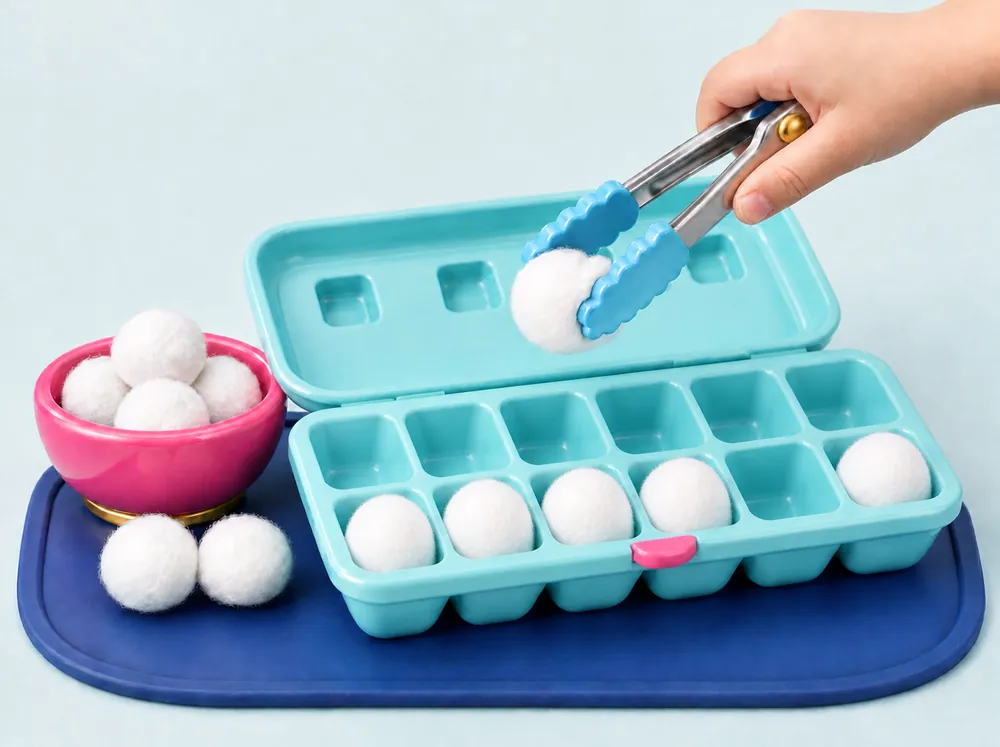
Squeeze them, and they close. Let go, and they open. Can you catch a snowball? Squeeze gently, lift it up, and hold it over a cup. Now let go, and the snowball drops in. Every little cup is waiting for one snowball.
TODAY’S LITTLE JOB · PRACTICAL LIFE
You need: kitchen tongs, an egg carton or muffin tin, 12 cotton balls
- Show how the tongs open and close.
- Pick up one snowball and drop it into a cup.
- Fill every cup.
Try this: Switch hands and try again.
SMALL PARTS · not for kids under 3 · a grown-up stays closeIF THEY ASK WHY
Do tongs pinch harder than your hand? No, and that is why they are so good for snowballs. Tongs are a kind of lever. They make your reach longer, but the tips pinch more gently than your hand squeezes. A gentle pinch lifts a soft cotton ball without squashing it.
For grown-ups: Grows: precise hand movements. Practical Life work builds fine-motor coordination.
Day 18: Clothespin Tree
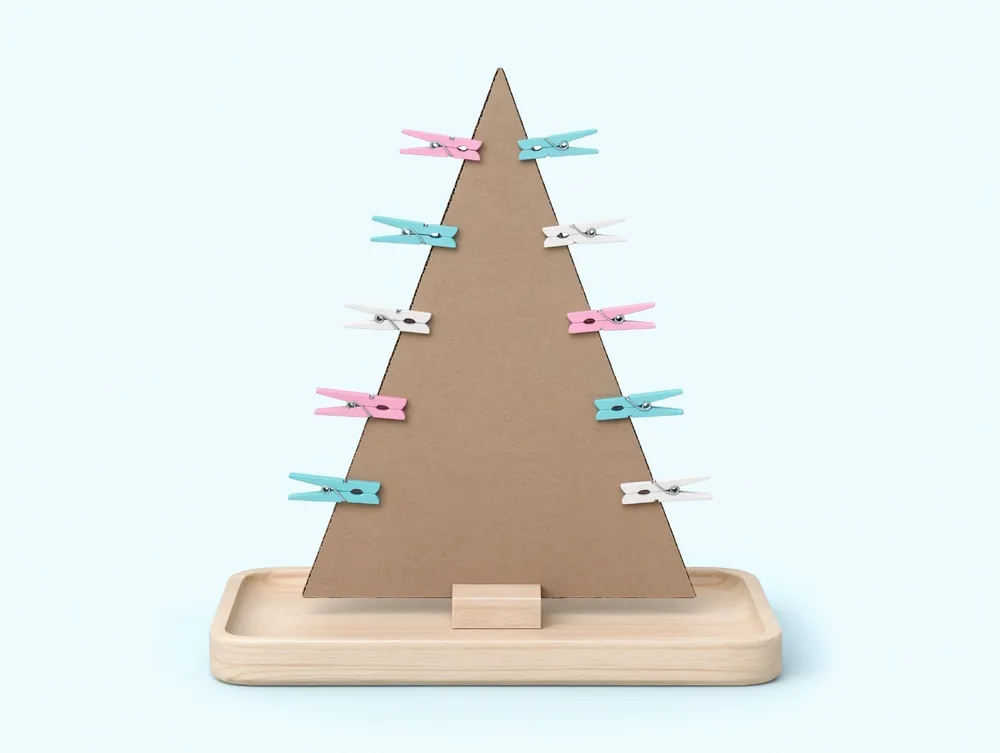
READ IT TOGETHER · DAY 18
A clothespin has a little spring inside!
Pinch the end, and its little mouth opens. Let go, and the spring snaps it shut. Can you feel the spring pushing back on your fingers? Open, clip, let go. Dress your cardboard tree with clothespins all the way around. Then take them off and start again.
TODAY’S LITTLE JOB · PRACTICAL LIFE
You need: a triangle tree cut from cardboard (a grown-up cuts it with scissors), 10 clothespins
- Show how to pinch a clothespin open.
- Clip the clothespins along the edges.
- Take them off and start again.
Try this: Count the clothespins as you clip.
IF THEY ASK WHY
Where does the snap come from? When you pinch, you bend the little metal spring. A bent spring stores the energy from your fingers. When you let go, it springs back to its old shape, and that snaps the clothespin’s mouth shut.
For grown-ups: Grows: finger control. Practical Life work builds fine-motor coordination.
Good to know: Use full-size clothespins, not mini craft ones, and set aside any clothespin that comes apart.
Can a 3-year-old really help get ready for Christmas?
Yes, with jobs that are small enough. Folding napkins and setting a place at the table are real help in a busy December. Buttoning is a bit harder. Many children start with big buttons at 3 or 4, and most can button some buttons by age 5. All three are Practical Life skills that children practice in Montessori classrooms.
Day 20: Button Up
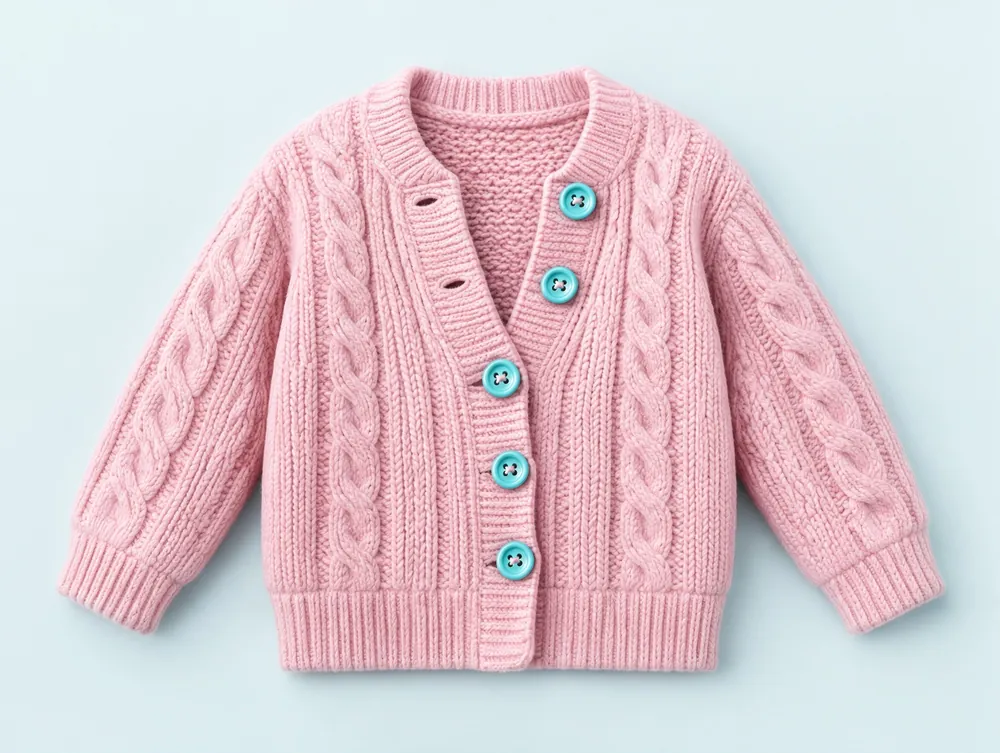
READ IT TOGETHER · DAY 20
A button and a buttonhole make a team!
The button slides through the hole and lies flat, and it stays closed. Hold the button with one hand. Open the hole a little with the other. Push the button through, and pull it to the other side. Then do the next one.
TODAY’S LITTLE JOB · PRACTICAL LIFE
You need: a cardigan, coat, or shirt with big buttons
- Lay it flat on the table.
- Push each button through its hole.
- Then unbutton, one by one.
Try this: Button up a grown-up’s coat.
IF THEY ASK WHY
Why doesn’t the button slip back out? The buttonhole is a slit, just long enough for the button to squeeze through on its edge. On the other side, the button lies flat across the slit. It can’t get back through until someone tips it onto its edge again.
For grown-ups: Grows: getting dressed alone. Most children can button some buttons by age 5.
Day 23: Fold the Napkins
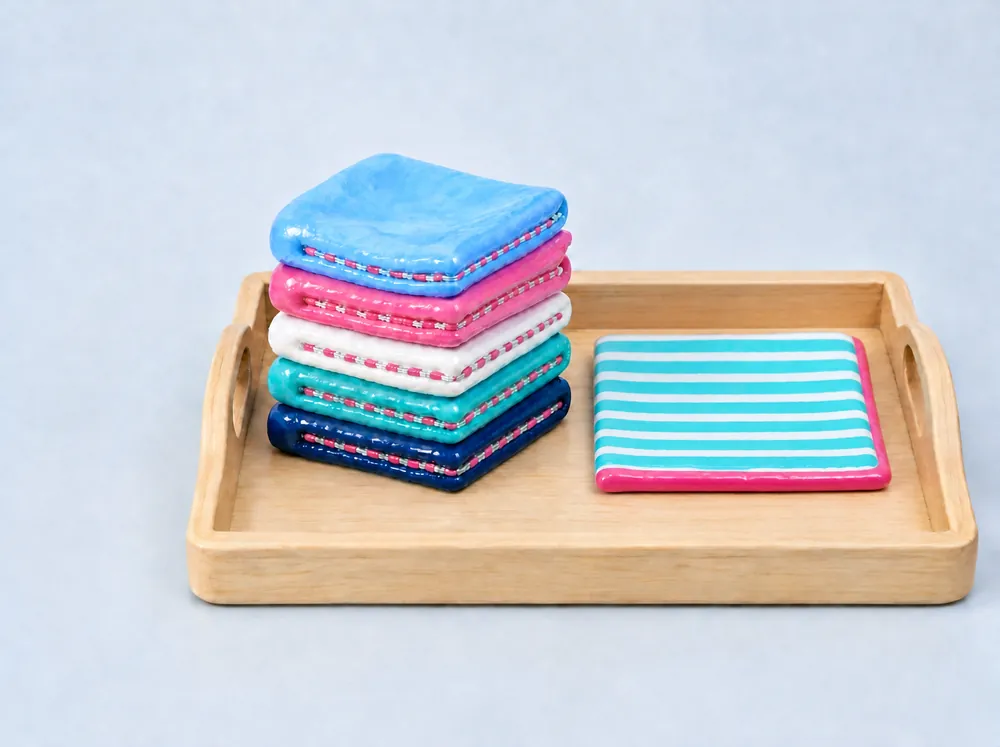
READ IT TOGETHER · DAY 23
Tomorrow the table needs napkins, and your hands can fold them!
Lay one napkin flat. Bring one edge over to meet the other edge, and press it down. Now it is folded in half. Fold it in half again and press. Put it on the tray and fold the next one. Stack them up, nice and neat.
TODAY’S LITTLE JOB · PRACTICAL LIFE
You need: cloth or paper napkins, a tray
- Fold a napkin in half.
- Fold it in half again.
- Stack the folded napkins on the tray.
Try this: Fold one napkin for every guest at Christmas dinner.
IF THEY ASK WHY
Why does the napkin get thicker? Every fold doubles the layers. One fold makes 2 layers. Fold again, and you have 4. A third fold would make 8.
For grown-ups: Grows: careful hands and helping others. Practical Life activities build independence and social skills.
Are Montessori Christmas activities safe for 3-year-olds?
They are made for ages 3 to 6, always with a grown-up nearby. Some jobs use small things, like rice, cotton balls, and stickers, that can cause choking, so keep them away from children under 3. If your 3-year-old still puts things in their mouth, skip the jobs with small things for now. Here are the safety rules from the calendar.
THE SAFETY RULES FROM THE CALENDAR
- Small parts: rice, beans, pasta, cotton balls, stickers, jingle bells, marker caps, cloves, and rubber bands can cause choking. Never for children under 3: keep them away from younger siblings, too.
- Nothing goes in the mouth, nose, or ears. Uncooked rice, beans, and pasta are for play only.
- Strings: never tie them into a loop or put them around a neck.
- No flames, no hot liquids, no sharp knives. Child-safe scissors, for paper only.
- Unbreakable bowls, jugs, cups, plates, and ornaments only. Take off metal hooks.

Ready for kitchen experiments?
If your little one loves spooning, pouring, and squeezing, kitchen experiments are a good next step. My book, Theo and Tilda’s Christmas Science Adventure, has 51 read-aloud stories and 51 kitchen experiments with real photos, plus a 24-day December plan. For ages 3 to 9.
In the book, December 1 is Milk Fireworks: a few drops of food coloring on a plate of milk, a cotton swab with one drop of dish soap, and the colors race apart and swirl. The soap weakens the milk’s surface, and the rest of the surface pulls the colors away.
Is there a printable Montessori advent calendar?
Yes. The eight jobs above come from Theo & Tilda’s Montessori-Inspired Christmas Advent Calendar, a printable advent calendar for kids ages 3 to 6. It has 24 hands-on activities, one for each day from December 1 to 24, and each one uses simple things from home.
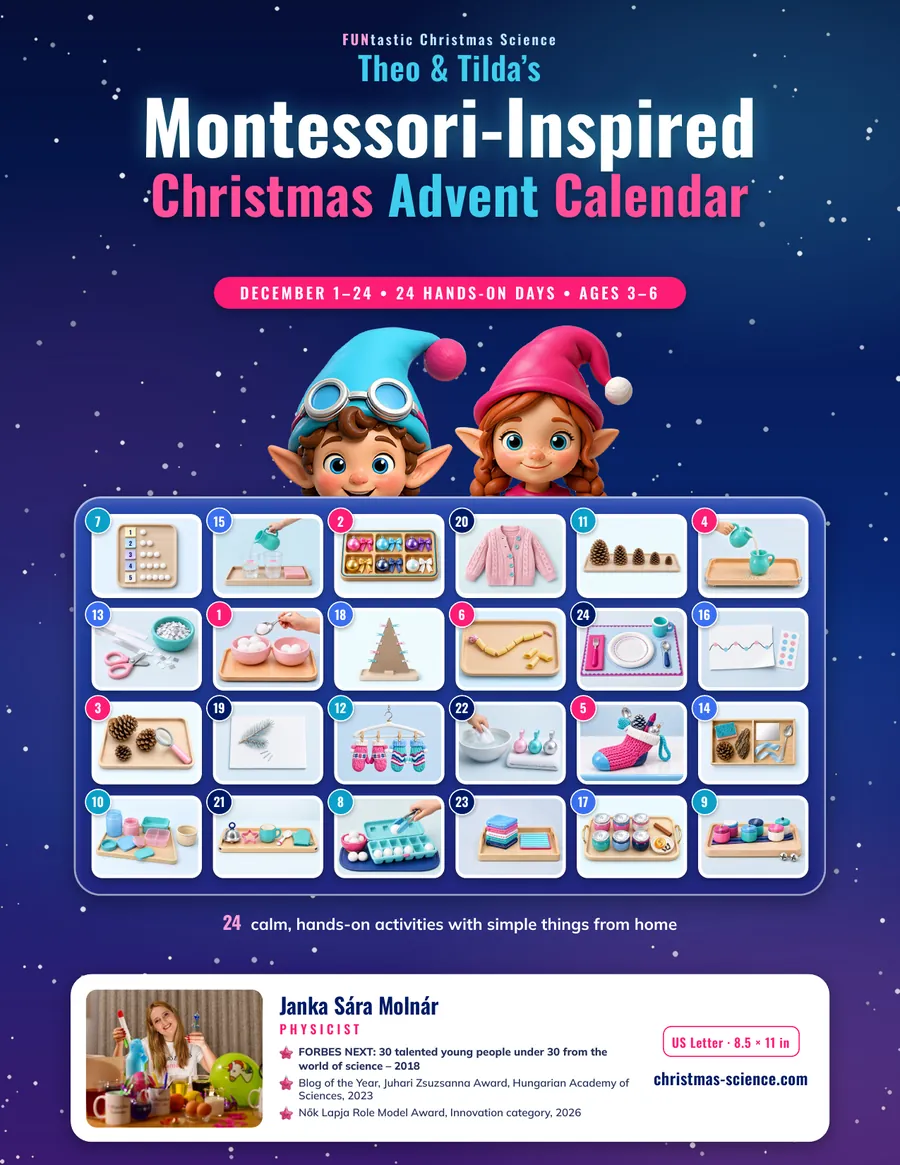
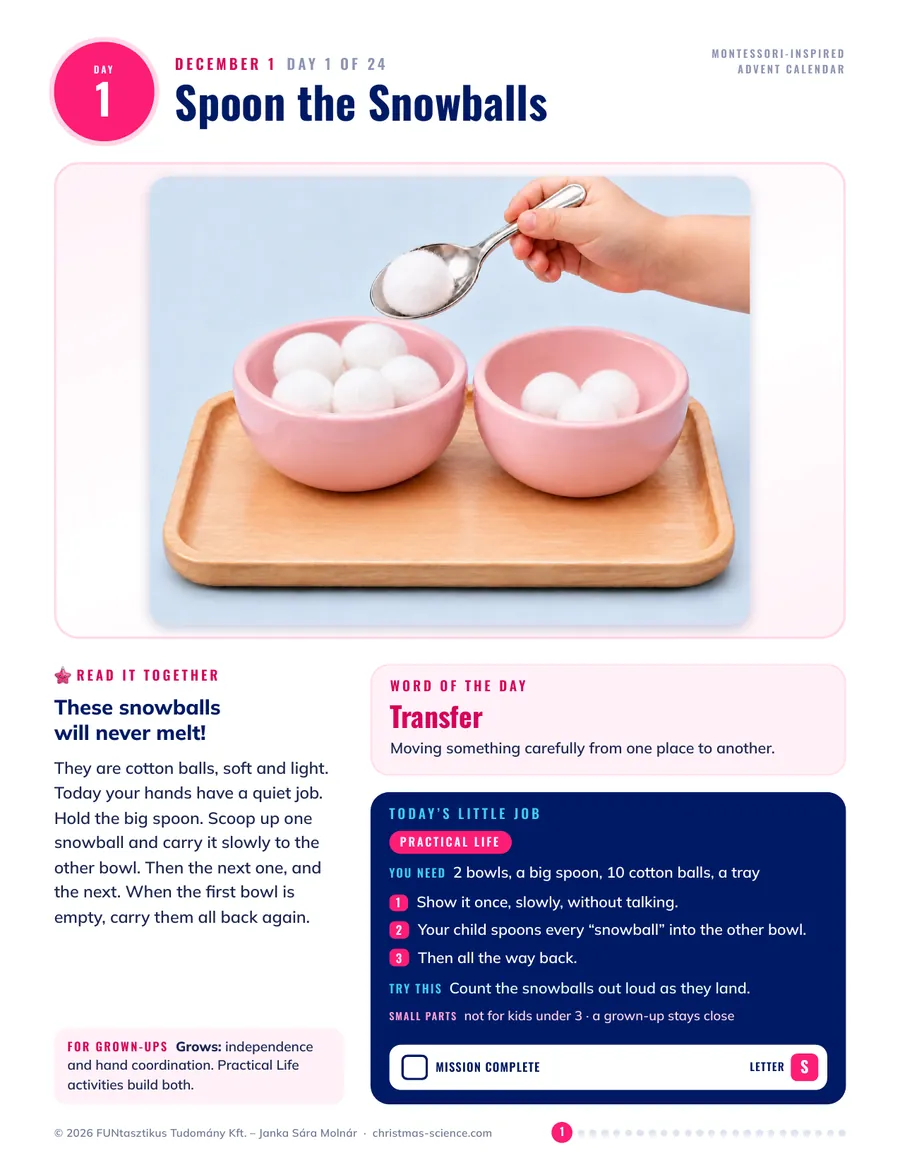
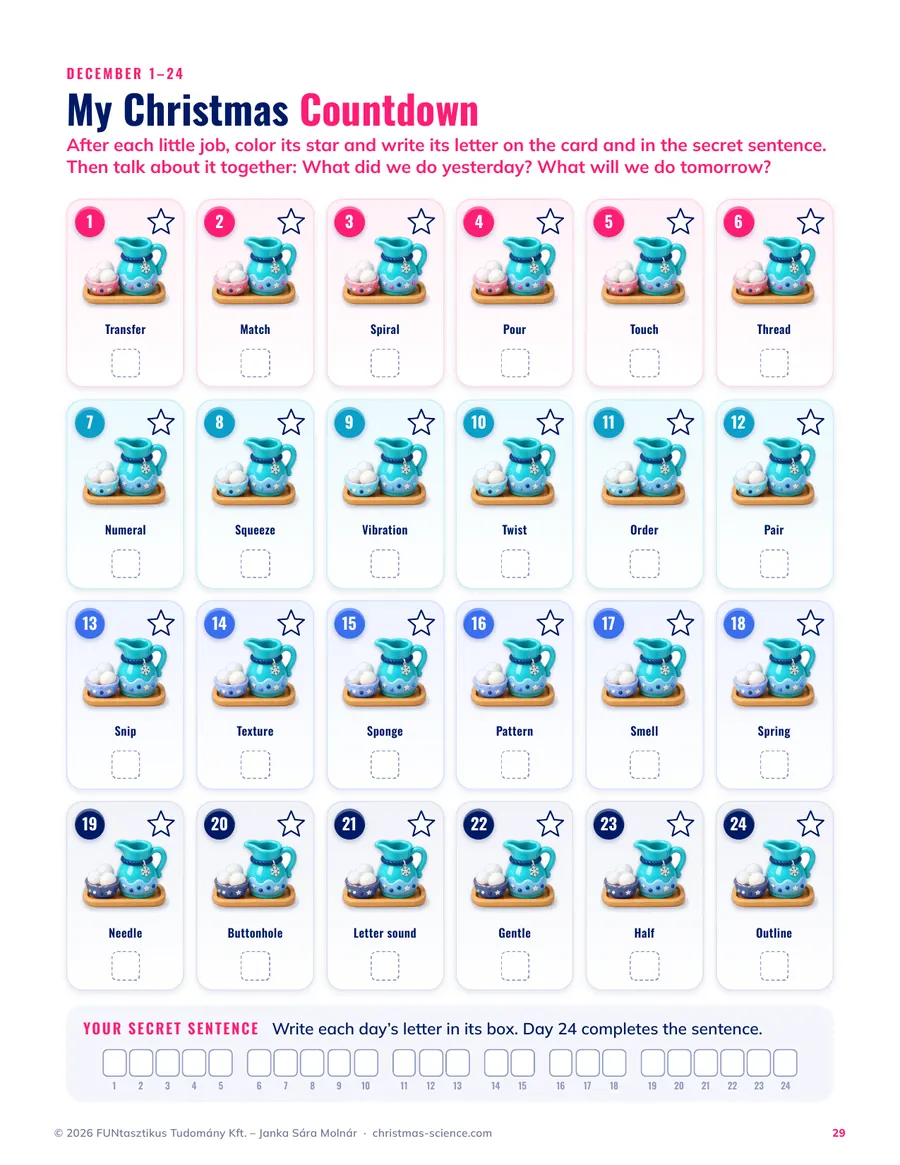
- 24 activity pages, one for each day: a big picture, a short text to read aloud, a word of the day, what you need, 3 easy steps, the skill it builds, and a “Try this” or “Wonder” idea
- Practical Life, senses, math, language, and nature: pouring, spooning, using tongs, folding, matching sounds and colors, feeling rough and smooth, threading a pasta garland, snipping paper snow, counting, ordering by size, and exploring a pine cone and Christmas tree needles
- A safety page and a weekly list of household things to gather
- A color-in countdown page: each day adds one letter, and on December 24 the letters spell a secret sentence
- A December 24 certificate
- No printer? You can read the whole calendar on a screen.
This calendar is Montessori-inspired. It is not an official Montessori product and is not affiliated with AMI or AMS.

A child who pours rice is watching grains flow. A child who squeezes tongs is using a lever. There is real science in these little jobs, and the “If they ask why” boxes give you simple words for it.
You don’t need to know every answer. It’s fine to say, “I don’t know. Let’s find out.” Scientists say it all the time.
Want the science behind more days of the calendar, from pine cones to smell jars? Read “Christmas Sensory Activities for Preschoolers.” And here are all my printable advent calendars for kids.
Set the Holiday Table
Today your hands get the table ready for the celebration! Every plate, cup, fork, and spoon has its own outline on the paper. Put each one on its shape. Add a napkin you folded yesterday. Remember spooning cotton snowballs on Day 1? Now your hands can set a whole table.
TODAY’S LITTLE JOB · PRACTICAL LIFE
You need: a sheet of paper with a plate, cup, fork, and spoon traced on it (a grown-up traces them), unbreakable plates, cups, forks, and spoons, the napkins from Day 23
- Put each thing on its outline.
- Add a folded napkin.
- Set one place for each person.
Try this: Make a name card for each person at the table.
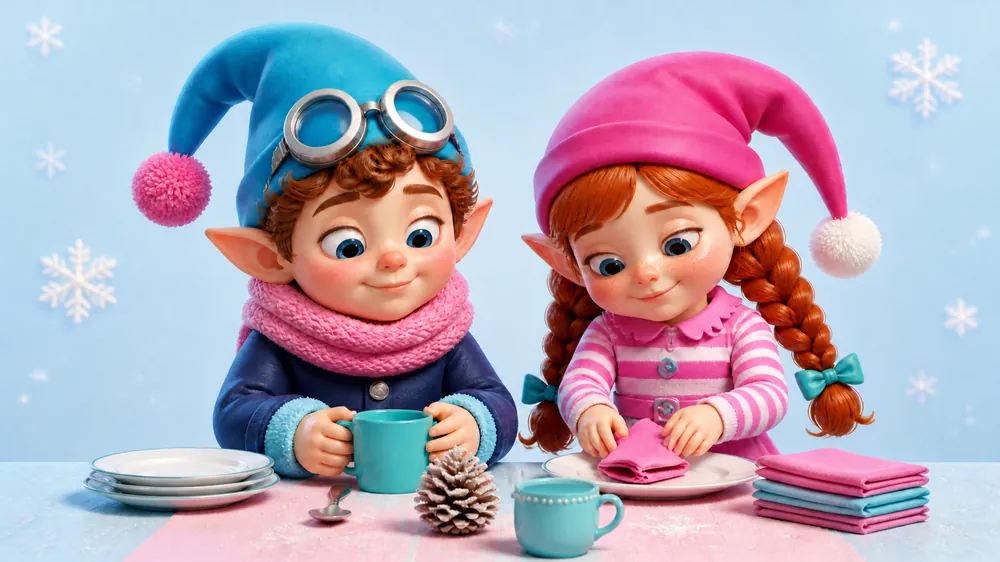
The certificate for December 24 says: “Little Hands, Big Helper, for 24 days of pouring, sorting, matching, and helping. Theo and Tilda, our Science Elves, are very proud of you!”
Ask at dinner on Christmas Eve: Which job did your hands like best?
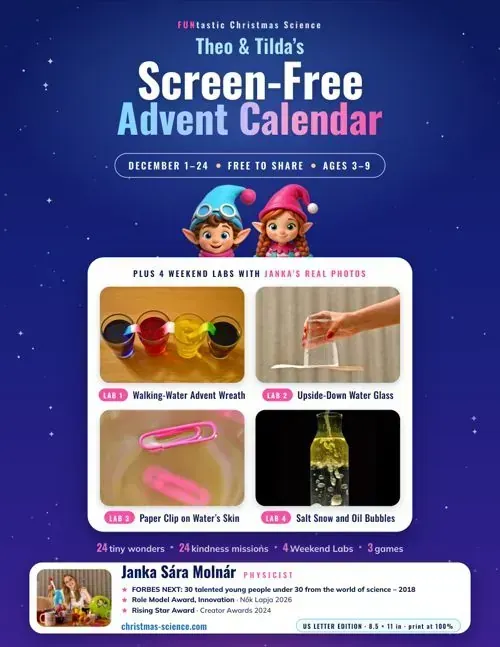
Theo & Tilda’s Screen-Free Advent Calendar
A free printable for ages 3 to 9: 24 tiny wonders and 24 kindness missions, one of each for every day from December 1 to 24.
This calendar is free to share. Print it as often as you like for your family or class, and pass it on to friends, families, and teachers. Please don’t sell it or change it.

Know a family with a little helper?
Send them this page. All eight little jobs are free to read here, and each one takes a few minutes.
COPY THIS MESSAGE
Paste it into a family group chat, or send it to a friend.
I found eight calm Montessori Christmas jobs for little ones: spooning snowballs, pouring rice, catching snowballs with tongs, clipping clothespins, buttoning, and setting the holiday table. Each one starts with a short read-aloud. www.christmas-science.com/blog/montessori-christmas-activities-for-preschoolers
Quick answers about Montessori Christmas activities
What are some easy Montessori Christmas activities for preschoolers?
They are small, real jobs that a 3- to 6-year-old can do with their own hands, with simple things from home: spooning cotton-ball snowballs, pouring rice and water, using tongs, clipping clothespins, buttoning, folding napkins, and setting the holiday table.
What are Practical Life activities?
Practical Life activities are everyday tasks like getting dressed, preparing snacks, and setting the table, and in Montessori classrooms also pouring and spooning. The American Montessori Society says Practical Life activities build independence and fine- and gross-motor coordination.
How long does each activity take?
A few minutes. Show the job once, slowly, with few or no words, and let your child repeat it as many times as they like.
What age is the Montessori-Inspired Christmas Advent Calendar for?
Ages 3 to 6, always with a grown-up nearby. Some activities use small items, so they are never for children under 3. The calendar comes as two PDF files, US Letter and A4, and you can also read it on a screen.
Is this an official Montessori product?
No. The calendar is Montessori-inspired. It is not an official Montessori product and is not affiliated with AMI or AMS.

About Janka
Janka Sára Molnár is a physicist and award-winning science communicator from Hungary, and the founder of FUNtastic Christmas Science. As a high school student, she built particle detectors and took them to CERN several times, where she presented them in its teacher program. She graduated from Eötvös Loránd University (ELTE) in Budapest, and for almost 15 years she has run several hundred science shows for children and families.
- FORBES NEXT: 30 talented young people under 30 from the world of science – 2018
- Nők Lapja Role Model Award, Innovation category, 2026
- Women of Excellence Award, 2026
- Creator Awards, Rising Star, 2024
- Blog of the Year, Juhari Zsuzsanna Award, Hungarian Academy of Sciences, 2023
- Winner of the HBO Max reality show A Híd
The illustrations and the pictures of Theo, Tilda, and their world were created with AI-assisted tools (Canva) and edited by our team. Physicist Janka Sára Molnár checked every fact in this post against trusted sources. The photos of Janka and of her Milk Fireworks experiment are real photos. The Montessori-Inspired Christmas Advent Calendar is not an official Montessori product and is not affiliated with AMI or AMS.
Keep reading
More Christmas science ideas from Theo, Tilda, and me.
 For parents · 21 min read8 Christmas Sensory Activities for Preschoolers, No Messy BinChristmas sensory activities for preschoolers without a messy bin: 8 calm ideas with pine cones, spices, and sound boxes, plus simple science answers.Read the post →
 Free calendar · Preschool · 9 min readScreen-Free Preschool Advent Calendar (Free Printable)A free, screen-free preschool advent calendar from a physicist: 24 ten-minute science wonders and kindness missions for Pre-K and K. Free to share.Read the post →
 Preschool · 22 min readWinter Science Experiments for Preschoolers (No Snow Needed)10 easy winter science experiments for preschoolers, no snow needed: ice, salt, cornstarch, a floating egg, static snowflakes. No flames, no hot water.Read the post →
© 2026 FUNtasztikus Tudomány Kft. – Janka Sára Molnár