Skip to Content
✦✦✦✦
December 1 · free experiment

Theo & Tilda’s Christmas Science

Milk Fireworks Experiment

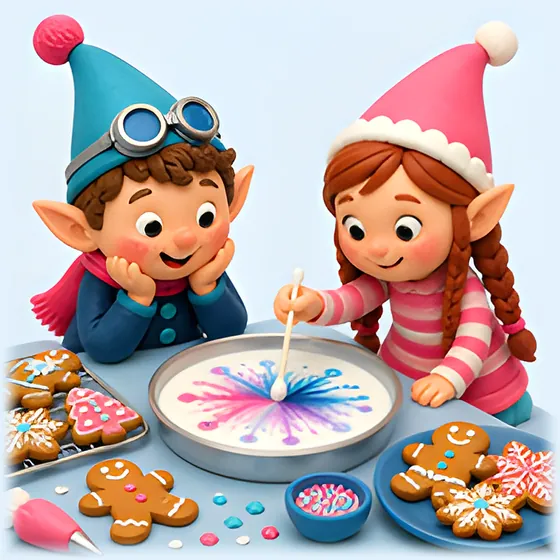
Put drops of food coloring on a plate of milk, touch the middle with a soapy cotton swab, and the colors race apart and swirl like fireworks. The soap weakens the milk’s surface tension, so the surface pulls away from the swab and carries the colors with it.

  • Age3 and up
  • ValueGratitude
  • ScienceSurface tension
  • FlameNone
  • Ages 3–9
  • Kitchen materials
  • No flame, no heat
  • Tested by a physicist
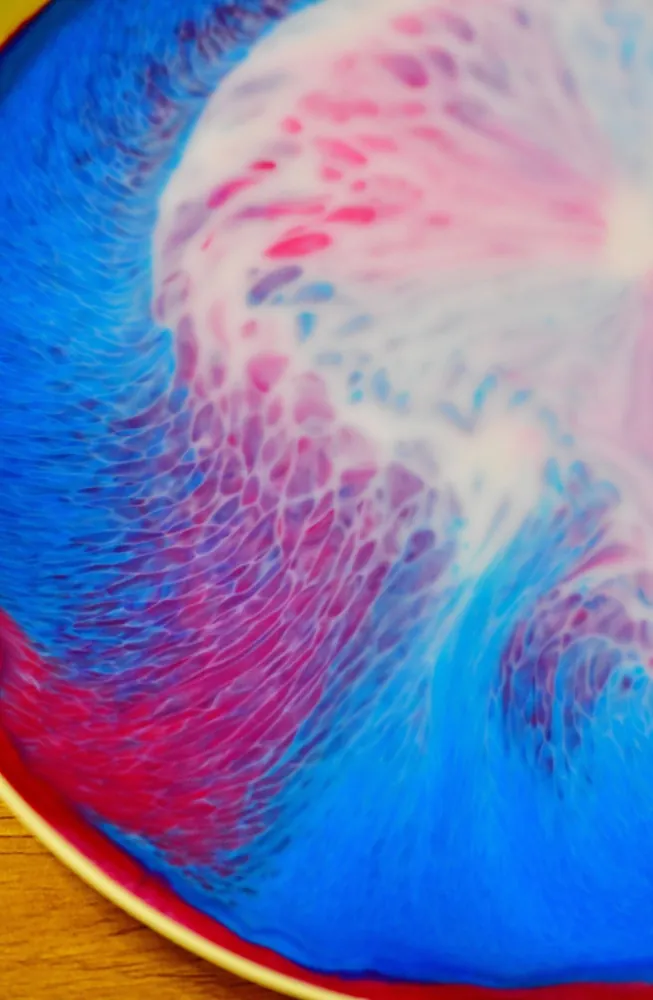
Real photo from Janka’s lab: the Milk Fireworks experiment
NO STOCK PHOTOJanka’s real result
December 1: Theo and Tilda’s Milk Fireworks adventure

In short

  • You need: whole milk, food coloring, one drop of dish soap, a shallow dish and a cotton swab.
  • You see: the colors burst away from the swab and keep swirling for minutes.
  • Why: dish soap lowers the milk’s surface tension right where it touches, and the rest of the surface pulls the colors away.
  • Name: Milk Fireworks, also called the magic milk experiment. Day 1 of a 24-day December plan.
Step by step

How do you make Milk Fireworks?

Watch one drop of soap send colors racing across milk. Here is everything from the book page, ready for your kitchen table.

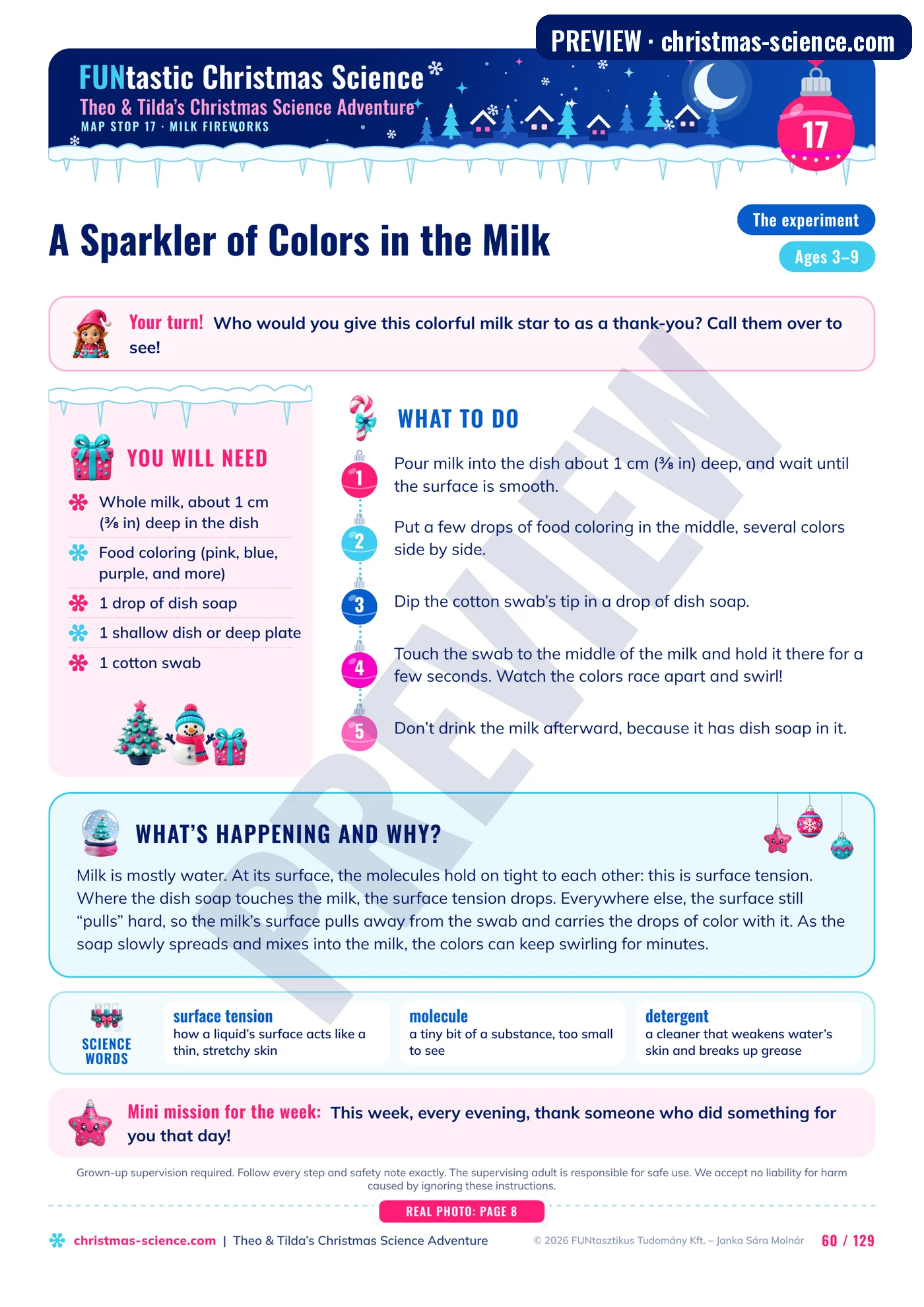
What you need

  • Whole milk, about 1 cm (⅜ in) deep in the dish
  • Food coloring (pink, blue, purple, and more)
  • 1 drop of dish soap
  • 1 shallow dish or deep plate
  • 1 cotton swab

Stay close the whole time. In the book, every step that only a grown-up may do is clearly marked.

  1. 1

    Pour milk into the dish about 1 cm (⅜ in) deep, and wait until the surface is smooth.

  2. 2

    Put a few drops of food coloring in the middle, several colors side by side.

  3. 3

    Dip the cotton swab’s tip in a drop of dish soap.

  4. 4

    Touch the swab to the middle of the milk and hold it there for a few seconds. Watch the colors race apart and swirl!

  5. 5

    Don’t drink the milk afterward, because it has dish soap in it.

What’s happening?

Why does it work?

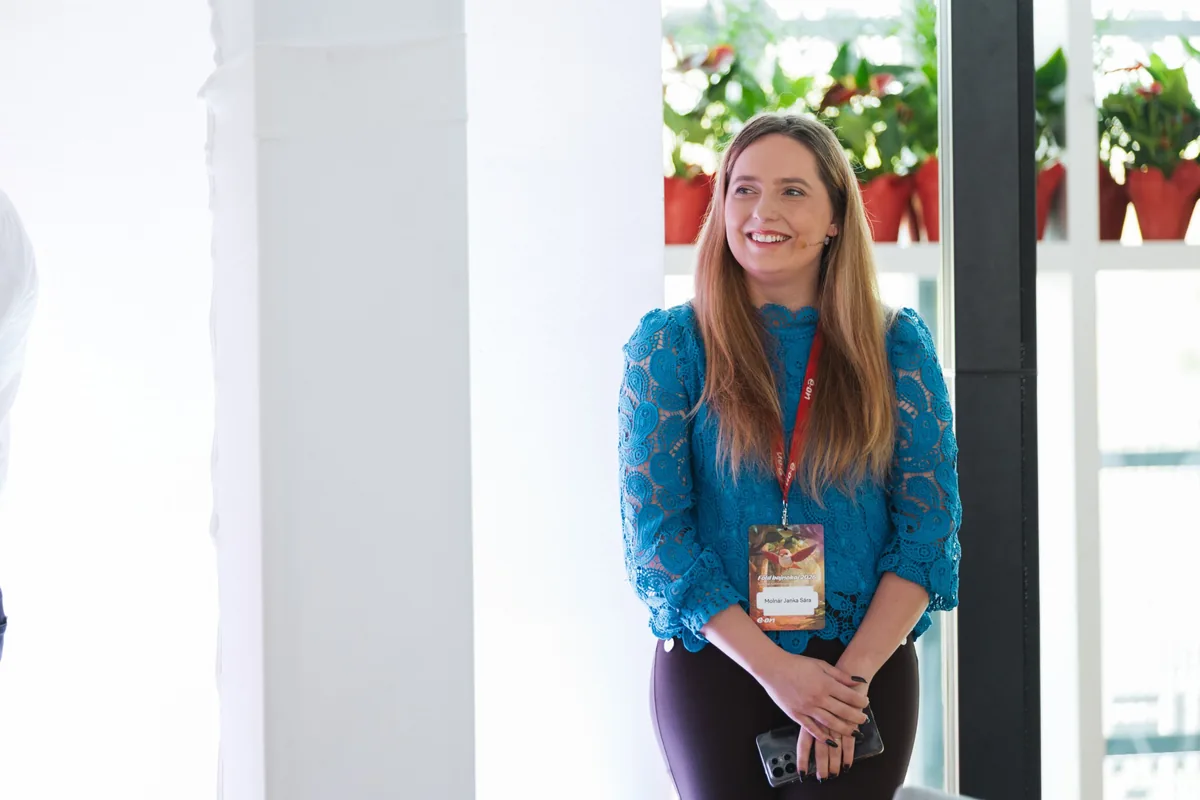
Janka Sára Molnár, physicist

Janka explainsThe same words you’ll find in the book, ready to read aloud.

Milk is mostly water. At its surface, the molecules hold on tight to each other: this is surface tension. Where the dish soap touches the milk, the surface tension drops. Everywhere else, the surface still “pulls” hard, so the milk’s surface pulls away from the swab and carries the drops of color with it. As the soap slowly spreads and mixes into the milk, the colors can keep swirling for minutes.

Science words for little scientists

  • surface tensionhow a liquid’s surface acts like a thin, stretchy skin
  • moleculea tiny bit of a substance, too small to see
  • detergenta cleaner that weakens water’s skin and breaks up grease
The Milk Fireworks experiment in Janka’s lab
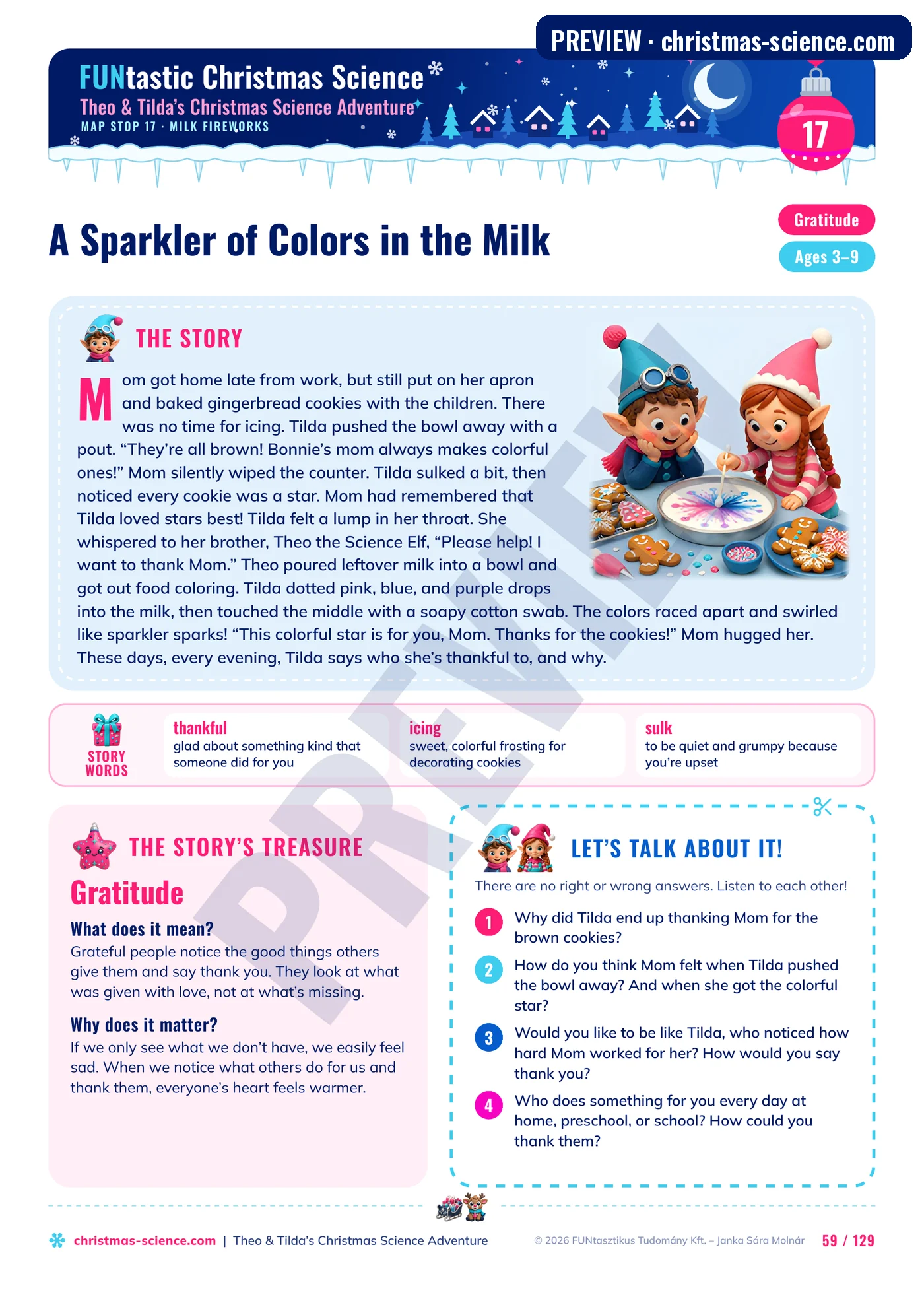
Theo and Tilda in the story “A Sparkler of Colors in the Milk”
The story for December 1

A Sparkler of Colors in the Milk

Mom got home late from work, but still put on her apron and baked gingerbread cookies with the children. There was no time for icing. Tilda pushed the bowl away with a pout. “They’re all brown! Bonnie’s mom always makes colorful ones!” Mom silently wiped the counter. Tilda sulked a bit, then noticed every cookie was a star. Mom had remembered that Tilda loved stars best! Tilda felt a lump in her throat. She whispered to her brother, Theo the Science Elf, “Please help!

How does it end? The whole story, the activity page and four more days are in the free sampler.

Read the whole story free
The value of the dayGratitude

What does it mean?

Grateful people notice the good things others give them and say thank you. They look at what was given with love, not at what’s missing.

Why is it important?

If we only see what we don’t have, we easily feel sad. When we notice what others do for us and thank them, everyone’s heart feels warmer.

Mini mission for the week

This week, every evening, thank someone who did something for you that day!
After the experiment

Let’s talk about it

Ready-made questions link the story’s value to your child’s own life. There are no wrong answers, only curious ones.

  • Why did Tilda end up thanking Mom for the brown cookies?

  • How do you think Mom felt when Tilda pushed the bowl away? And when she got the colorful star?

  • Would you like to be like Tilda, who noticed how hard Mom worked for her? How would you say thank you?

  • Who does something for you every day at home, preschool, or school? How could you thank them?

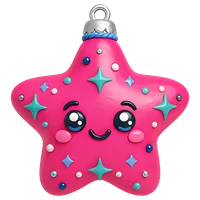
Tilda’s tip: Who would you give this colorful milk star to as a thank-you? Call them over to see!

Look inside

This is how Day 1 looks in the book

Real pages from the free sampler. Tap a page to see it big, then read it on a tablet or print it at home.

The story page for December 1: A Sparkler of Colors in the Milk
Story page
The experiment page for December 1: Milk Fireworks
Experiment page
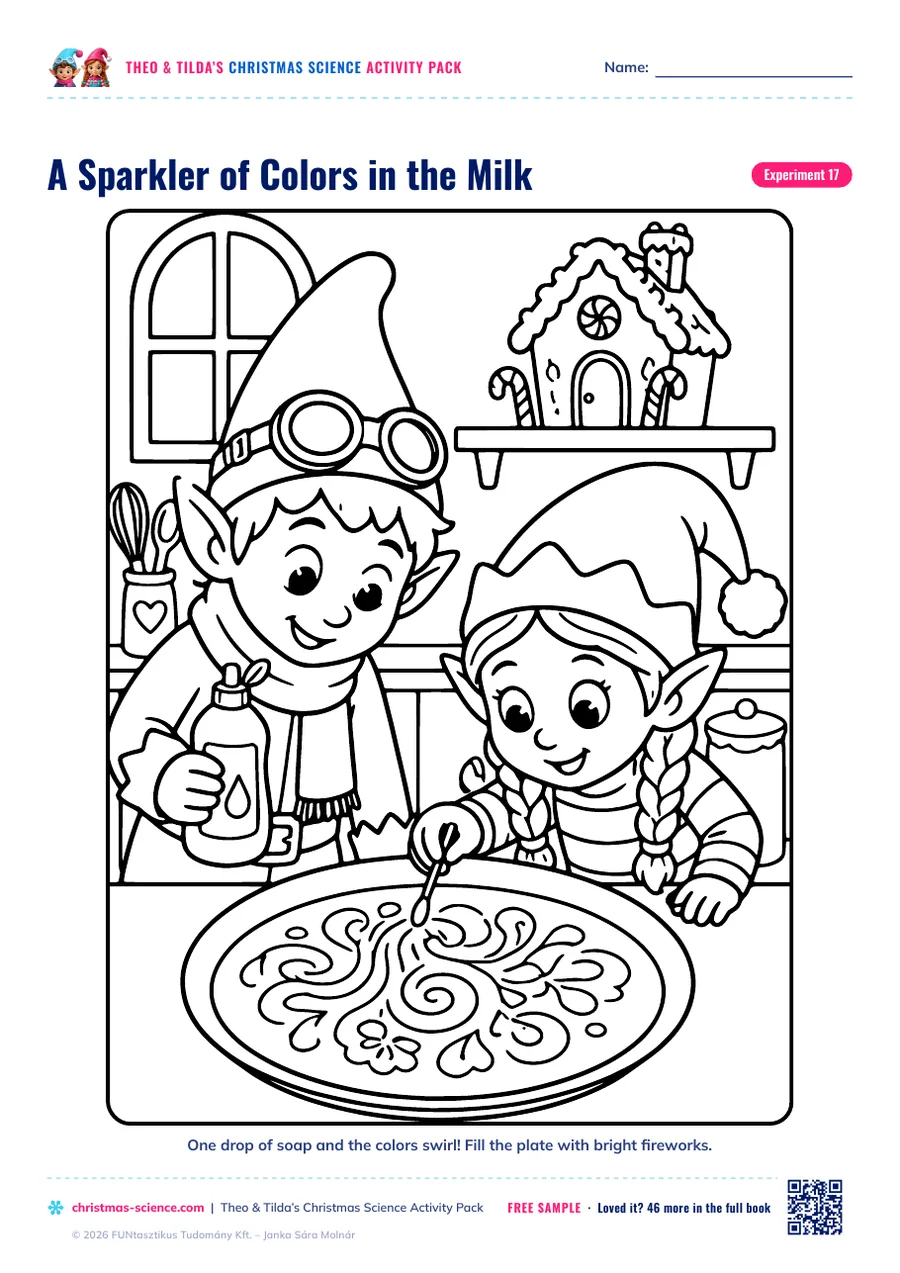
The coloring page for December 1 from the free sampler
Coloring page

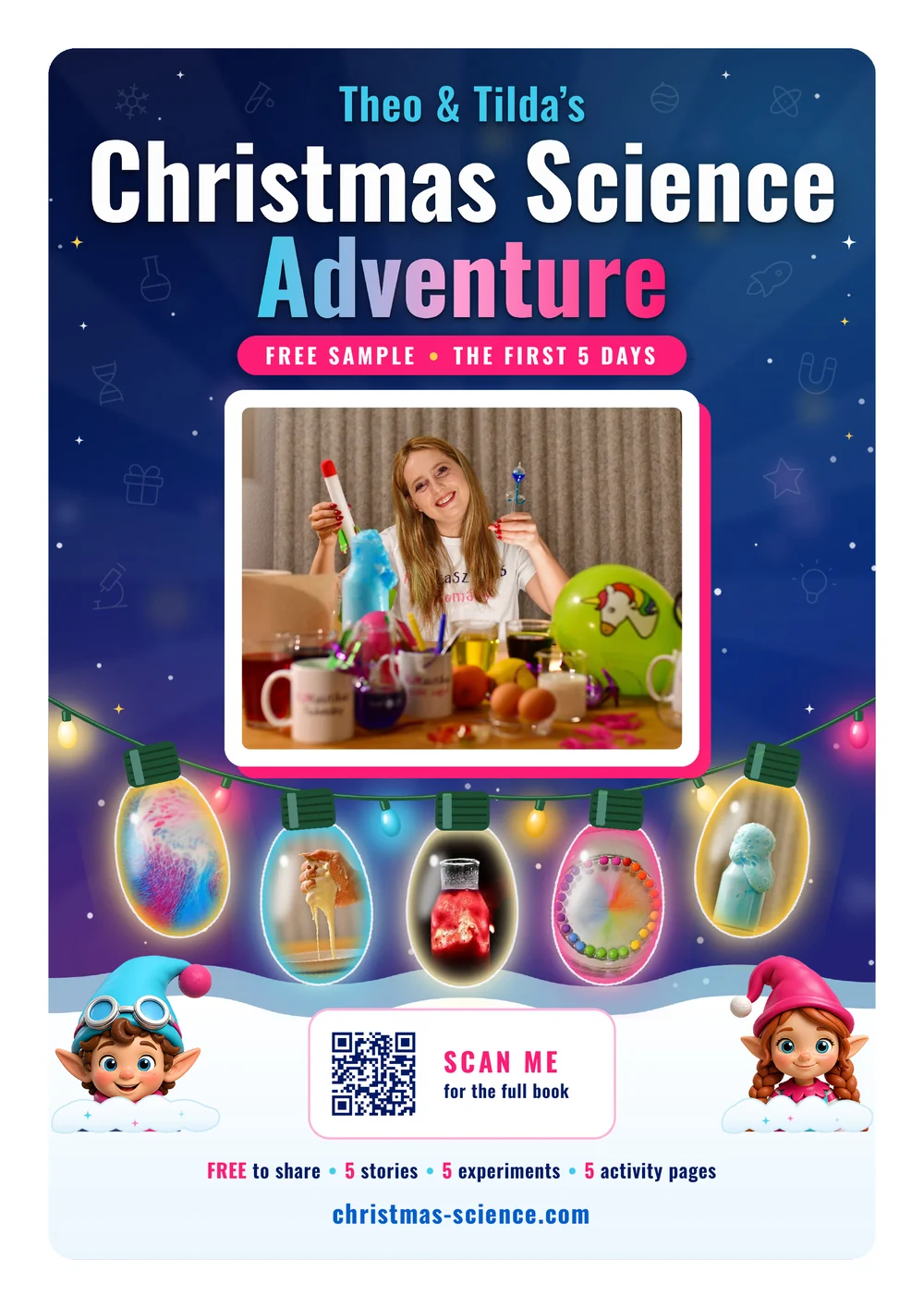
Day 1 is one of 5 free days. The full book has 51.

✦✦✦
Free sampler

Can we try it first?

Of course! The first 5 days of the December plan are yours for free. Try them at home or with your group, and see if your little scientist asks for Day 6.

  • 5 cozy stories
  • 5 kitchen experiments
  • 5 activity pages
  • A note from Janka
  • A cover with your name and the 5 experiments

No printer needed. Open it on a tablet or phone and start today.

Launch prices

How much does it cost? Less than a hot cocoa.

Launch prices until December 24. Your files are ready the moment you check out.

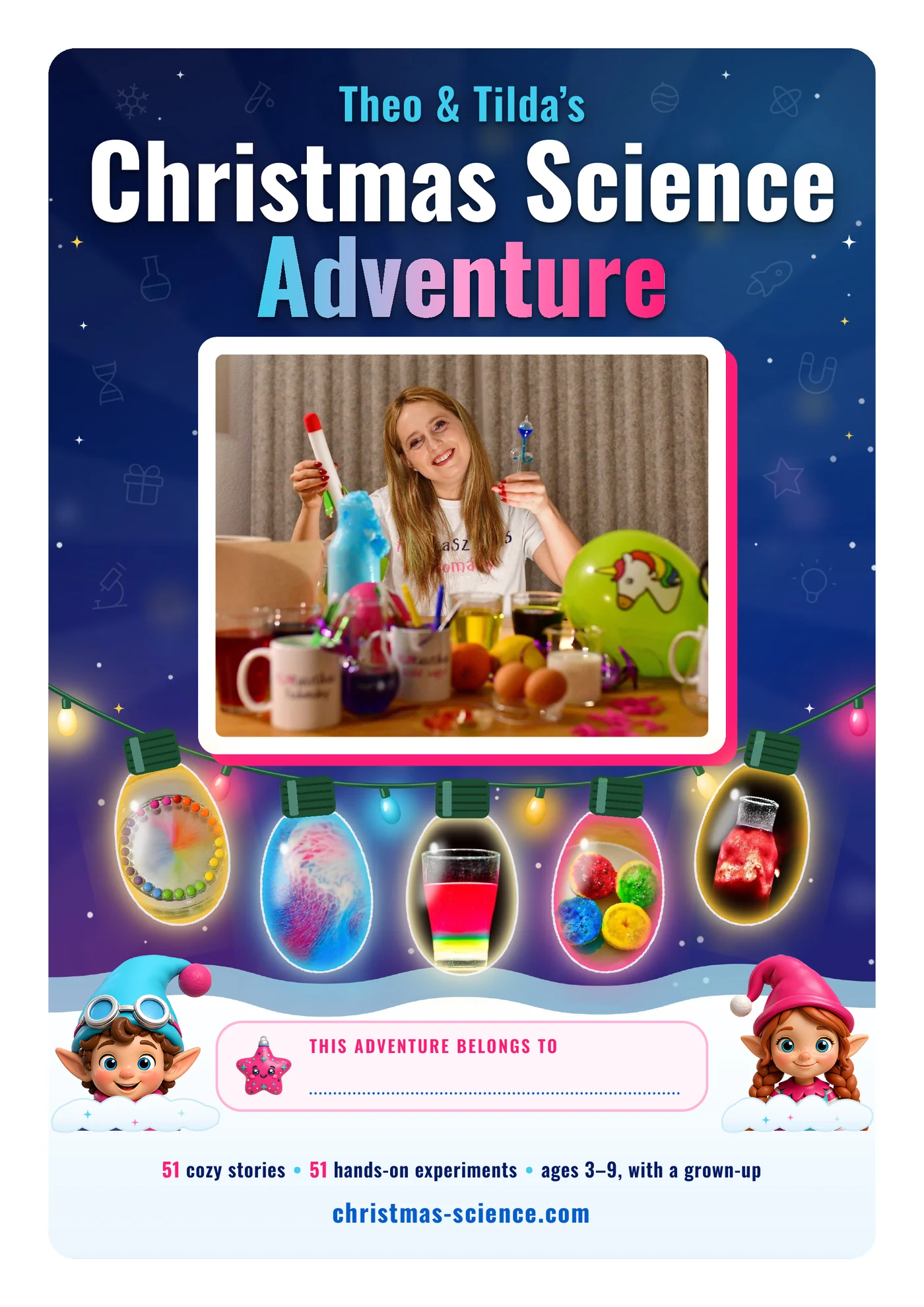
The cover of Theo and Tilda’s Christmas Science Adventure

The Book

129 printable pages

$11.99Regular price $14.99

less than 50¢ a day in December

Get the book
  • 51 stories and 51 experiments
  • 24-day December plan
  • Story words and science words
  • Stampable two-page adventure map
  • Contents, learning index, and certificate
Best value
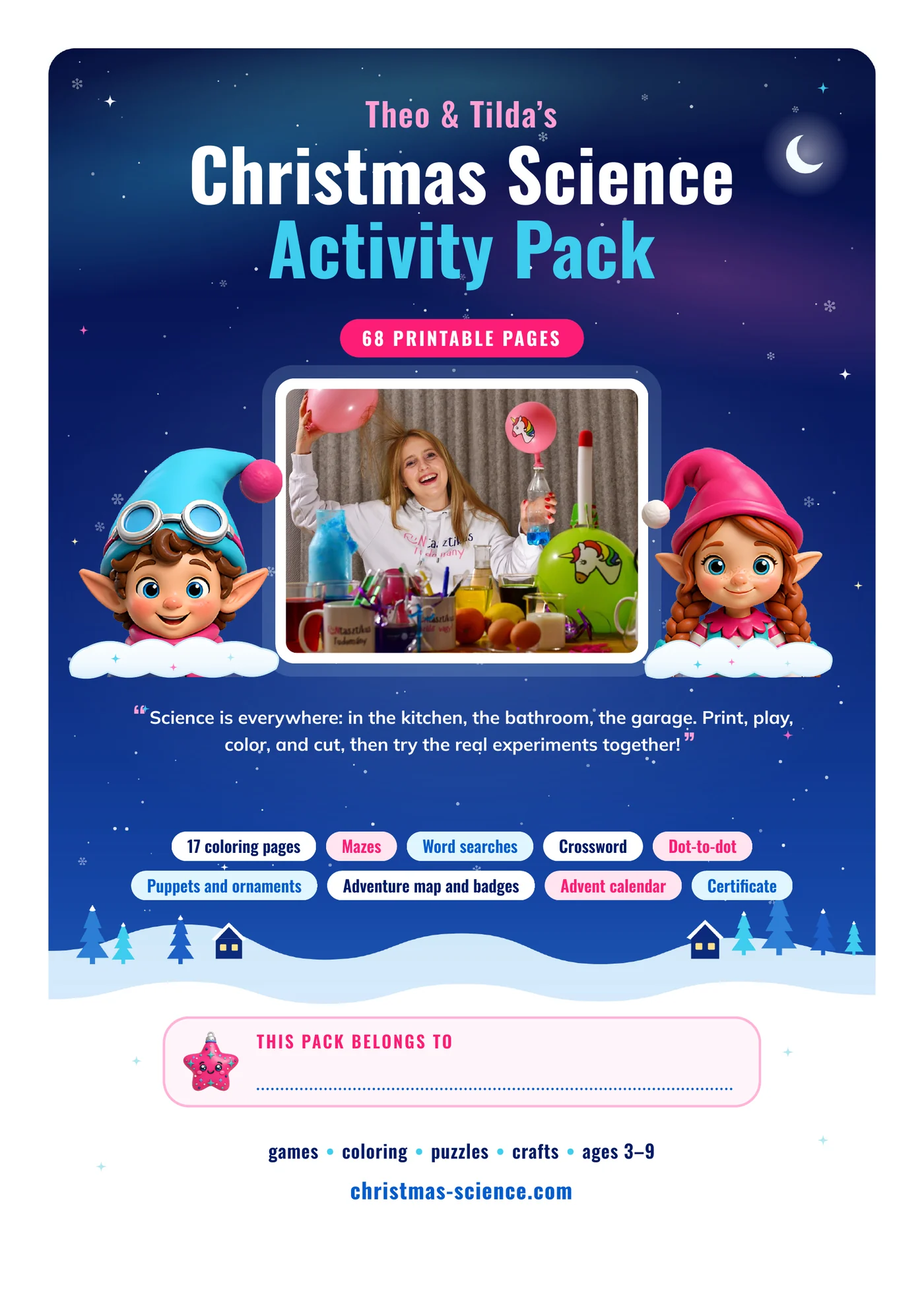
The cover of the Theo and Tilda Christmas Activity Pack

Book + Activity Pack

Everything in the book, plus 60+ pages of FUN

$13.99Regular price $17.99

less than 60¢ a day in December

Get the bundle
  • The complete book
  • Coloring pages, mazes, and word games
  • Puppets, ornaments, and bookmarks
  • Kindness advent calendar
  • Word cards and value talk cards

No printer? No problem. Read it on any tablet, phone or computer, and print only the pages you love.

One price for everyone. A parent can print it for Advent at home, and a preschool teacher can bring it to her group. One purchase covers one family, or one teacher with their own group or class.

Prices in US dollars. Any sales tax or VAT is calculated at checkout.

Questions and answers

Milk Fireworks: what parents ask

Short answers from Janka, the physicist who tested the experiment in her own lab.

Still wondering?

Write to Janka. She reads every email herself.

molnar.janka.sara@funtasztikus-tudomany.hu
Why does the soap make the colors move?

Milk is mostly water, and its surface acts like a thin, stretchy skin. That’s surface tension. Where the soap touches, the skin gets weaker, so the rest of the surface pulls away and carries the drops of color with it.

What kind of milk works best?

Whole milk, which is what the book uses. The swirling usually lasts longer in whole milk than in skim milk, so the show is bigger.

Why do the colors stop after a while?

The soap slowly spreads through all of the milk. Once it’s everywhere, there is nothing left to pull the colors. Touch a new spot with a fresh drop of soap, or pour fresh milk for the full show again.

Is it safe for a 3-year-old?

Yes, with a grown-up at the table. Everything comes from the kitchen and there is no heat or flame. Just don’t drink the milk afterward, because it has dish soap in it.

Which story goes with Milk Fireworks?

“A Sparkler of Colors in the Milk”, the story for December 1. Its value is gratitude: Tilda turns the swirling milk into a colorful thank-you star for Mom.