Winter Solstice for Kids: 5 True Sky Stories to Tell Your Kids Tonight
The winter solstice is the day with the fewest hours of daylight. In the northern half of Earth, it comes on December 21 in 2026. Winter days are short because Earth is tilted, not because we are far from the Sun. In fact, Earth is closest to the Sun in early January. Here is the winter solstice for kids, explained in five true sky stories from my Space Advent Calendar, each short enough to read aloud before bed.
- 5 true stories
- Ages 4–9
- About a minute each
- No telescope needed
Save this for a dark December evening with your little stargazer, or send it to a friend whose kids keep asking why it gets dark so early.
The Room Only the Winter Sun Can Reach
More than 5,000 years ago, before the pyramids in Egypt were built, people in Ireland built a big stone mound. Today it is called Newgrange.
A long, narrow passage leads from the outside to a room deep inside the mound.
Around the winter solstice, and only then, something special happens at sunrise. The rising Sun shines through a small opening above the entrance, down the long passage, all the way into the room.
The people who built it had no clocks and no printed calendars. They watched the Sun, day after day, year after year.
Stop here and ask your child: Why would people build a room that only the winter Sun can reach? The end of the story is at the bottom of this page.
Know a little one who asks, “Why is it dark already?” every evening? Send this to their grown-up so they have a true answer ready tonight. Share it
Why are days shorter in winter?
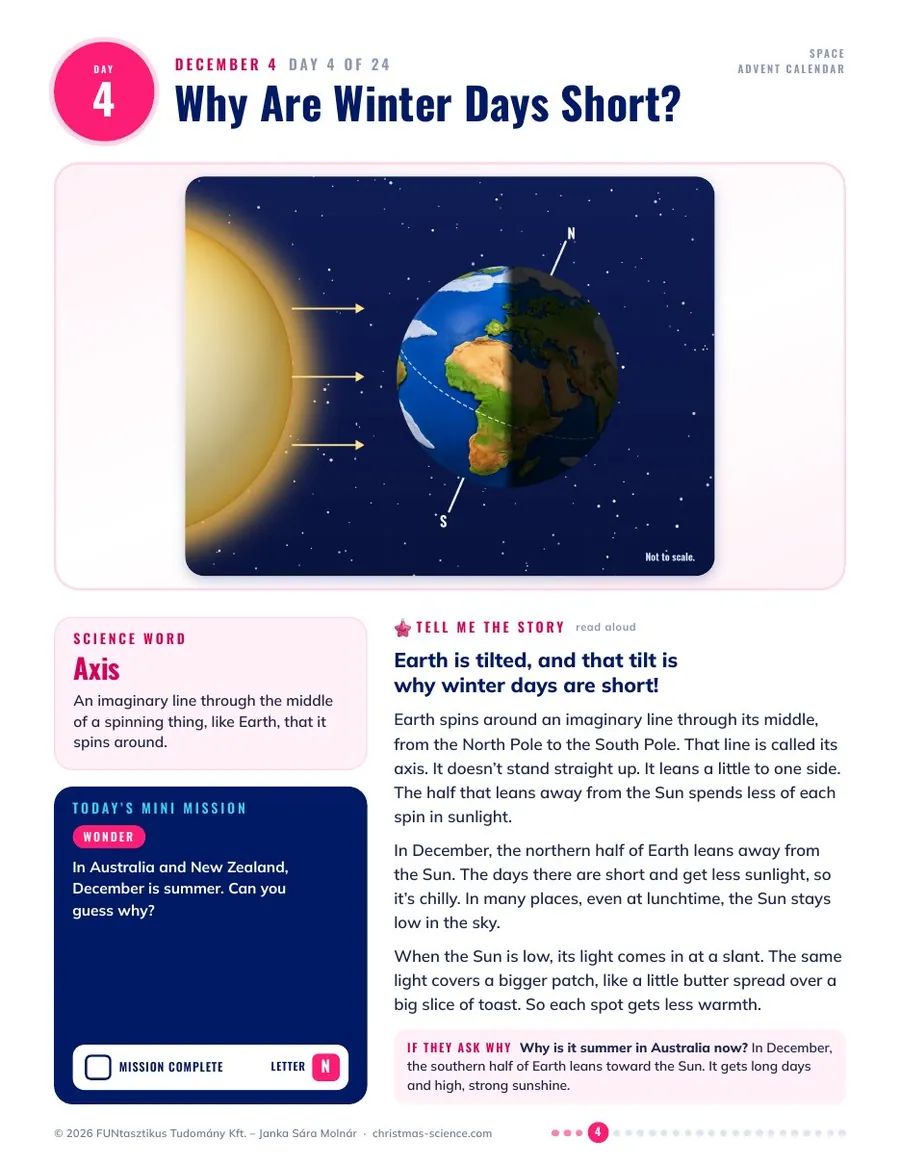
Winter days are short because Earth is tilted. In December, the northern half of Earth leans away from the Sun, so it spends less of each day in sunlight, and the Sun stays low in the sky.
Earth spins around an imaginary line through its middle, from the North Pole to the South Pole. That line is called its axis, and it doesn’t stand straight up. It leans to one side, about 23.4 degrees.
Here is the physics, for the grown-up. When the Sun is low, its light comes in at a slant. The same light covers a bigger patch of ground, like a little butter spread over a big slice of toast. So each spot gets less warmth. Short days and slanted light: that is winter.
TODAY’S MINI MISSION · A QUESTION TO WONDER ABOUT
In Australia and New Zealand, December is summer. Can you guess why?
IF THEY ASK WHY
Why is it summer in Australia now? In December, the southern half of Earth leans toward the Sun. It gets long days and high, strong sunshine.
Is Earth closer to the Sun in winter?
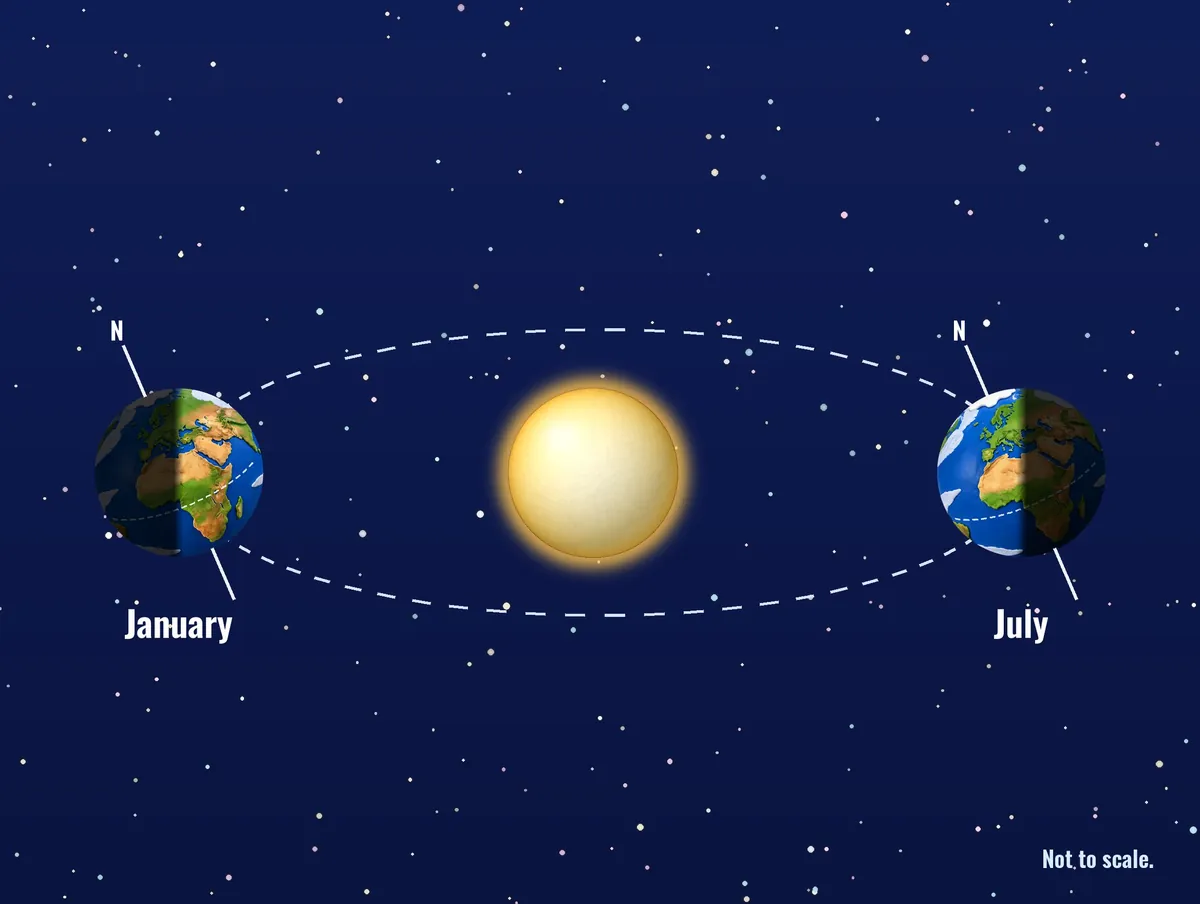
Yes, if you live in the northern half of Earth. Earth is closest to the Sun in early January, during northern winter. This winter, Earth will be closest to the Sun on January 2, 2027, in North America, and on January 3 in Europe, Australia, and New Zealand.
This one surprises most grown-ups, so it is a FUN one to tell. Earth’s orbit, its path around the Sun, is not a perfect circle. It is very slightly stretched. The closest point is called perihelion (say pair-ih-HEE-lee-un).
The difference is small, about 3 million miles (5 million kilometers). That’s like moving one step closer to a heater when you’re 30 steps away. What matters much more is how long the days are and how high the Sun climbs. So winter comes from Earth’s tilt, not from its distance.
TODAY’S MINI MISSION · QUIZ
Look back at the story about Earth’s tilt. In January, which half of Earth leans toward the Sun? A) The northern half B) The southern half
Answer: B. The southern half. That’s why January is summer in Australia.
IF THEY ASK WHY
Then why isn’t it warmer up north in January? Being a little closer adds only a little warmth. Short days and a low Sun take away much more.
Know someone who thinks winter comes because Earth is far from the Sun? Most grown-ups learned it that way. Send them this one. Share it
What is the winter solstice?
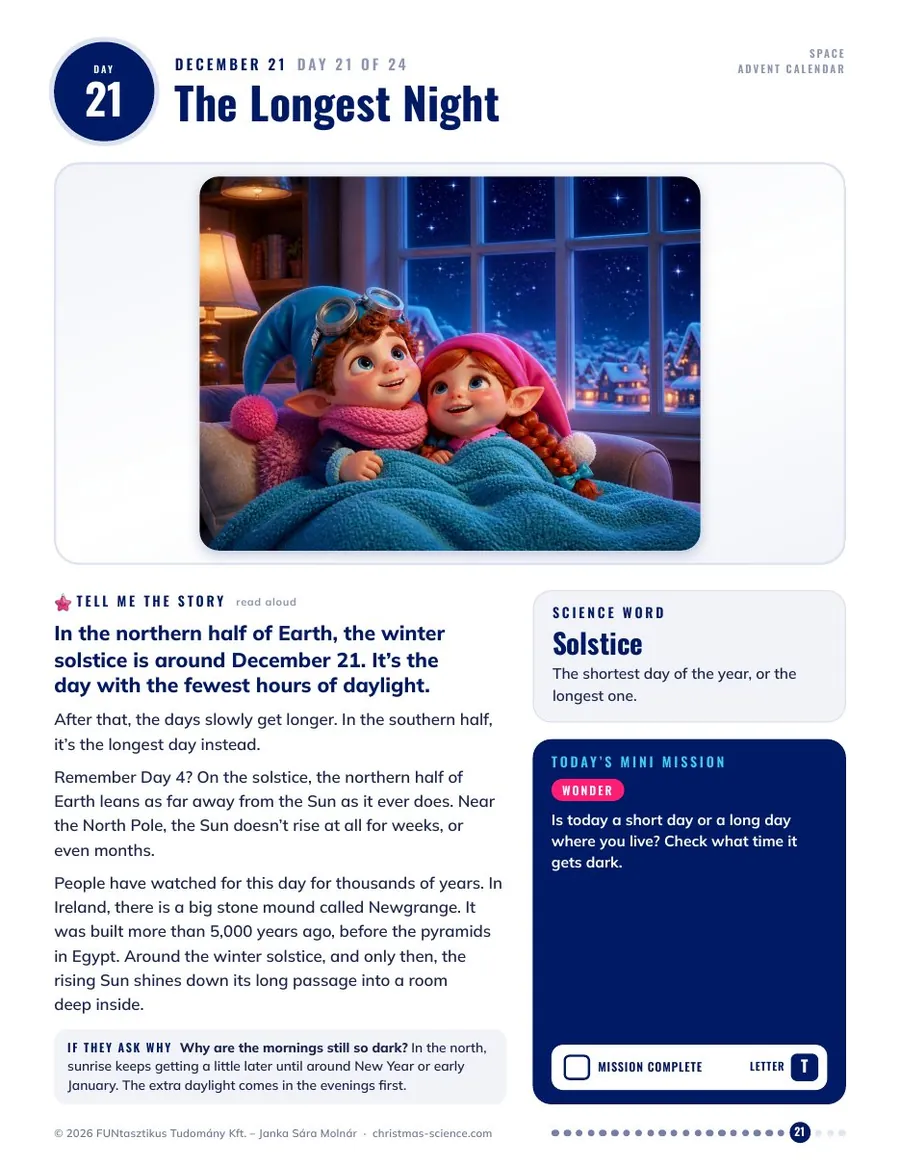
The winter solstice is the day with the fewest hours of daylight. In the northern half of Earth, it comes around December 21. In 2026, the exact moment is December 21 at 3:50 p.m. Eastern Time (20:50 UTC). After that, the days slowly get longer.
In the southern half of Earth, the same moment is the summer solstice, the longest day of the year. In Australia and New Zealand, the clocks already say December 22 when it happens.
The word solstice comes from two Latin words: sol, the Sun, and sistere, to stand still. Around the solstice, the Sun’s path across the sky stops getting lower, seems to stand still for a few days, and then starts to climb again.
Near the North Pole, the Sun doesn’t rise at all for weeks, or even months. In Ireland, Newgrange still lets the rising Sun into its stone room around the winter solstice, more than 5,000 years after it was built.
TODAY’S MINI MISSION · A QUESTION TO WONDER ABOUT
Is today a short day or a long day where you live? Check what time it gets dark.
IF THEY ASK WHY
Why are the mornings still so dark after the solstice? In the north, sunrise keeps getting a little later until early January. The extra daylight comes in the evenings first.
What can kids see in the December night sky?
Two easy December treats: the Geminid meteor shower in the middle of the month and Orion the Hunter rising in the east in the evening. You don’t need a telescope for either one.
When is the Geminid meteor shower in 2026?
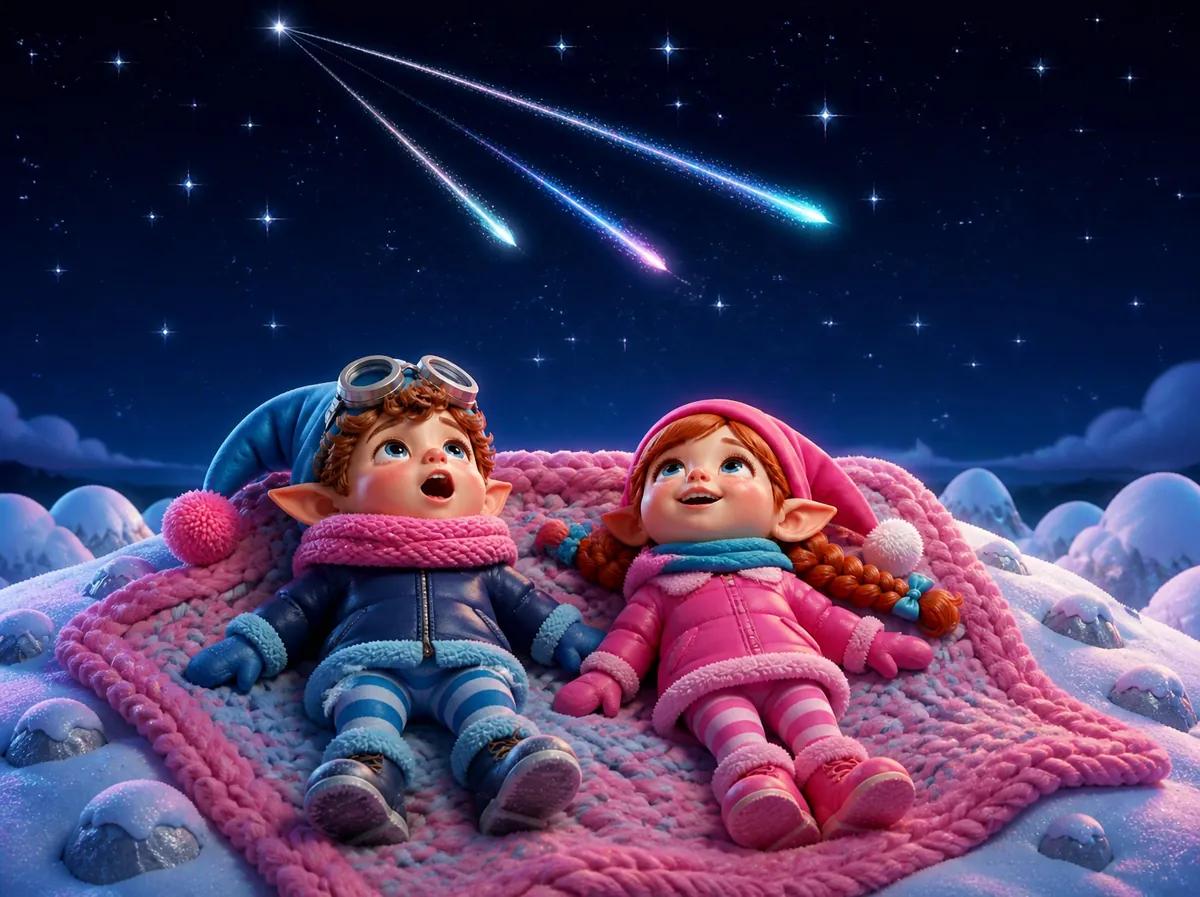
Shooting stars aren’t stars at all. They are tiny bits of space rock and dust, most no bigger than a pea. They rush into our air so fast that they heat up, and the air around them glows. Every December, Earth passes through a trail of dusty crumbs left by a rocky object called Phaethon (say FAY-uh-thon). That is the Geminid meteor shower.
2026 is a good year for it. The best night is December 13, from evening into the early hours of December 14. The Moon was new just a few days earlier, so on the best night only a thin crescent Moon is up, and it sets in the evening. Far from city lights, you could count dozens of shooting stars in an hour. In the southern half of Earth, there are fewer, and they come later at night.
TODAY’S MINI MISSION · COUNT IT
Bundle up and find a safe, dark spot with a grown-up. Give your eyes a few minutes in the dark. How many shooting stars can you count?
How do you find Orion’s Belt?
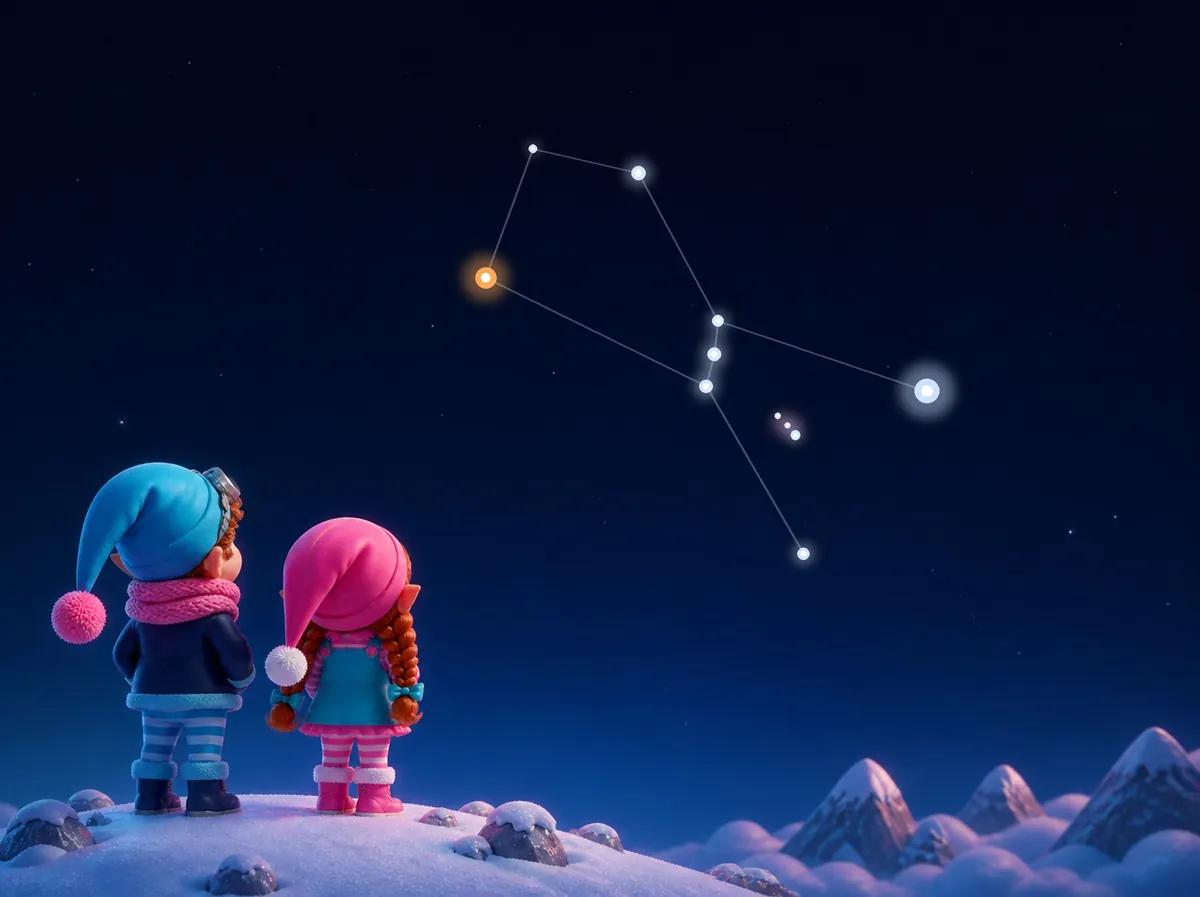
Every star you see belongs to a constellation, a picture people imagined in the stars long ago. One of the easiest to find in December is Orion the Hunter. At his shoulder shines Betelgeuse (say BEET-el-jooz), a reddish-orange star. At his foot shines Rigel (say RYE-jel), a blue-white star.
TODAY’S MINI MISSION · FIND IT
On a clear December evening, after about 8 p.m., go out with a grown-up and look east. Can you find three bright stars in a row? That’s the belt of Orion the Hunter!
IF THEY ASK WHY
Why are the stars different colors? A star’s color shows how hot it is. Blue-white stars like Rigel are much hotter than reddish stars like Betelgeuse.
STARGAZING SAFETY
- Always look at the night sky with a grown-up.
- Dress warmly and choose a safe spot, away from roads.
- Never look straight at the Sun, not even with sunglasses. Never point binoculars or a telescope at the Sun.
Is there a printable space advent calendar with true stories?
Yes. The five stories above come from Theo & Tilda’s Space Advent Calendar, a printable advent calendar with 24 true space stories for kids ages 4 to 9, one for each day from December 1 to 24.
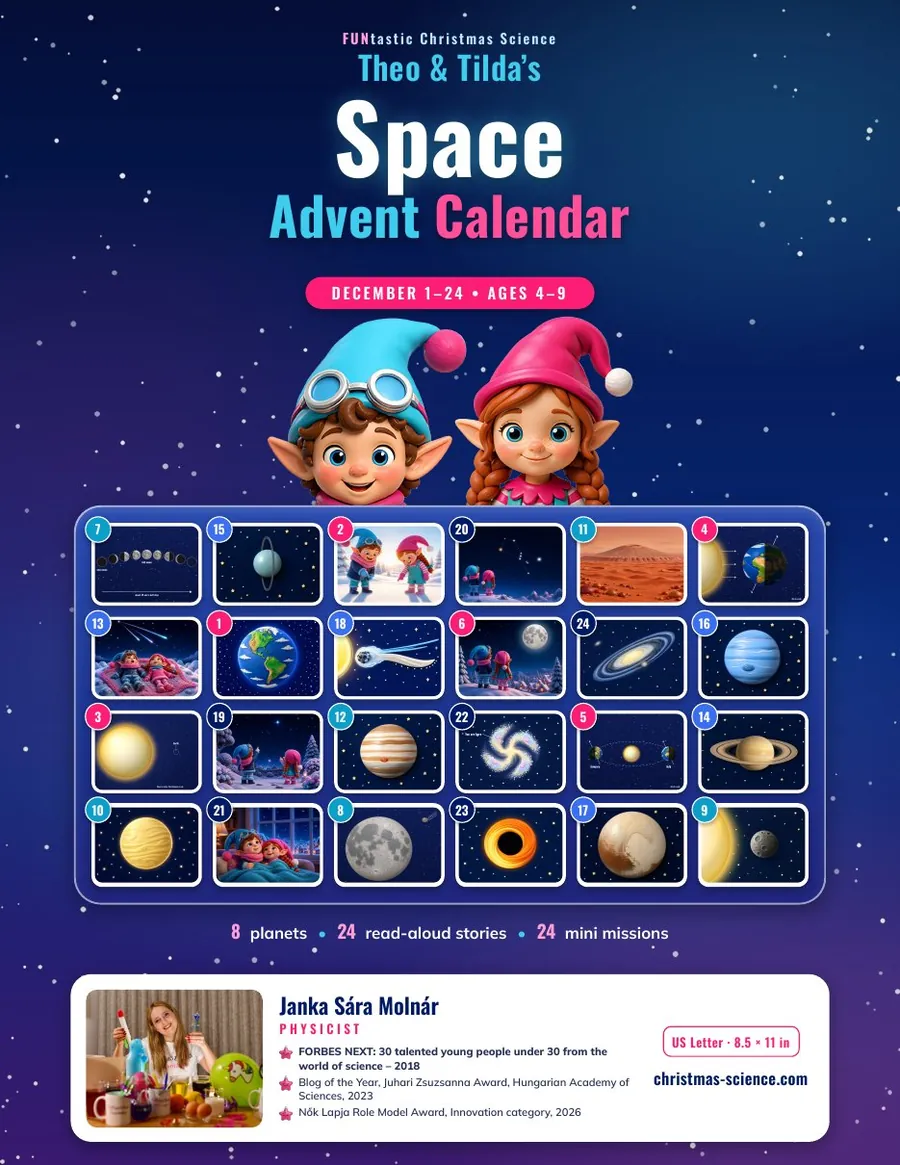
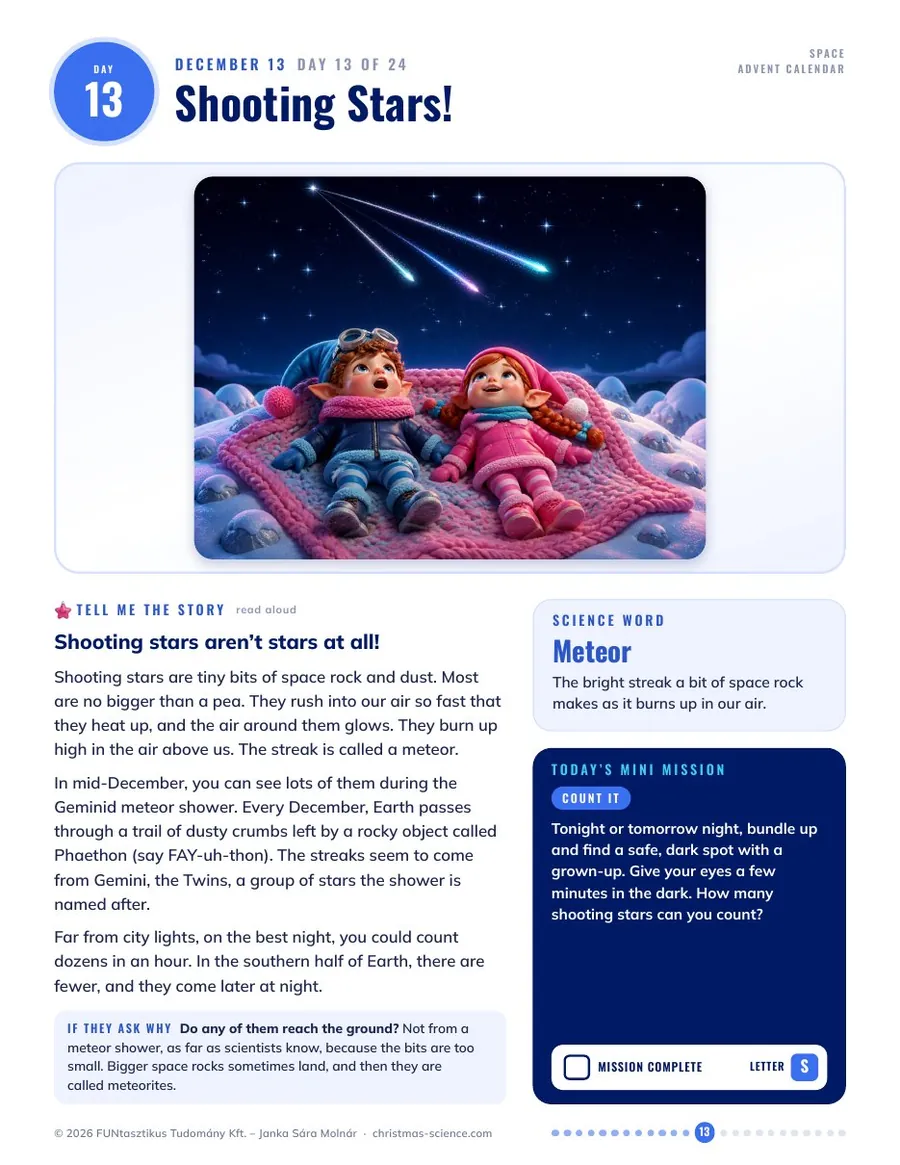
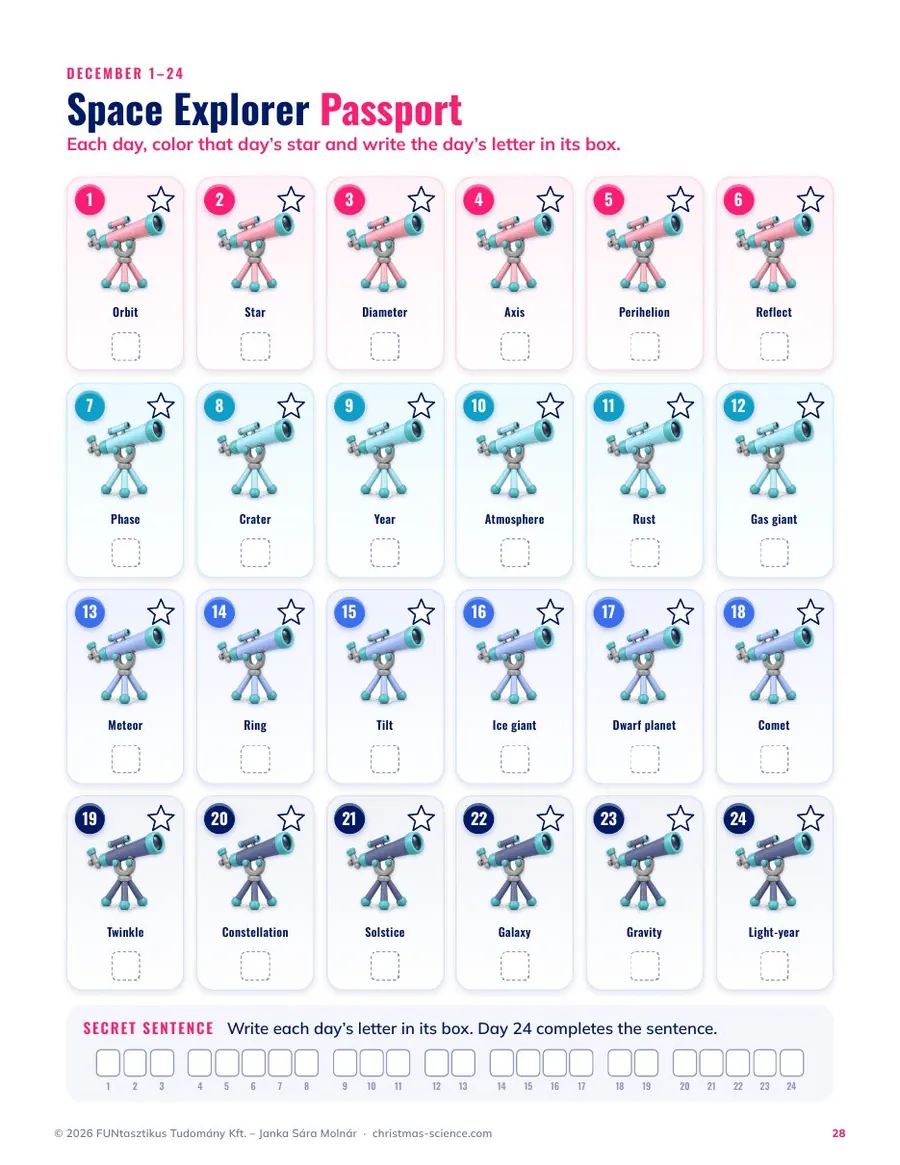
- 24 day pages, each with its own illustration, a one-minute story, a Science word, a mini mission (a quiz, a movement game, a drawing, something to find in the sky, or a question for dinner), and an “If they ask why” helper for the grown-up
- The Sun and the Moon, all eight planets, Pluto, comets, shooting stars, constellations, the Milky Way, black holes, and faraway galaxies
- Pages that match the December sky: the Geminid meteor shower and the winter solstice
- A Space Explorer Passport with all 24 Science words and a secret sentence, and a Junior Astronomer certificate for Christmas Eve
- No telescope needed. No printer? Read it on a tablet, a laptop, or a phone.
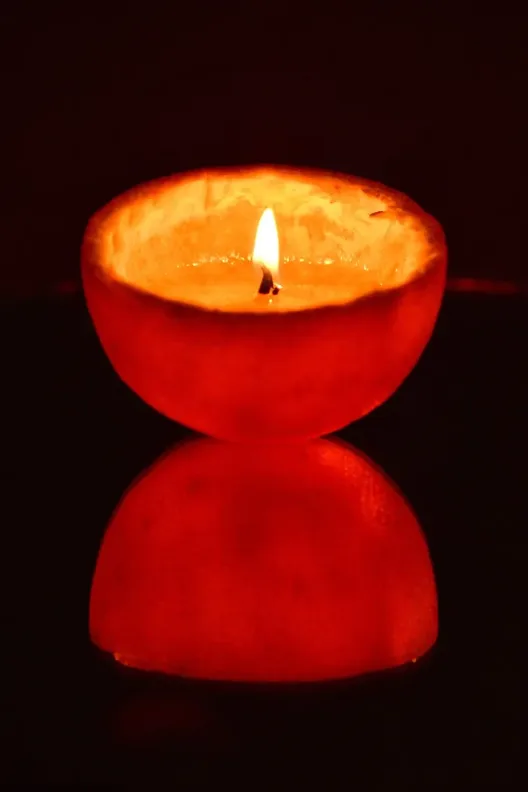
One real experiment for the longest night: the Orange Lamp, an orange peel oil lamp
On the longest night of the year, make a little light together. This is the Orange Lamp, Experiment 32 in Theo and Tilda’s Christmas Science Adventure. You need half an orange and 2 to 3 tablespoons of cooking oil. The white strand in the middle of the orange becomes the wick.
The white pith is spongy and full of tiny channels, so it soaks up the oil. The flame’s heat turns the oil at the tip into vapor, and it is really this vapor that burns.
GROWN-UPS ONLY: HOW TO DO IT SAFELY
- A grown-up cuts the orange and lights the wick. Use a fireproof plate on a steady table, away from the edge, and keep a metal lid within reach before lighting.
- Everyone wears safety goggles. Tie back long hair, and keep paper, curtains, the Christmas tree, and decorations away.
- Children watch from about 6 feet (2 meters) away.
- Never leave the flame alone, and don’t move the lamp while it burns or until the oil has cooled. To put it out, a grown-up covers it with the metal lid. Never pour water on burning oil.

Sky questions are wonderful science questions. When a child asks, “Why is it dark already?” they are already noticing the sky, just like the people who built Newgrange. For this calendar, I checked every fact against NASA and other trusted science sources, so when your child asks, “Is that really true?” you can say yes.
One page a day, five minutes at a window or outside in a warm coat, and one slower moment in the shopping-baking-visiting rush of December.
Looking for a different theme? Here are all my printable advent calendars for kids, from true dinosaur stories to animal superpowers. And if your child loves the planets, read eight true planet stories next.
Why build a room for the winter Sun?
Nobody knows everything about why Newgrange was built. But we know one thing for sure. Its builders watched the Sun so carefully that they could make its light reach the room only around the winter solstice.
And the winter solstice is the day the light starts to come back. After it, the days in the northern half of Earth get a little longer, bit by bit, all the way to summer.
You are part of this story too. You live on a spinning planet that travels around the Sun once a year, and every birthday, you finish one more trip.
Ask at dinner tonight: If you could build a window that only one special sunrise shines through, which day would you choose?
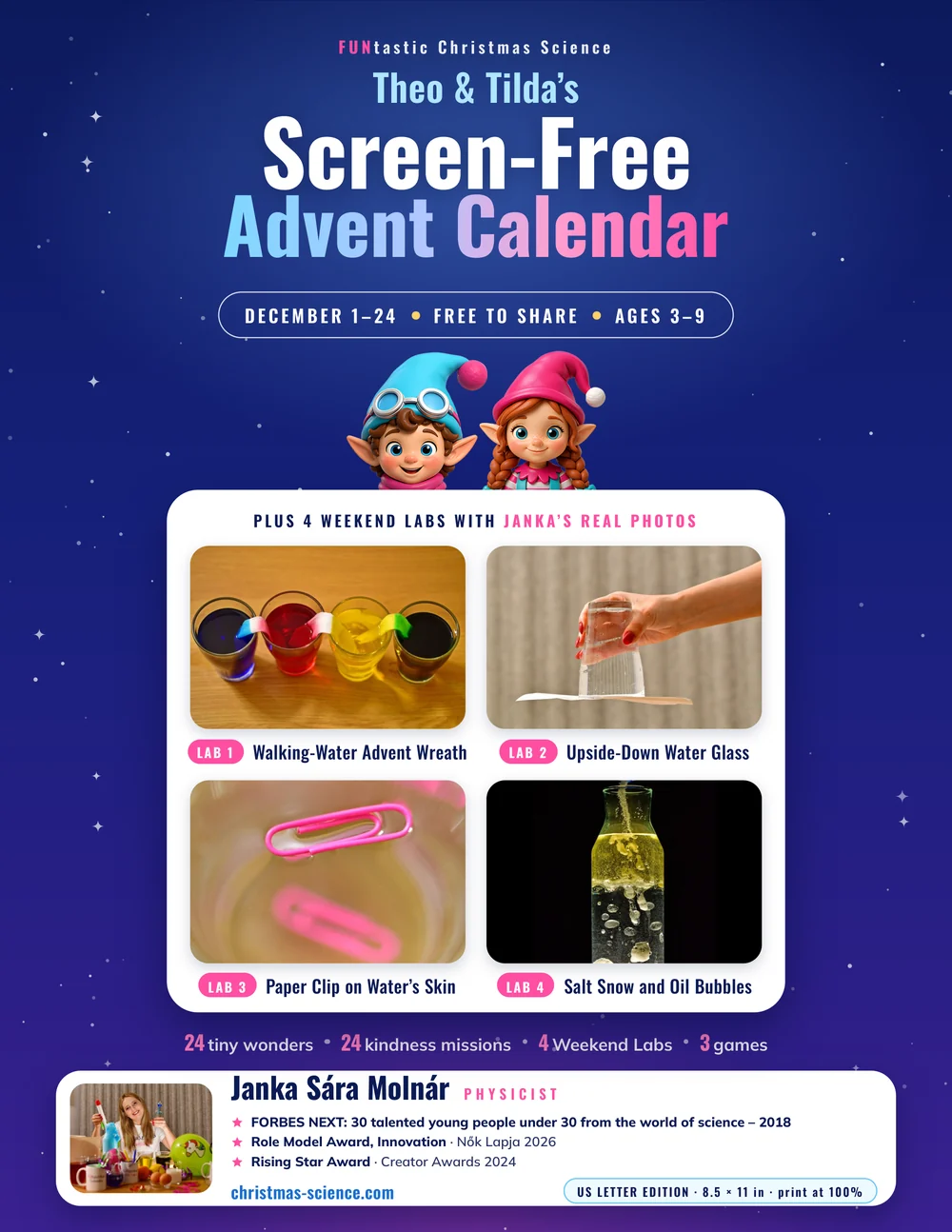
Theo & Tilda’s Screen-Free Advent Calendar
24 tiny wonders and 24 kindness missions, one for every day from December 1 to 24, plus 4 Weekend Labs with my real photos and 3 games. Most tiny wonders take about 10 minutes and use things you probably already have. 22 pages, for ages 3–9.
This calendar is free to share. Print it as often as you like for your family or class, and pass it on to friends, families, and teachers. Please don’t sell it or change it.

Know a family with a little stargazer?
Send them tonight’s story. The five true sky stories above are free to read aloud, and each one takes about a minute.
COPY THIS MESSAGE
Paste it into a family group chat, or send it to a friend.
I found five true sky stories to read to the kids before the winter solstice: why winter days are short, why Earth is closest to the Sun in January, the Geminid shooting stars, and a 5,000-year-old room that only the winter Sun can reach. A physicist checked every fact. www.christmas-science.com/blog/winter-solstice-for-kids
Quick answers about the winter solstice
When is the winter solstice in 2026?
In the northern half of Earth, on Monday, December 21, 2026, at 3:50 p.m. Eastern Time (20:50 UTC). In Australia and New Zealand, the clocks already say December 22, and there it is the summer solstice, the longest day of the year.
Why are days shorter in winter?
Because Earth is tilted. In December, the northern half of Earth leans away from the Sun, so it spends less of each day in sunlight, and the Sun stays low in the sky.
Is Earth closer to the Sun in winter?
Yes, if you live in the northern half of Earth. Earth is closest to the Sun in early January, but the difference is small, about 3 million miles (5 million kilometers). Earth’s tilt matters much more than its distance.
Why is it summer in Australia at Christmas?
In December, the southern half of Earth leans toward the Sun, so it gets long days and high, strong sunshine.
What age is the Space Advent Calendar for?
Ages 4 to 9. Little ones can enjoy it with a grown-up reading aloud. Each of the 24 day pages has a one-minute true story, a Science word, and a mini mission, and the calendar comes as two PDF files, US Letter and A4. No printer? You can read it on a tablet, a laptop, or a phone.

About Janka
Janka Sára Molnár is a physicist and award-winning science communicator from Hungary, and the founder of FUNtastic Christmas Science. As a high school student, she built particle detectors and took them to CERN several times, where she presented them in its teacher program. She graduated from Eötvös Loránd University (ELTE) in Budapest, and for almost 15 years she has run several hundred science shows for children and families.
- FORBES NEXT: 30 talented young people under 30 from the world of science – 2018
- Rising Star Award, Creator Awards, 2024
- Role Model Award, Innovation, Nők Lapja, 2026
- Juhari Zsuzsanna Blog of the Year Award, Hungarian Academy of Sciences, 2023
The space illustrations and the pictures of Theo, Tilda, and their world were created with AI-assisted tools (Canva) and edited by our team. Physicist Janka Sára Molnár checked every fact in this post against NASA and other trusted science sources. The Orange Lamp photo is a real photo of her own experiment.
Keep reading
More Christmas science ideas from Theo, Tilda, and me.
 For parents · 13 min readFun Facts About the Planets for Kids (Physicist-Checked)Fun facts about the planets for kids: one true story for each of the 8 planets, plus Pluto’s heart and why stars twinkle. Checked by a physicist.Read the post →
 For parents · 10 min readDid Dinosaurs Live in the Snow? True Stories for KidsDid dinosaurs live in the snow? Yes. Baby dinosaurs hatched in snowy Arctic Alaska, and a crested dinosaur lived in forested Antarctica. Four true stories.Read the post →
 Preschool · 22 min readWinter Science Experiments for Preschoolers (No Snow Needed)10 easy winter science experiments for preschoolers, no snow needed: ice, salt, cornstarch, a floating egg, static snowflakes. No flames, no hot water.Read the post →
© 2026 FUNtasztikus Tudomány Kft. – Janka Sára Molnár