How Do Rockets Work? 8 True Rocket Stories to Tell Your Kids Tonight
A rocket works by pushing hot gas out of its tail, and the gas pushes the rocket the other way, up. That push is called thrust. A rocket doesn’t need air to push on, and it carries its own oxygen, so it works in space too. Here is how rockets work, explained for kids in eight true stories from my Rocket Advent Calendar, each short enough to read aloud before bed.
- 8 true stories
- Ages 4–9
- About a minute each
- No prep

Save this for a cozy evening with your little rocket fan, or send it to a friend whose child turns every cardboard tube into a rocket.
A Rocket in the Cabbage Patch
On March 16, 1926, a professor named Robert Goddard stood a brand-new kind of rocket in a tall metal frame on his Aunt Effie’s farm in Massachusetts. There was snow on the ground.
Until then, rockets had burned powder, the way fireworks do. Goddard’s rocket was different. It burned gasoline with liquid oxygen, oxygen made so cold that it turns into a liquid.
The rocket rose 41 feet (12.5 meters) into the air. Then it came down in the snowy cabbage patch. Two and a half seconds, and it was all over.
Stop here and ask your child: The rocket flew for only two and a half seconds. Was it a success? The end of the story is at the bottom of this page.
Know a little one who loves rockets? Send this to their grown-up, so they have a true rocket story ready for tonight. Share it
How do rockets work?
A rocket engine burns fuel and shoots very hot gas out of its tail, as hard and as fast as it can. The gas pushes back on the rocket and sends it up. That push is called thrust.
Thrust is the topic of Day 1 in my Rocket Advent Calendar, and it is the whole secret. A rocket doesn’t climb by pushing on the ground. It pushes on its own hot gas. Every push gets a push back. The gas rushes down, so the rocket goes up.
Here is the physics, for the grown-up. Scientists call this Newton’s third law of motion: when one thing pushes on another, the second thing pushes back just as hard, in the opposite direction. Your child already knows it from jumping. Feet push down on the floor, and the floor pushes them up.
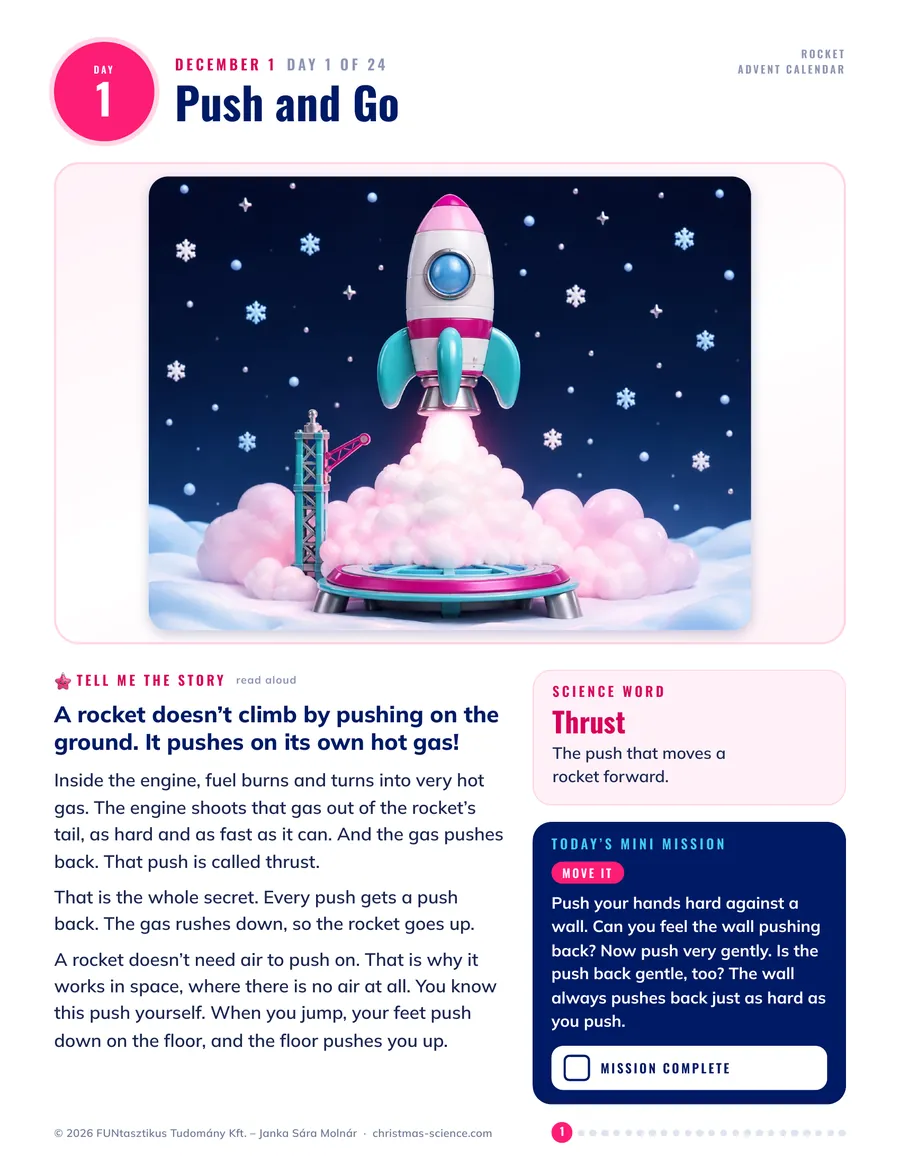
TODAY’S MINI MISSION · MOVE IT
Push your hands hard against a wall. Can you feel the wall pushing back? Now push very gently. Is the push back gentle, too? The wall always pushes back just as hard as you push.
IF THEY ASK WHY
Why does a rocket go up at liftoff? Its engines point down, so the hot gas shoots down. The push back always goes the opposite way: up. A few seconds later, the rocket starts to lean over and steer, because to stay up in space it has to race sideways very fast.
How do rockets fly in space without air?
A rocket doesn’t need air to push on, because it pushes on its own hot gas. It doesn’t need air to burn its fuel either. It carries its own oxygen, so its engines keep working in space.
A fire needs oxygen to burn. A campfire takes the oxygen it needs from the air around it. But a rocket flies up to where there is no air. So a big Moon rocket carries two things in its tanks: fuel, and oxygen to burn the fuel with.
To fit enough oxygen on board, engineers make it very, very cold: almost 300 degrees below zero Fahrenheit (−183°C). That is far colder than the freezer in your kitchen. In that cold, oxygen stops being a gas and turns into a pale blue liquid. Rocket teams call it LOX.
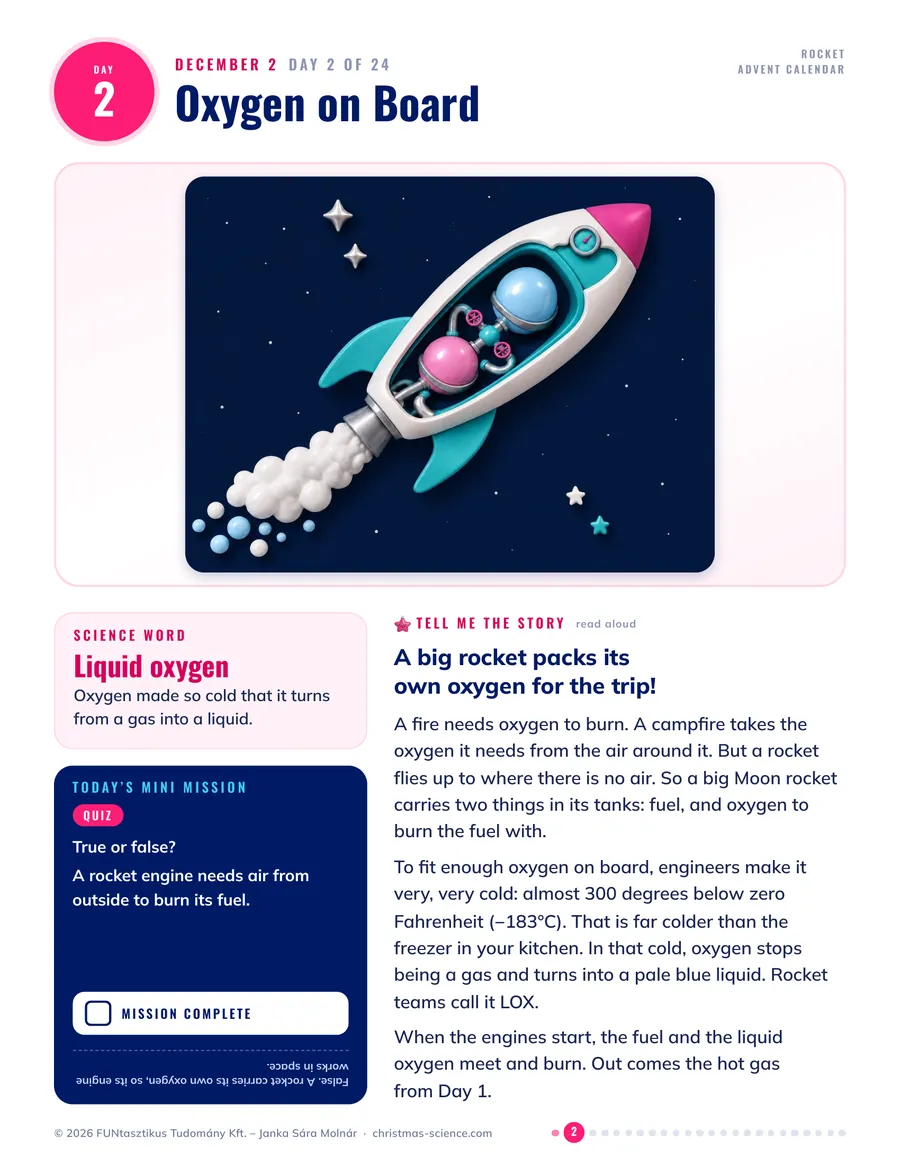
TODAY’S MINI MISSION · QUIZ
True or false? A rocket engine needs air from outside to burn its fuel.
Answer: False. A rocket carries its own oxygen, so its engine works in space.
IF THEY ASK WHY
Then why can’t an airplane fly to space? A jet engine gulps in air from outside to burn its fuel, and the wings need air to hold the plane up. The higher you go, the thinner the air gets. A rocket brings its own oxygen along.
Know someone who thinks rockets push off the air? Many grown-ups do. Send them this one. Share it
Why do rockets have stages?
Big rockets have stages so they can drop weight on the way up. Each stage has its own engines and its own fuel. When a stage runs out of fuel, it falls away, and the lighter rocket can speed up more easily, until it is fast enough to stay up in space.
The bottom stage fires first and lifts the whole rocket off the ground. A few minutes later, its tanks are empty. Now it is just a heavy, empty shell that the rocket doesn’t need anymore. So the rocket lets it fall away, and the next stage starts its engines.
It’s like running a race with a heavy backpack and taking it off halfway. Now you can run much faster.
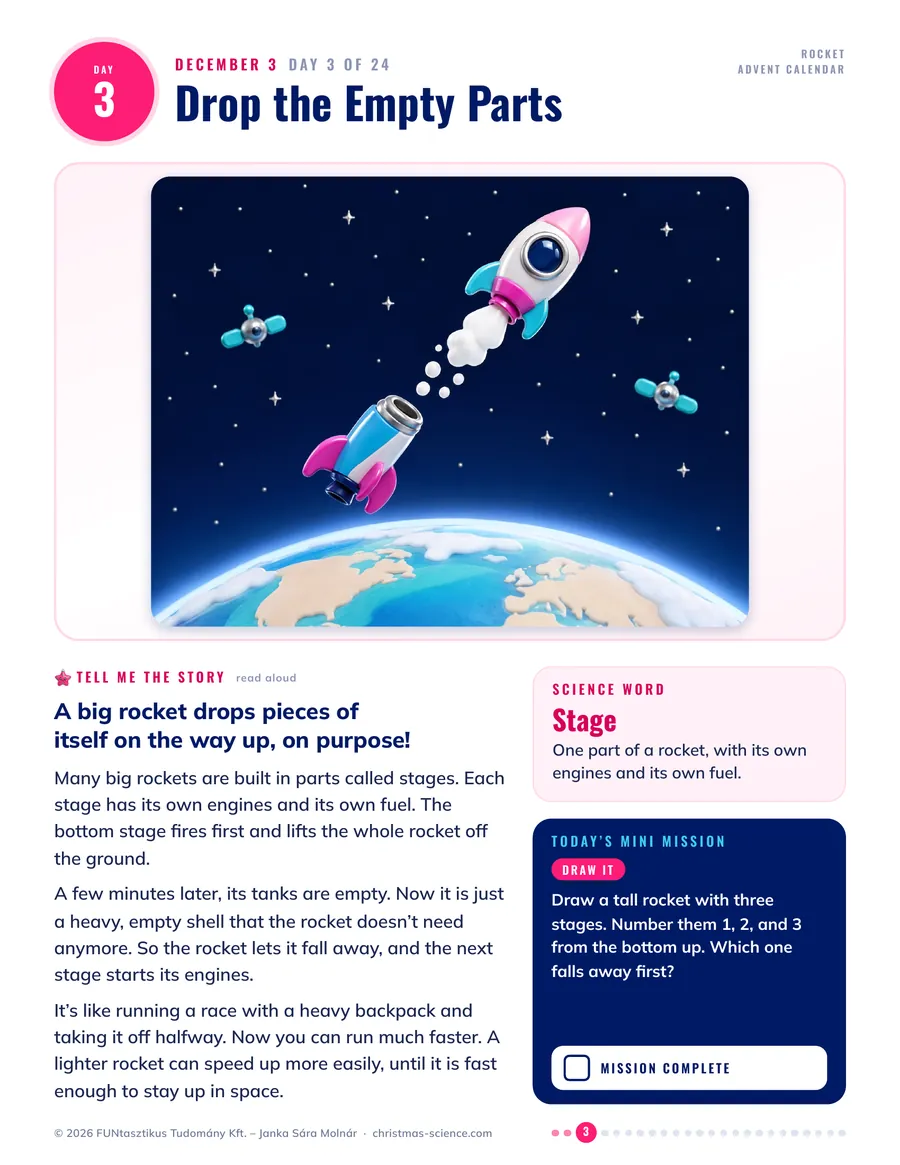
TODAY’S MINI MISSION · DRAW IT
Draw a tall rocket with three stages. Number them 1, 2, and 3 from the bottom up. Which one falls away first?
How big was the Saturn V Moon rocket?
The Saturn V, the rocket that took the Apollo astronauts to the Moon, stood 363 feet (111 meters) tall, about as high as a 36-story building. The V is the Roman numeral for five, so you say “Saturn Five.” It had three stages. Filled with fuel and ready to go, it weighed about as much as 400 elephants. Twelve people have walked on the Moon, and all of them rode a Saturn V.
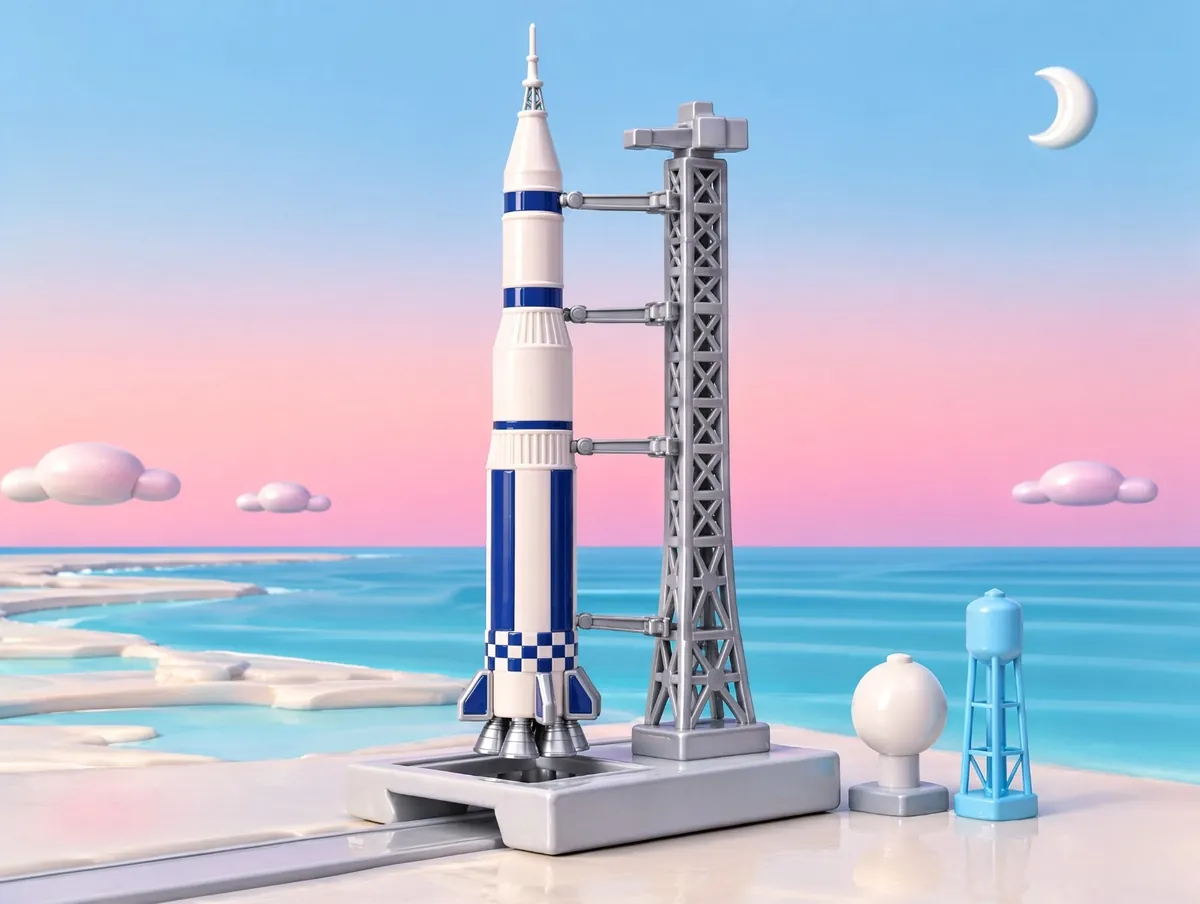
TODAY’S MINI MISSION · QUIZ
Which one is taller? A) The Statue of Liberty B) The Saturn V rocket C) They are the same height
Answer: B. The Saturn V was about 60 feet (18 meters) taller.
How does a rocket countdown work?
A rocket countdown is a long list of checks that runs on a clock. For the Artemis II Moon rocket, the clock started about two days before liftoff, and every now and then it stopped on purpose. These planned pauses are called holds, and they give the team time to check that everything is ready.
In those two days, the launch team goes through a very long list. Is the rocket filled with fuel? Is the weather good? Is the crew strapped in? A hold lets the team catch up or look at a problem without rushing.
It works like getting ready for a trip with your family. Shoes? Check. Coat? Check. Wait, where is Teddy? Hold. The last ten seconds begin only when every answer is “go.”
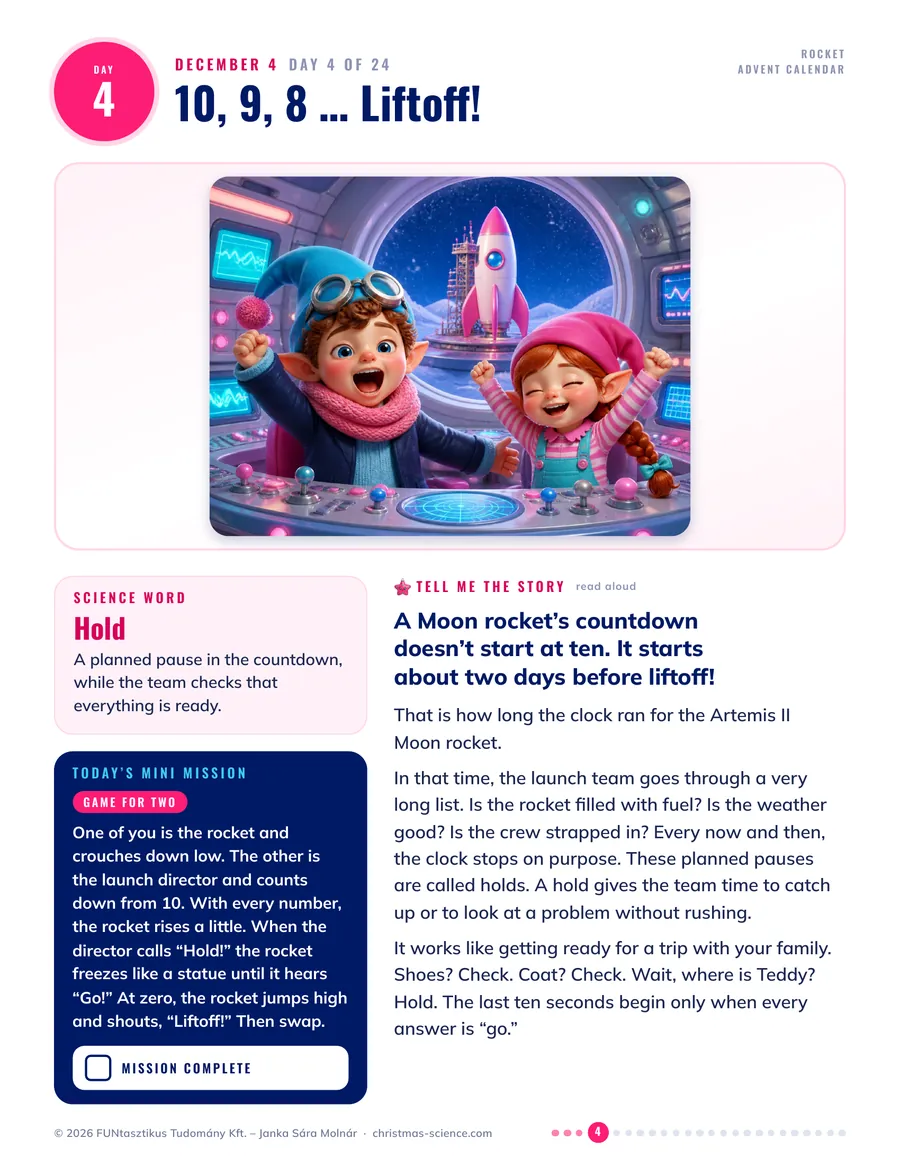
TODAY’S MINI MISSION · GAME FOR TWO
One of you is the rocket and crouches down low. The other is the launch director and counts down from 10. With every number, the rocket rises a little. When the director calls “Hold!” the rocket freezes like a statue until it hears “Go!” At zero, the rocket jumps high and shouts, “Liftoff!” Then swap.
Why do they spray water during a rocket launch?
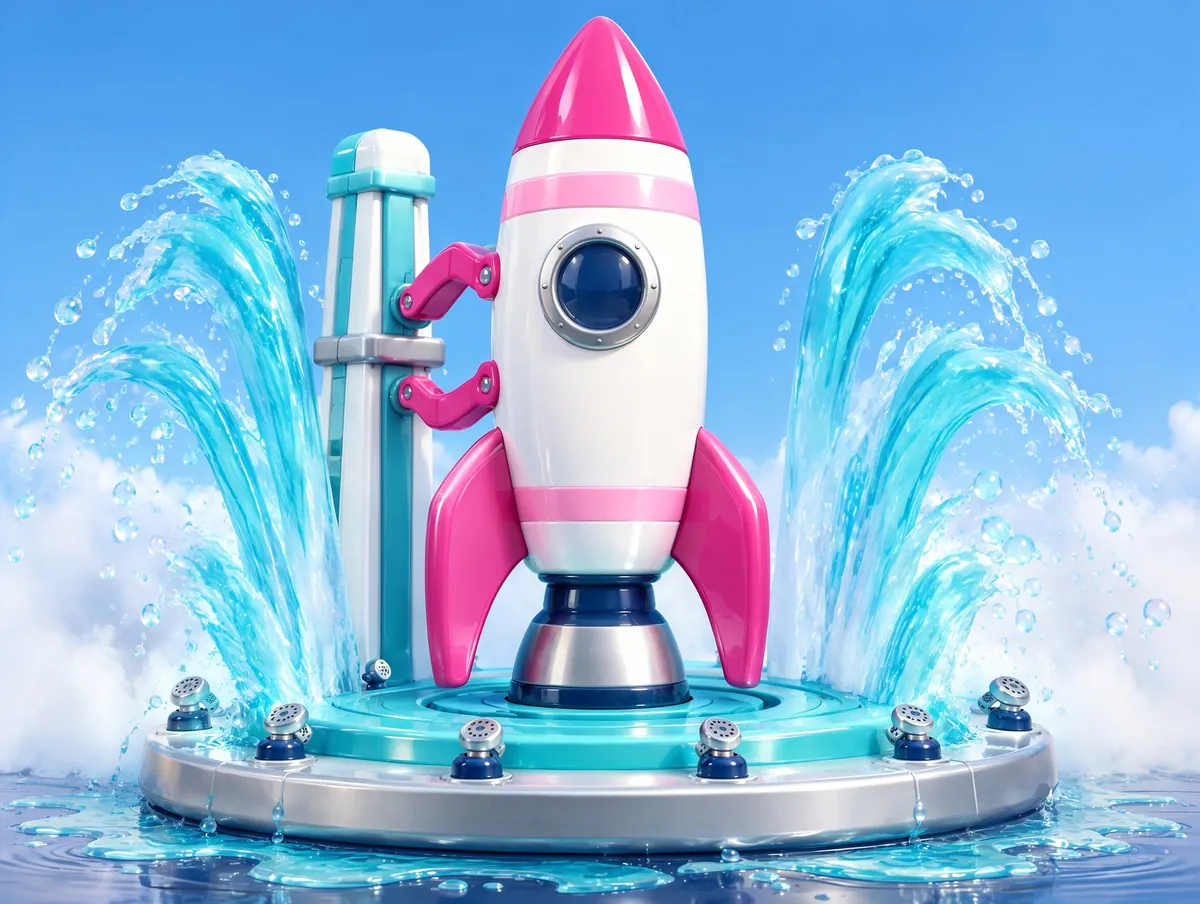
To soak up some of the noise. The roar of a big Moon rocket is so strong that the sound itself could harm the rocket and the pad it stands on. So about 20 seconds before liftoff, water starts to rush across the launch pad.
In one NASA test, about 450,000 gallons (1.7 million liters) poured out in just 30 seconds. Picture every bathtub in your town emptying at the same moment. The water soaks up some of the noise, a bit like a thick pillow over a ringing alarm clock. Then the engines light, and their heat turns some of the water into white clouds of steam.
TODAY’S MINI MISSION · QUIZ
What is the water at the launch pad mostly for? A) To wash the rocket B) To soak up the noise C) To give the crew a drink
Answer: B. The water soaks up some of the sound of the engines.
How do astronauts get back to Earth?
Astronauts come home in a small capsule. On the way back from the Moon, Earth’s air slows the Orion capsule down first, while a heat shield protects the crew. Then 11 parachutes open in a careful order, and the capsule splashes down softly in the ocean.
Orion comes back from the Moon at about 25,000 miles (40,000 kilometers) an hour, and it has no brakes the way a car does. As it dives into the air, the outside of the capsule heats up to about 5,000 degrees Fahrenheit (2,800°C), hotter than lava. The crew sits behind the heat shield, the wide, round bottom of the capsule. It is 16 and a half feet (5 meters) across, wider than most bedrooms. Its outer layer is made to burn off slowly and take the heat with it, so inside, the cabin stays as comfy as a room at home.
The air slows the capsule to about 325 miles (520 kilometers) an hour. That is still far too fast for a landing, so the parachutes take over. First, three small ones pull the cover off the top of the capsule. Two more hold the capsule steady and slow it down. Then three little helpers pull out the three huge main parachutes. They slow Orion to about 17 miles (27 kilometers) an hour. The capsule splashes down softly in the ocean, and a ship comes to pick up the crew.
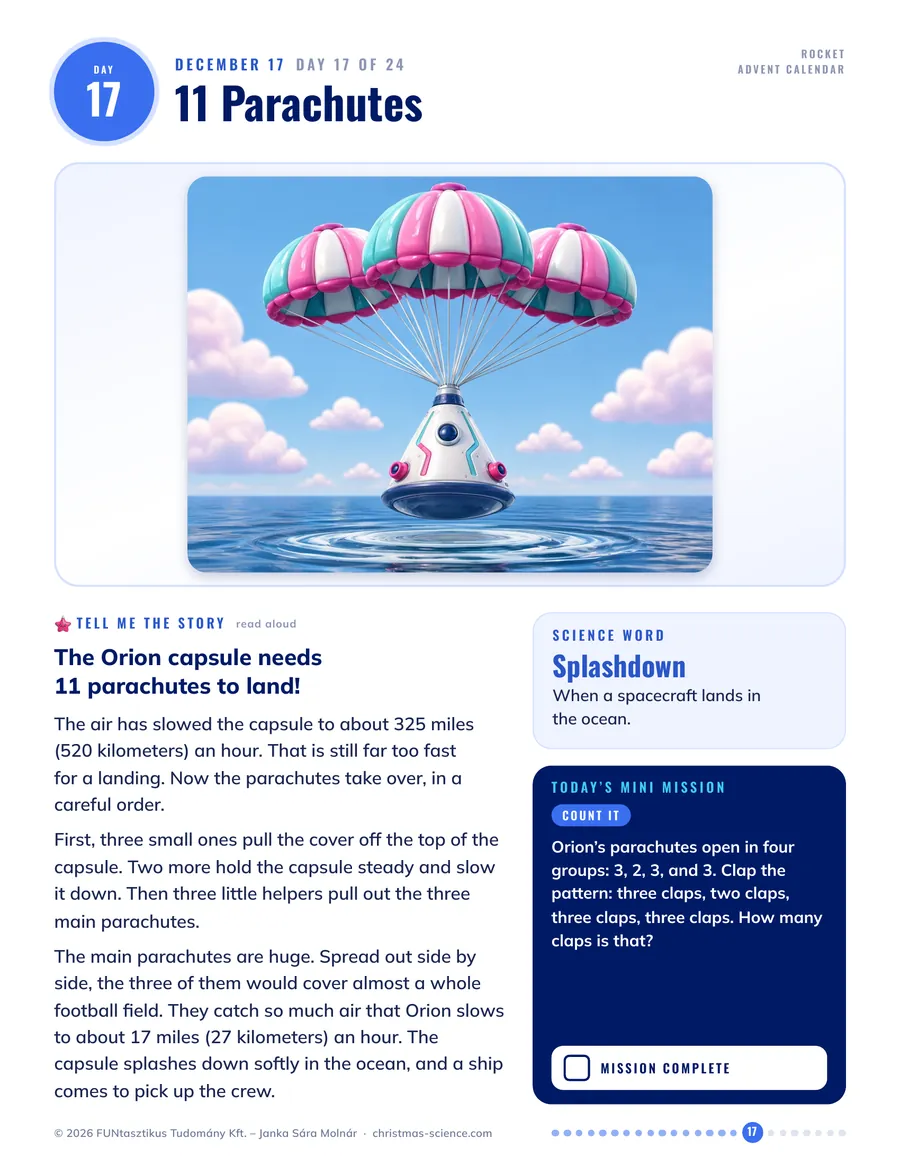
TODAY’S MINI MISSION · COUNT IT
Orion’s parachutes open in four groups: 3, 2, 3, and 3. Clap the pattern: three claps, two claps, three claps, three claps. How many claps is that?
Answer: 11 claps, one for each parachute.
Can kids launch a rocket at home?
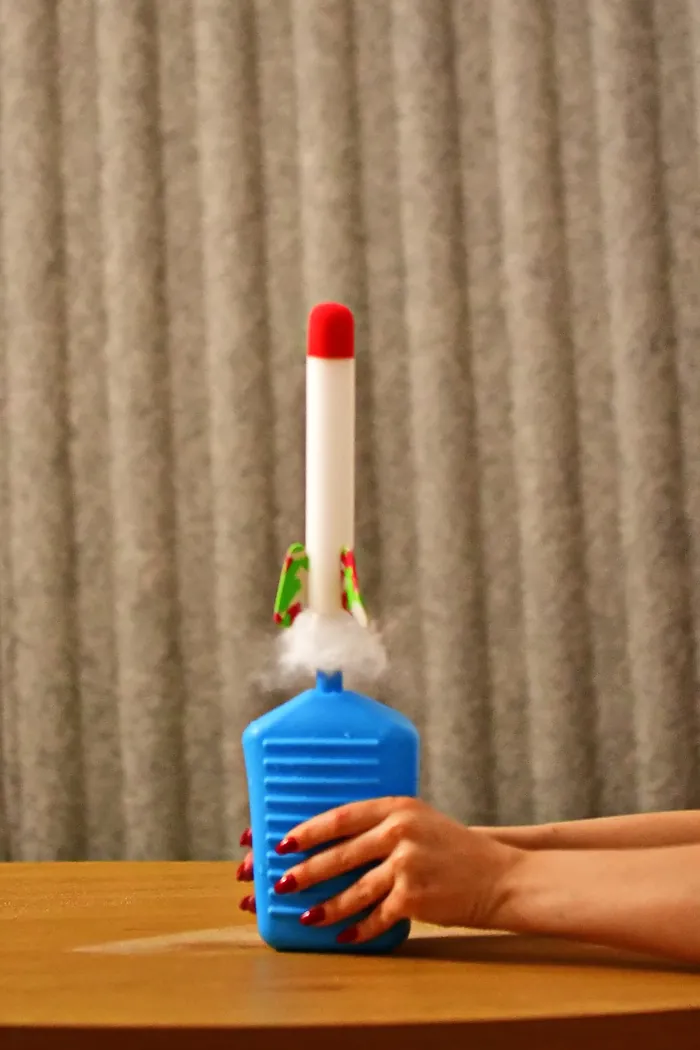
Yes, outdoors and with a grown-up in charge. Two of the 51 real experiments in my book, Theo and Tilda’s Christmas Science Adventure, are rockets you can launch in your own backyard.
The Fizzy Tablet Rocket (Experiment 7) uses a little water and a fizzy vitamin C tablet in a film canister or tablet tube with a snap-on cap, never glass or a screw-top bottle. The tablet makes carbon dioxide gas, and the pressure builds until it pops the cap off. The gas and water shoot down, and the tube flies the other way: up. That is the same push and push back that lifts a real rocket.
The Foam Rocket (Experiment 18) uses vinegar and baking soda. The gas they make is trapped in a sealed cylinder, so its pressure keeps rising until the rocket pops out like a cork from a bottle.
GROWN-UPS IN CHARGE: HOW TO DO IT SAFELY
- Rockets launch outdoors, with a grown-up in charge. Everyone wears safety goggles and stands at least 7 feet (2 meters) back.
- A grown-up snaps the cap on and stands the tube cap-side down on the ground, or fits the foam rocket into place, then steps back right away. Never lean over a rocket, and never point the open end at anyone’s face.
- If nothing happens for a minute, don’t lean over it. A grown-up carefully opens it, holding it away from their face.
- Use fizzy vitamin C tablets only, never Alka-Seltzer or any other medicine, and put the leftover tablets away.
Is there a printable rocket advent calendar with true stories?
Yes. The eight stories above come from Theo & Tilda’s Rocket Advent Calendar, a printable advent calendar with 24 true rocket and space stories for kids ages 4 to 9, one for each day from December 1 to 24.
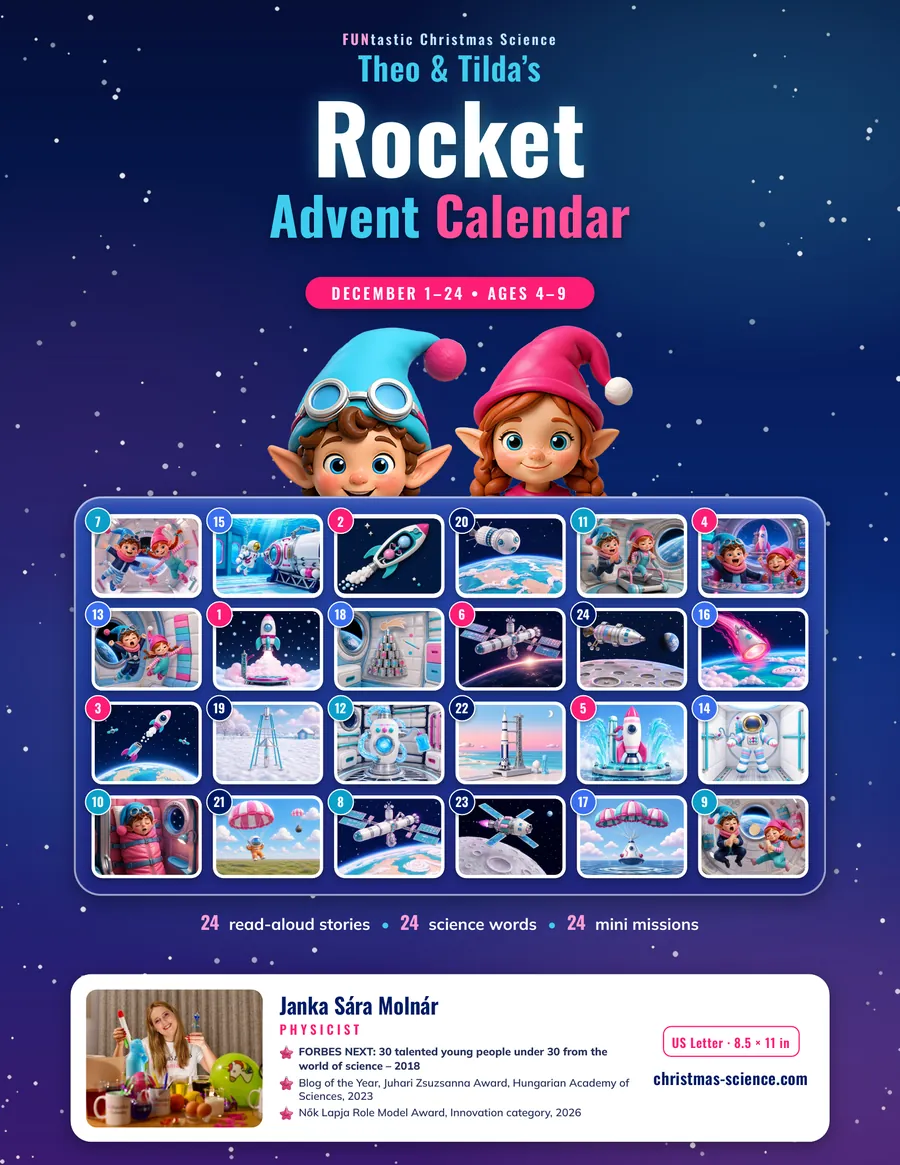
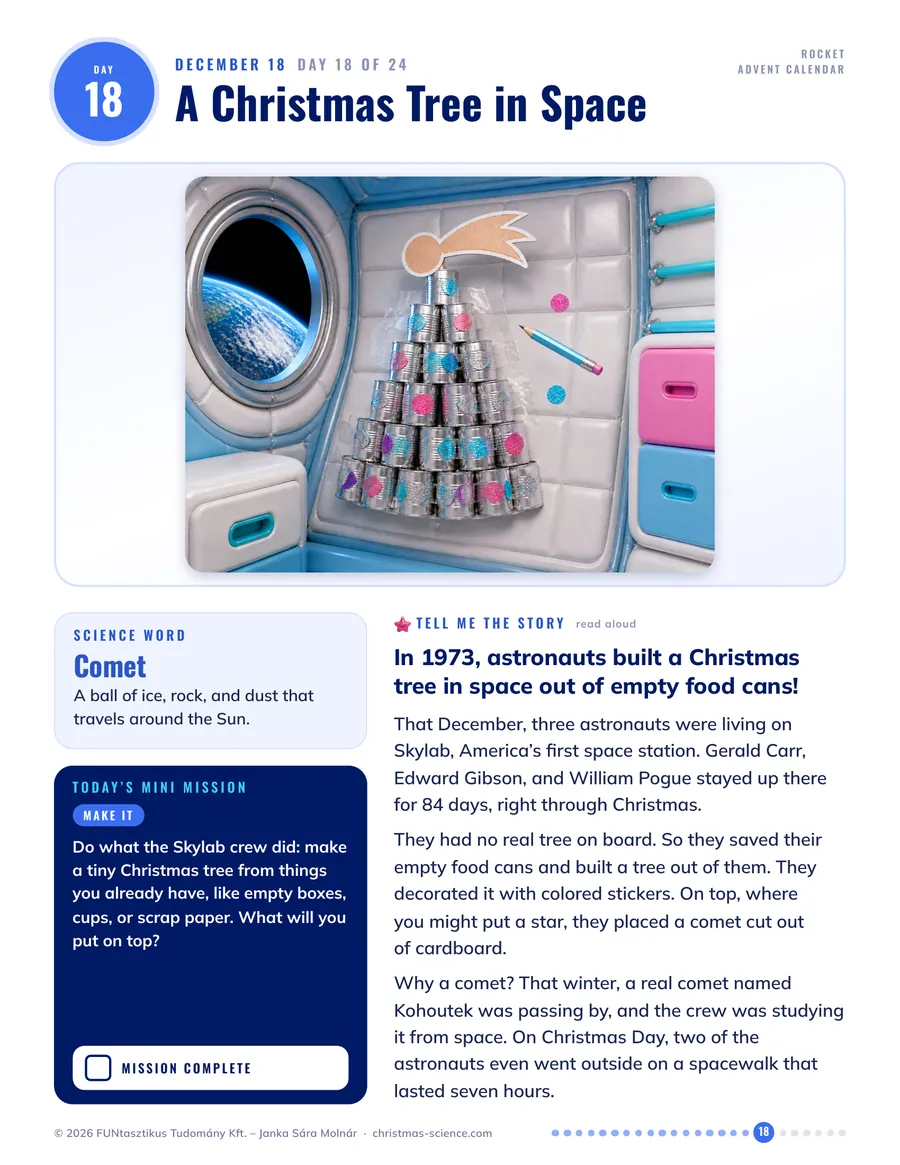
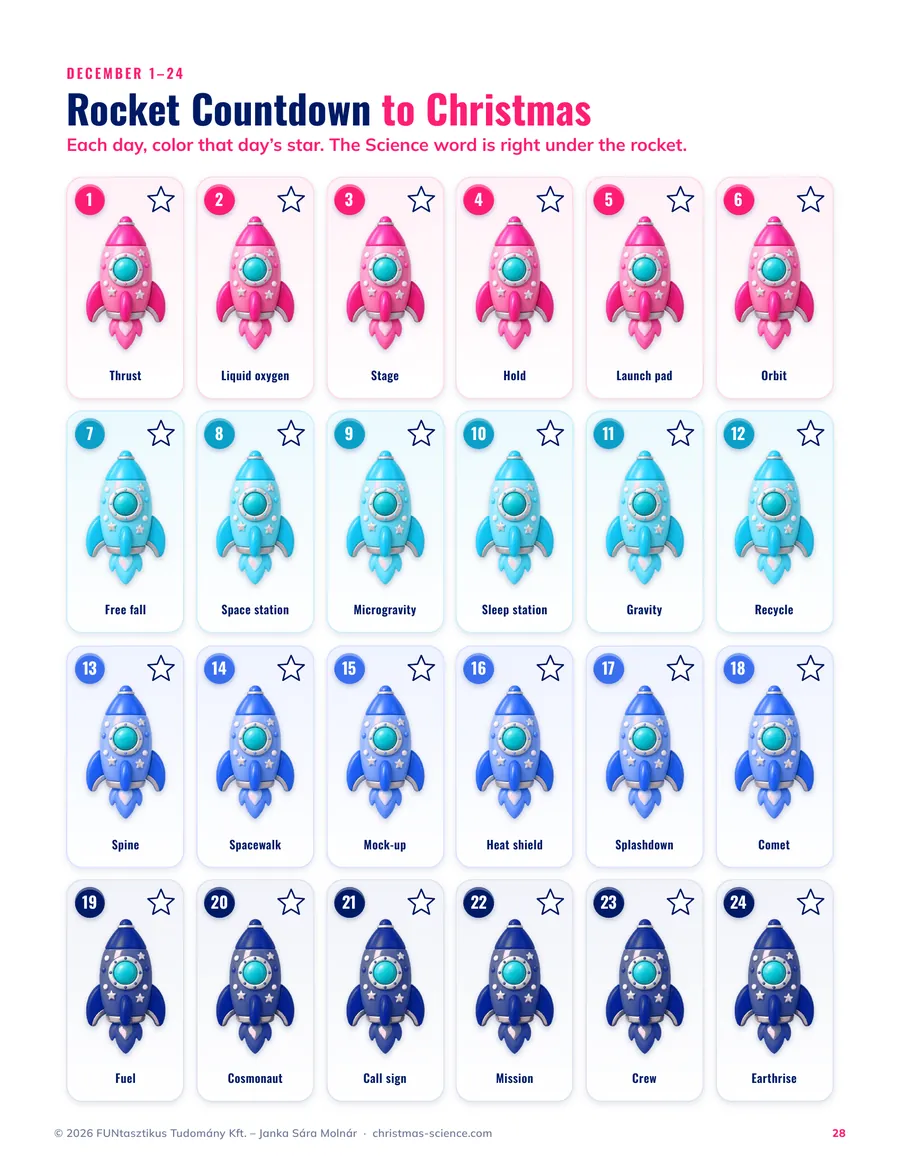
- 24 day pages, each with its own illustration, a one-minute true story to read aloud, a Science word, and a mini mission, like a quiz, a game for two, a drawing, a movement game, or a question for dinner
- How rockets fly, launch day, life on the space station, spacewalks, the trip home, and the first people in space
- Christmas in space: the tree astronauts built from food cans in 1973, and Christmas Eve at the Moon in 1968
- A Rocket Countdown page to color, with all 24 Science words, and a Junior Rocket Scientist certificate for December 24
- No prep and no supplies to buy. No printer? Read it on a tablet, a laptop, or a phone.

Every rocket in this calendar flies because of one simple idea: push something away, and it pushes you back. Your child will feel that push on Day 1, with two hands against a wall. By Day 24, that same push has carried three astronauts around the Moon on Christmas Eve.
Read one page a day together, do the mini mission, and let the questions come. You don’t need to know every answer. It’s fine to say, “I don’t know. Let’s find out.” Scientists say it all the time.
Wondering how astronauts eat, sleep, and stay strong once the rocket gets them to space? Read “How Do Astronauts Live in Space?” And here are all my printable advent calendars for kids, from true dinosaur stories to animal superpowers.
Was two and a half seconds a success?
Yes, a very big one. It doesn’t sound like much. A hop of 41 feet (12.5 meters), and a landing in the cabbages. But that short hop showed something new: a rocket can fly on liquid fuel.
In 1969, 43 years later, a giant Saturn V carried the first astronauts to walk on the Moon. It burned liquid fuel too.
So the next time something you try works for only a moment, remember the rocket in the cabbage patch. A very short hop can be the start of a very long trip.

Ask at dinner tonight: What is something you could do only a little at first, but can do much better now?
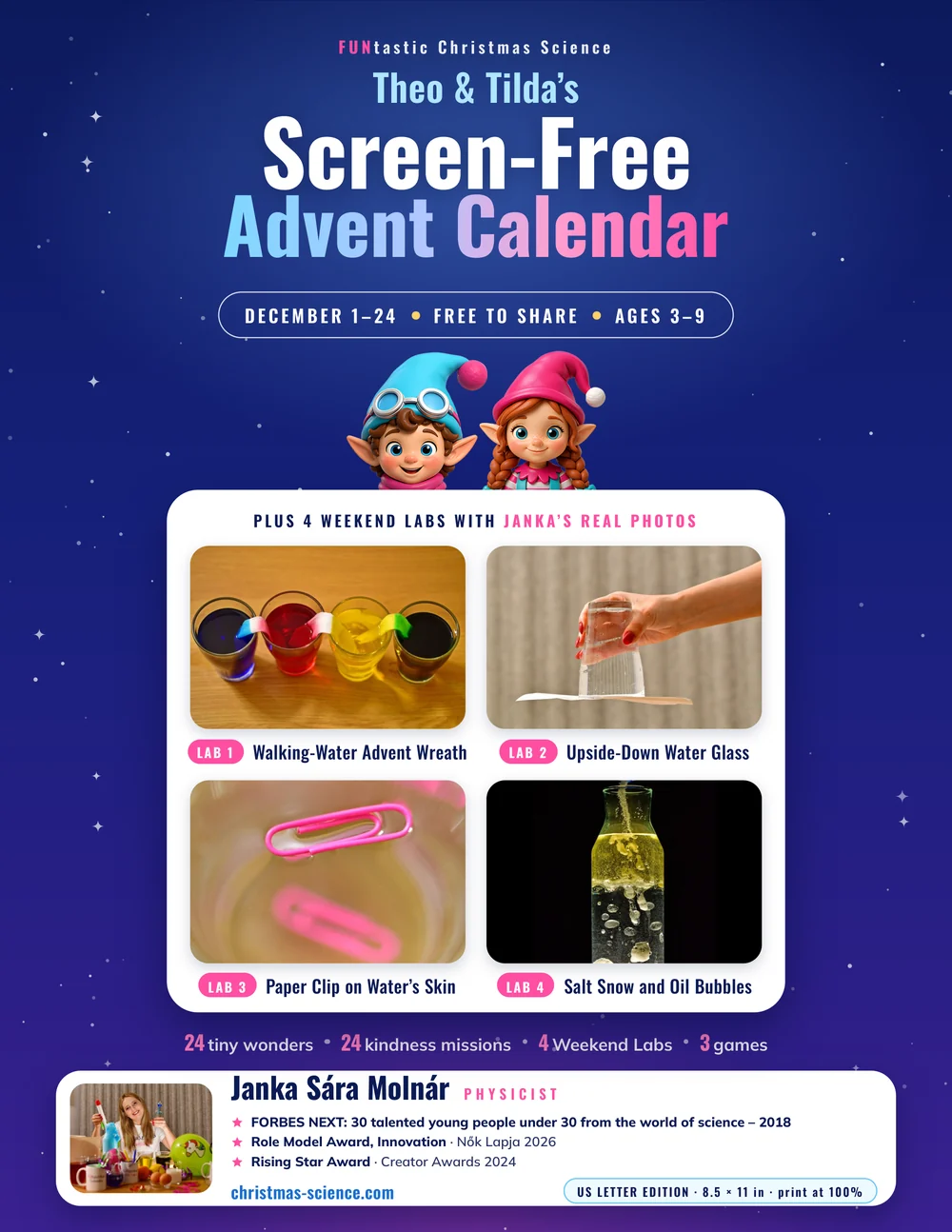
Theo & Tilda’s Screen-Free Advent Calendar
24 tiny wonders and 24 kindness missions, one for every day from December 1 to 24, plus 4 Weekend Labs with my real photos and 3 games. Most tiny wonders take about 10 minutes and use things you probably already have. 22 pages, for ages 3–9.
This calendar is free to share. Print it as often as you like for your family or class, and pass it on to friends, families, and teachers. Please don’t sell it or change it.

Know a family whose kids love rockets?
Send them tonight’s story. The eight true rocket stories above are free to read aloud, and each one takes about a minute.
COPY THIS MESSAGE
Paste it into a family group chat, or send it to a friend.
I found eight true rocket stories to read to the kids: how a rocket really flies, why it carries its own oxygen, why it drops pieces of itself on the way up, and how astronauts land with 11 parachutes. A physicist checked every fact. www.christmas-science.com/blog/how-do-rockets-work-for-kids
Quick answers about how rockets work
How do rockets work for kids?
A rocket pushes very hot gas out of its tail, and the gas pushes the rocket the other way, up. That push is called thrust. Scientists call this push and push back Newton’s third law of motion.
How do rockets fly in space without air?
A rocket doesn’t push on the air. It pushes on its own hot gas. It also carries its own oxygen to burn its fuel, so its engines work even where there is no air at all.
Why do rockets have stages?
Big rockets have stages to drop weight on the way up. When a stage runs out of fuel, it falls away, and the lighter rocket can speed up more easily, until it is fast enough to stay up in space.
Why do they spray water during a rocket launch?
To soak up some of the noise. The roar of a big rocket is so strong that the sound could harm the rocket and the launch pad. In one NASA test, about 450,000 gallons (1.7 million liters) of water poured across the pad in just 30 seconds.
What age is the Rocket Advent Calendar for?
Ages 4 to 9. Little ones can enjoy it with a grown-up reading aloud. Each of the 24 day pages has a one-minute true story, a Science word, and a mini mission. The calendar comes as two PDF files, US Letter and A4. No printer? You can read it on a tablet, a laptop, or a phone.

About Janka
Janka Sára Molnár is a physicist and award-winning science communicator from Hungary, and the founder of FUNtastic Christmas Science. As a high school student, she built particle detectors and took them to CERN several times, where she presented them in its teacher program. She graduated from Eötvös Loránd University (ELTE) in Budapest, and for almost 15 years she has run several hundred science shows for children and families.
- FORBES NEXT: 30 talented young people under 30 from the world of science – 2018
- Nők Lapja Role Model Award, Innovation category, 2026
- Women of Excellence Award, 2026
- Creator Awards, Rising Star, 2024
- Blog of the Year, Juhari Zsuzsanna Award, Hungarian Academy of Sciences, 2023
- Winner of the HBO Max reality show A Híd
The rocket and space illustrations and the pictures of Theo, Tilda, and their world were created with AI-assisted tools (Canva) and edited by our team. Physicist Janka Sára Molnár checked every fact in this post against NASA and other trusted science sources. The photos of Janka and of her Foam Rocket experiment are real photos.
Keep reading
More Christmas science ideas from Theo, Tilda, and me.
 For parents · 14 min readHow Do Astronauts Live in Space? 8 True Stories for KidsHow do astronauts live in space? For kids, a physicist explains floating, space food, sleeping on the wall, recycled water, and Christmas in space.Read the post →
 For parents · 13 min readFun Facts About the Planets for Kids (Physicist-Checked)Fun facts about the planets for kids: one true story for each of the 8 planets, plus Pluto’s heart and why stars twinkle. Checked by a physicist.Read the post →
 For parents · 10 min readDid Dinosaurs Live in the Snow? True Stories for KidsDid dinosaurs live in the snow? Yes. Baby dinosaurs hatched in snowy Arctic Alaska, and a crested dinosaur lived in forested Antarctica. Four true stories.Read the post →
© 2026 FUNtasztikus Tudomány Kft. – Janka Sára Molnár