How Do Astronauts Live in Space? 8 True Stories to Tell Your Kids Tonight
Most astronauts in space today live on the International Space Station, a science lab that flies around Earth about every 90 minutes. Up there, everything floats, so astronauts eat tortillas instead of bread, sleep in sleeping bags fastened to the wall, and drink water that has been cleaned and used again. Here is how astronauts live in space, explained for kids in eight true stories from my Rocket Advent Calendar, each short enough to read aloud before bed.
- 8 true stories
- Ages 4–9
- About a minute each
- No prep
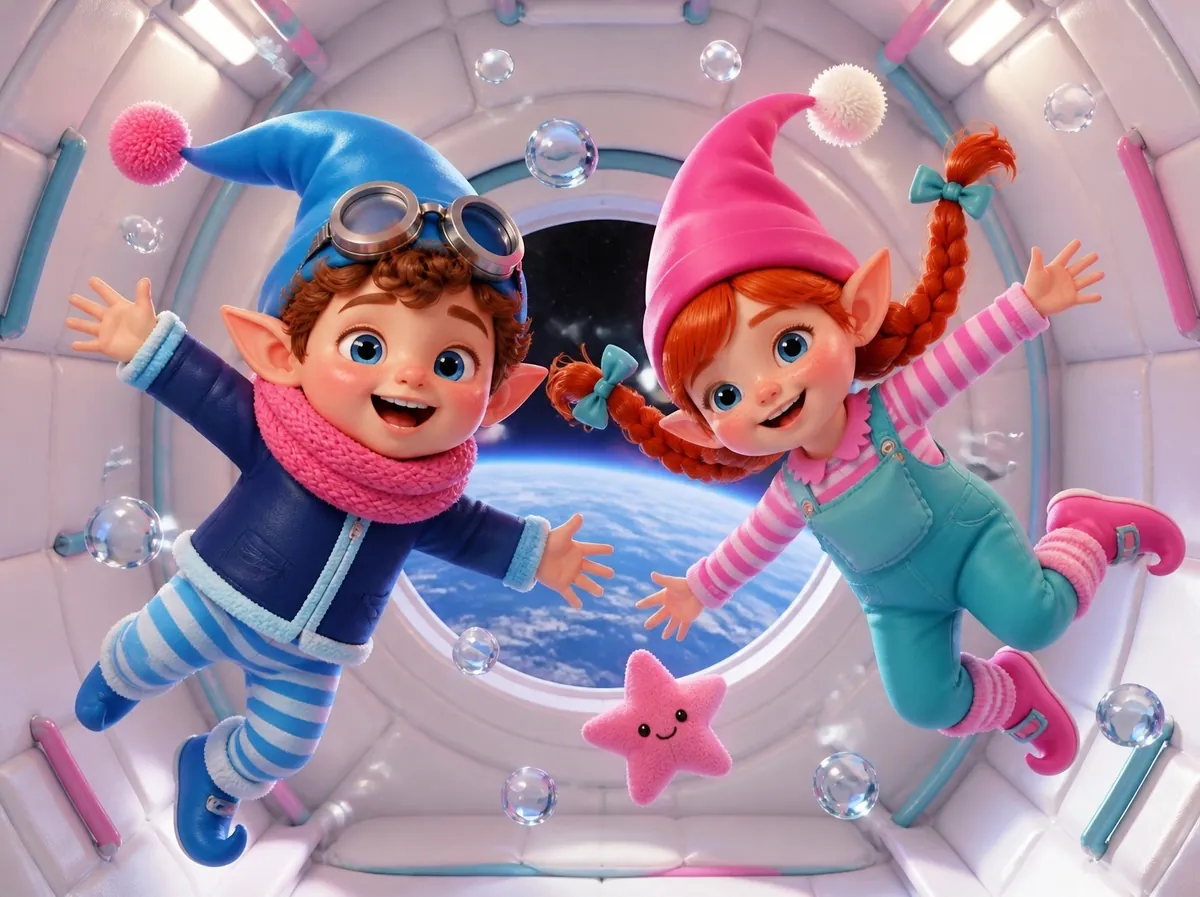
Save this for a cozy evening with your little astronaut, or send it to a friend whose child asks a hundred questions about space.
A Christmas Tree in Space
In December 1973, three astronauts were living on Skylab, America’s first space station. Gerald Carr, Edward Gibson, and William Pogue stayed up there for 84 days, right through Christmas.
Christmas was coming, but they had no real tree on board.
So they looked around their space station for something they could build one from.
Stop here and ask your child: If you lived in space, what would you build a Christmas tree from? The end of the story is at the bottom of this page.
Know a little one who wants to be an astronaut? Send this to their grown-up, so they have a true space story ready for tonight. Share it
How do astronauts live in space?
Today, most astronauts in space live and work on the International Space Station. Since November 2000, there has not been one single day without people living there. Everything floats on board, so eating, sleeping, and even drinking work differently.
The station is 356 feet (109 meters) long, almost as long as a football field. Inside, there is more room than in a six-bedroom house. The crew has two bathrooms, a gym, and a big window for looking down at Earth. Fifteen countries run it, so astronauts who grew up speaking different languages eat dinner together and share the chores.
Here are the questions kids often ask about life in space, answered with true stories from my Rocket Advent Calendar.
Why do astronauts float in space?
Astronauts float because they are falling. Earth’s gravity is almost as strong up on the space station as it is on the ground. But the station, the astronauts, and even their toothbrushes are all falling together, so nothing drops to the floor. This is called free fall.
They are also moving sideways, very fast. The station races along at nearly 5 miles (8 kilometers) every second. By the time you finish saying “space station,” it is 5 miles (8 kilometers) farther along. That is so fast that the station keeps falling around Earth and never hits the ground. One trip around the planet takes about 90 minutes, so the crew sees 16 sunrises and 16 sunsets every day.
You know the floaty feeling of free fall. It’s the tickle in your tummy just as a swing starts to swoop down.
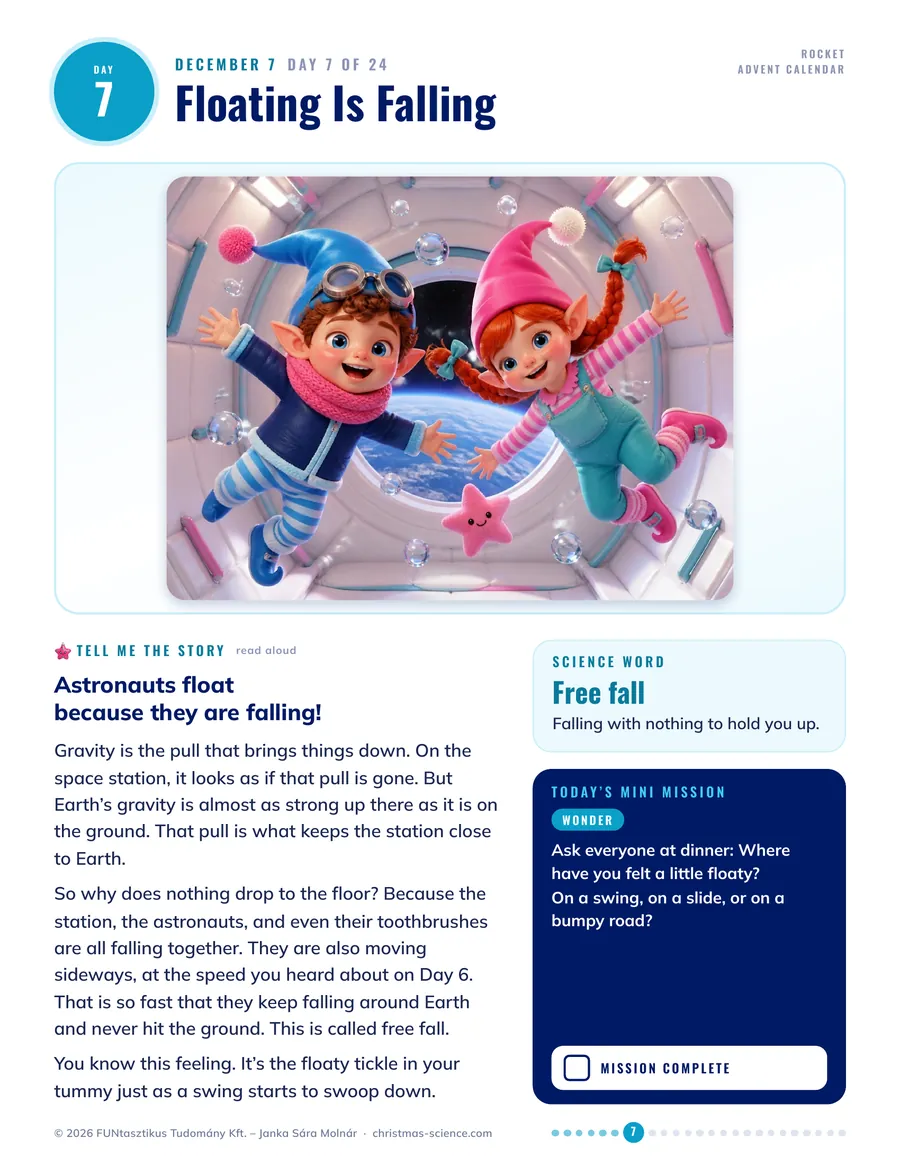
TODAY’S MINI MISSION · WONDER
Ask everyone at dinner: Where have you felt a little floaty? On a swing, on a slide, or on a bumpy road?
IF THEY ASK WHY
So is there no gravity in space? There is. Earth’s pull is what keeps the station going around Earth instead of flying off into space.
Know someone who thinks there is no gravity in space? It’s a very common mix-up. Send them this one. Share it
What do astronauts eat in space?
Astronauts eat many of the foods we eat, but bread is a problem. On the space station, crumbs don’t drop to a plate. They float away, and they can get stuck in the machines that keep the station running. So astronauts eat tortillas instead, because tortillas hardly make any crumbs.
They roll up all kinds of food in them, so a space sandwich is really a space wrap.
Salt and pepper are tricky, too. You can’t shake them over your food, because the grains would drift off. In space, salt and pepper come as liquids, in little dropper bottles.
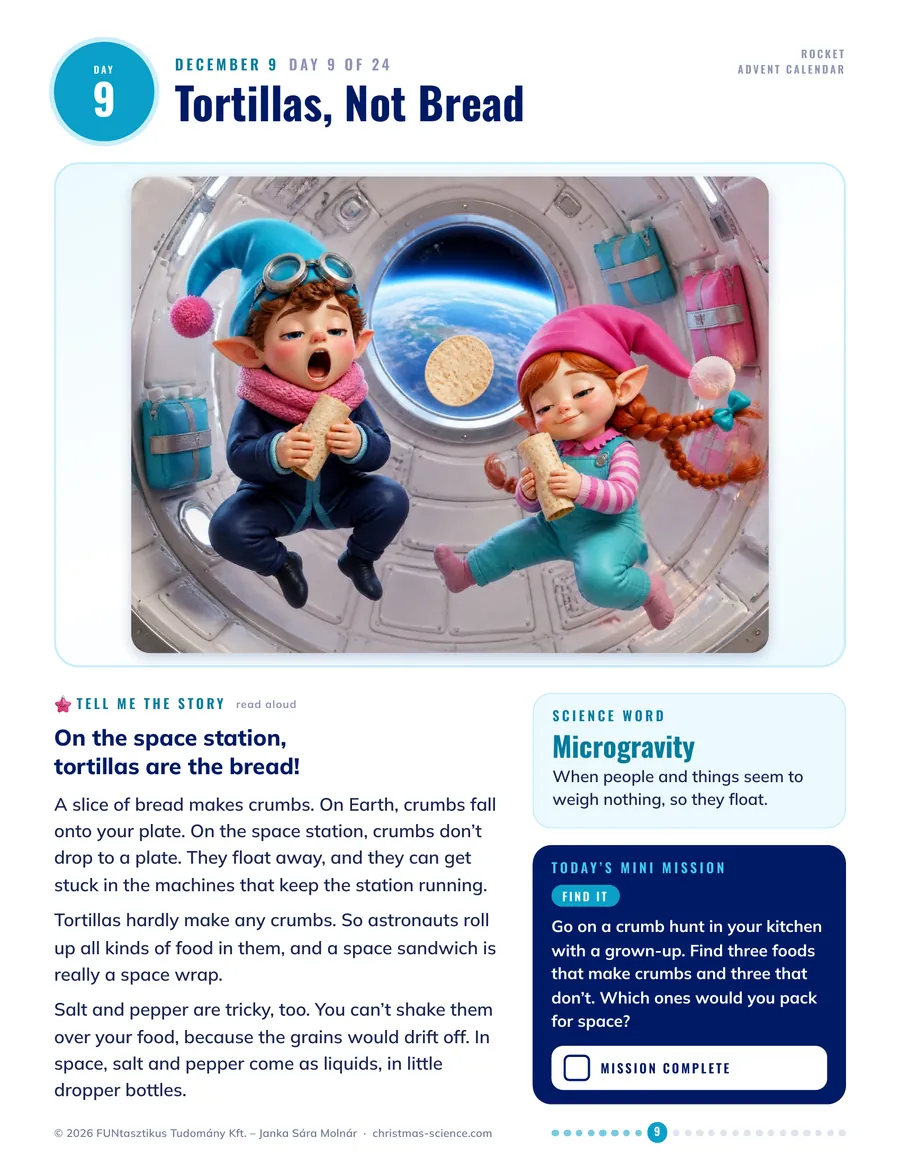
TODAY’S MINI MISSION · FIND IT
Go on a crumb hunt in your kitchen with a grown-up. Find three foods that make crumbs and three that don’t. Which ones would you pack for space?
How do astronauts sleep in space?
Astronauts sleep in sleeping bags fastened to the wall. When everything floats, there is no up and no down, so a bed doesn’t have to lie flat. Astronauts can sleep on the wall, or even on the ceiling.
Each astronaut has a sleep station about the size of a small closet. Inside are a sleeping bag and a pillow. The sleeping bag is fastened to the wall for a good reason. Otherwise, a sleeping astronaut would slowly drift through the station and bump into things.
And remember the 16 sunrises? The Sun comes up every 90 minutes, so the crew can’t wait for a dark night. They close the door of their sleep station to keep the light out.
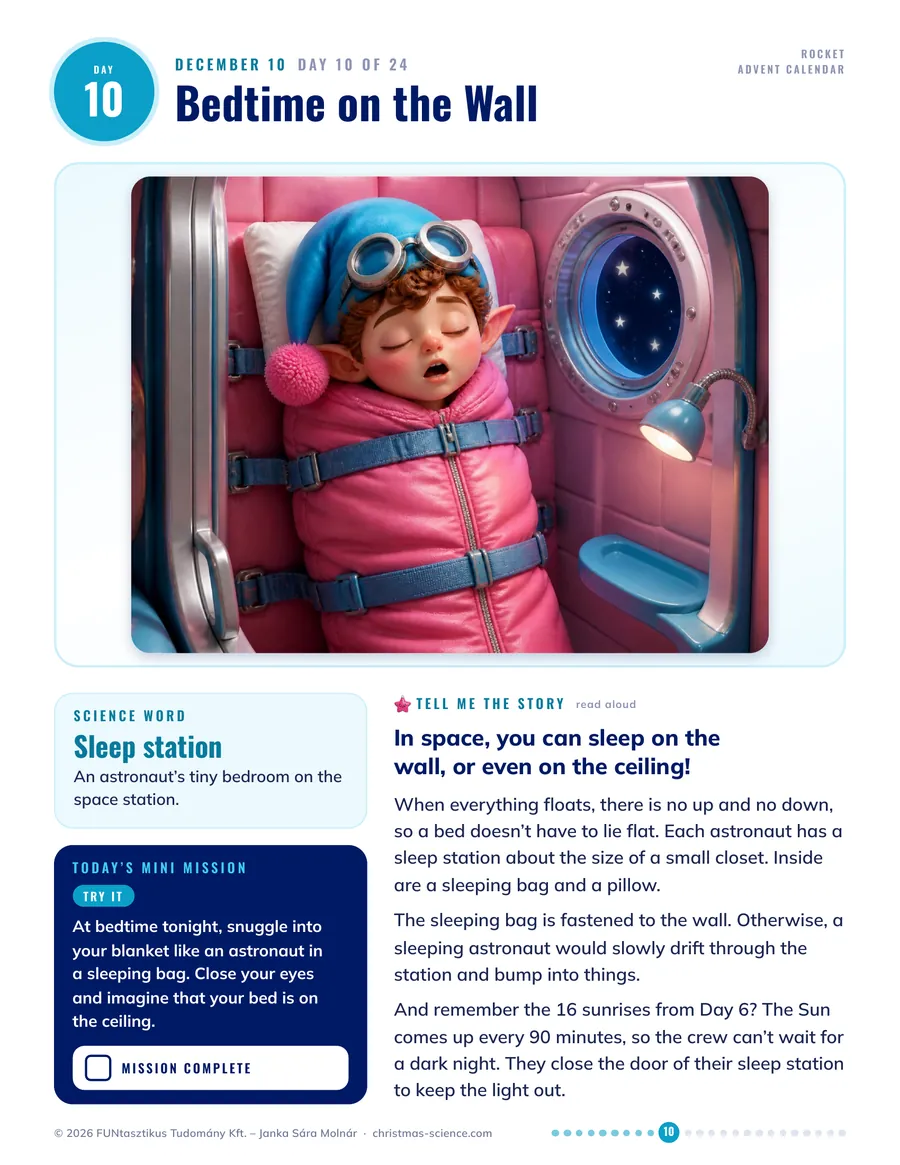
TODAY’S MINI MISSION · TRY IT
At bedtime tonight, snuggle into your blanket like an astronaut in a sleeping bag. Close your eyes and imagine that your bed is on the ceiling.
How do astronauts get water in space?
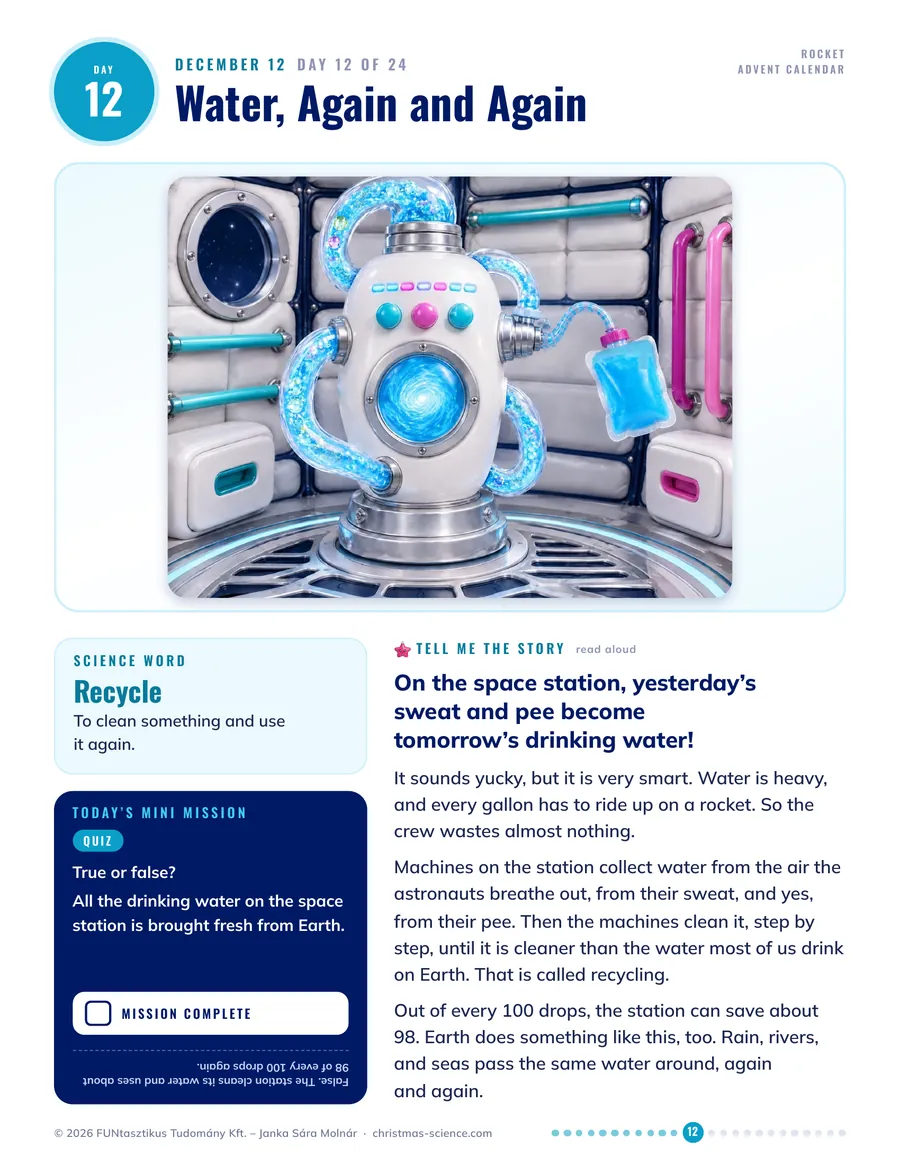
Astronauts recycle almost all of their water. Machines on the space station collect water from the air the crew breathes out, from their sweat, and yes, from their pee. They clean it step by step, until it is cleaner than the water most of us drink on Earth. Out of every 100 drops, the station can save about 98.
It sounds yucky, but it is very smart. Water is heavy, and every gallon has to ride up on a rocket. So the crew wastes almost nothing.
Earth does something like this, too. Rain, rivers, and seas pass the same water around, again and again.
TODAY’S MINI MISSION · QUIZ
True or false? All the drinking water on the space station is brought fresh from Earth.
Answer: False. The station cleans its water and uses about 98 of every 100 drops again.
Why does water float in balls in space?
Water forms floating balls on the space station because water pulls on itself, and up there nothing presses it flat.
On the space station, water that gets loose doesn’t make a puddle. It floats around in wobbly blobs, and the blobs pull themselves into balls. What holds a water ball together? Something you can see at home, in a glass of water.
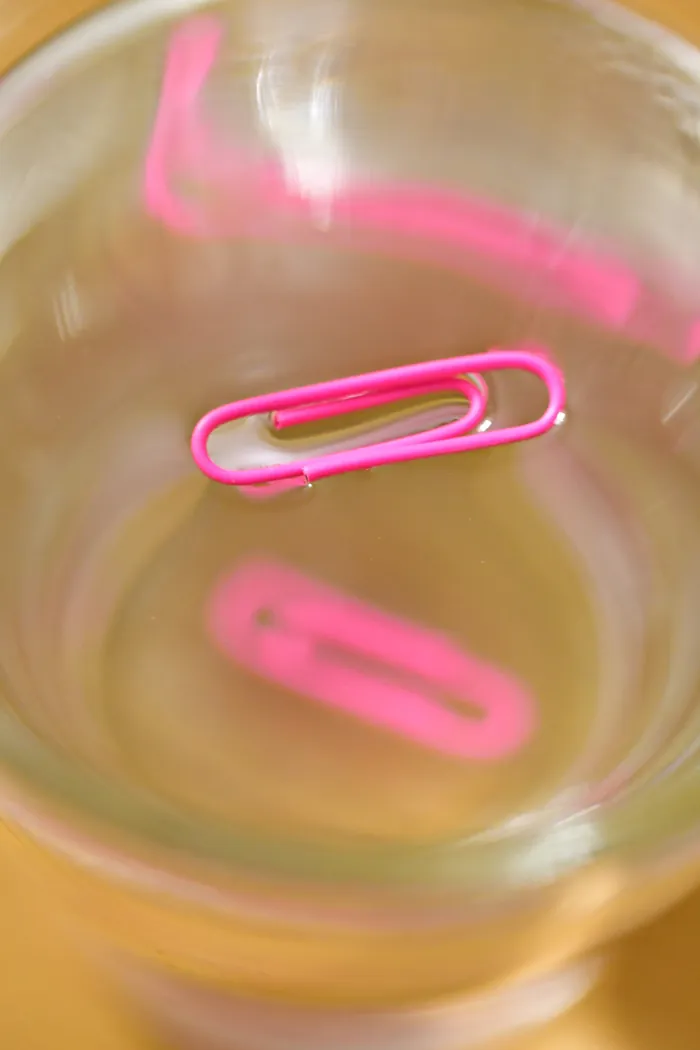
Water pulls on itself. At the surface, it acts like a thin, stretchy skin. Scientists call it surface tension. On Earth, gravity pulls a big blob of water down against a table and squashes it flat. On the space station, the water is falling along with everything around it, so nothing squashes it, and the skin pulls the water into a ball.
At home, the skin can even hold up a metal paper clip. Try it with Water’s Skin, Experiment 16 in Theo and Tilda’s Christmas Science Adventure. With a grown-up nearby, lay a dry paper clip on a small piece of tissue, set them very gently on the water, and wait for the tissue to sink. The clip stays on top!
Why do astronauts grow taller in space?
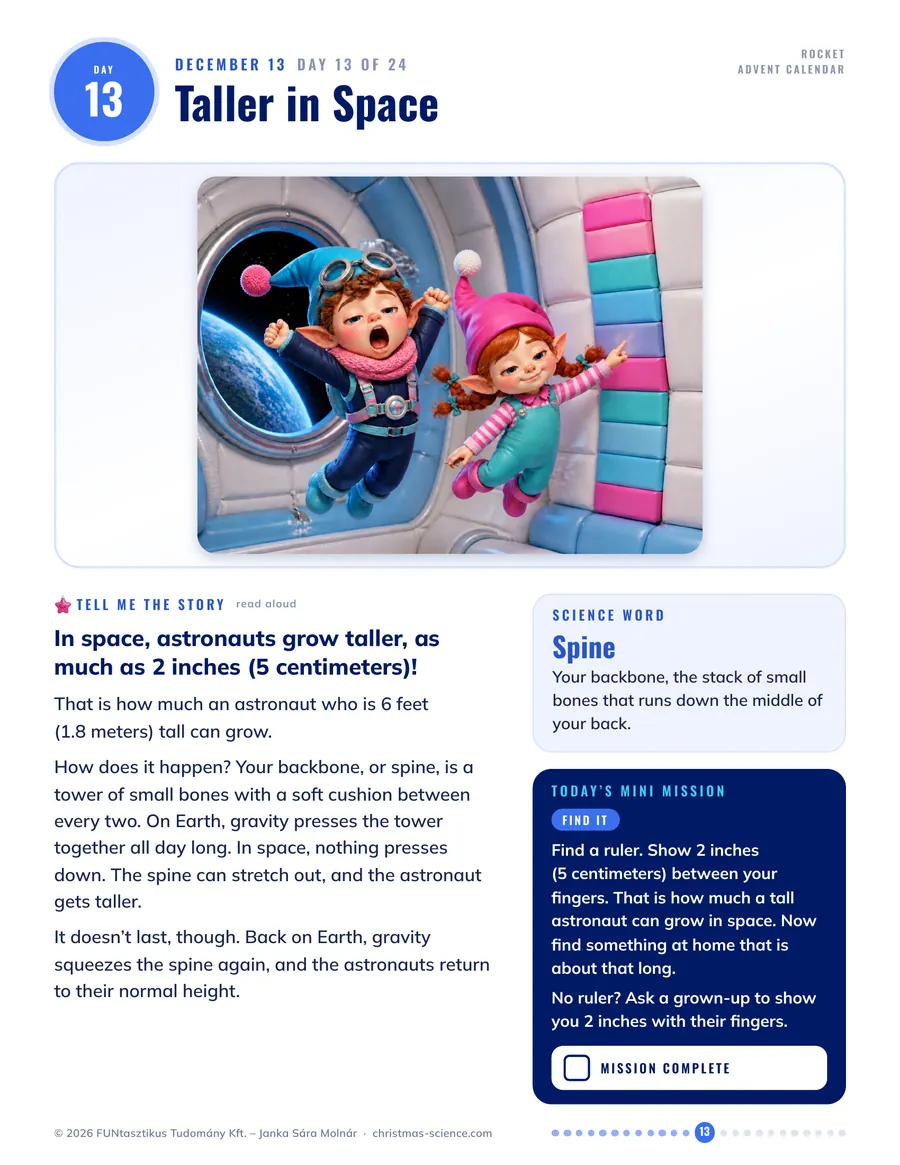
Astronauts grow taller in space because their spine stretches out when nothing presses it together. An astronaut who is 6 feet (1.8 meters) tall can grow as much as 2 inches (5 centimeters). On Earth, gravity presses the spine together all day long. On the space station, the body falls along with everything else, so nothing presses down, and the spine can stretch out.
Your backbone, or spine, is a tower of small bones with soft cushions in between. The extra height doesn’t last, though. Back on Earth, gravity squeezes the spine again, and the astronauts return to their normal height.
There is a catch to floating. Bones and muscles that have no work to do get smaller and weaker. So astronauts exercise for about two hours every day, and it is part of their job. The station has a treadmill, an exercise bike, and a machine that works like lifting weights. Runners wear a harness with stretchy cords that pull them down onto the treadmill, so they don’t push off and sail away.
TODAY’S MINI MISSION · FIND IT
Find a ruler. Show 2 inches (5 centimeters) between your fingers. That is how much a tall astronaut can grow in space. Now find something at home that is about that long.
How do astronauts train for spacewalks?
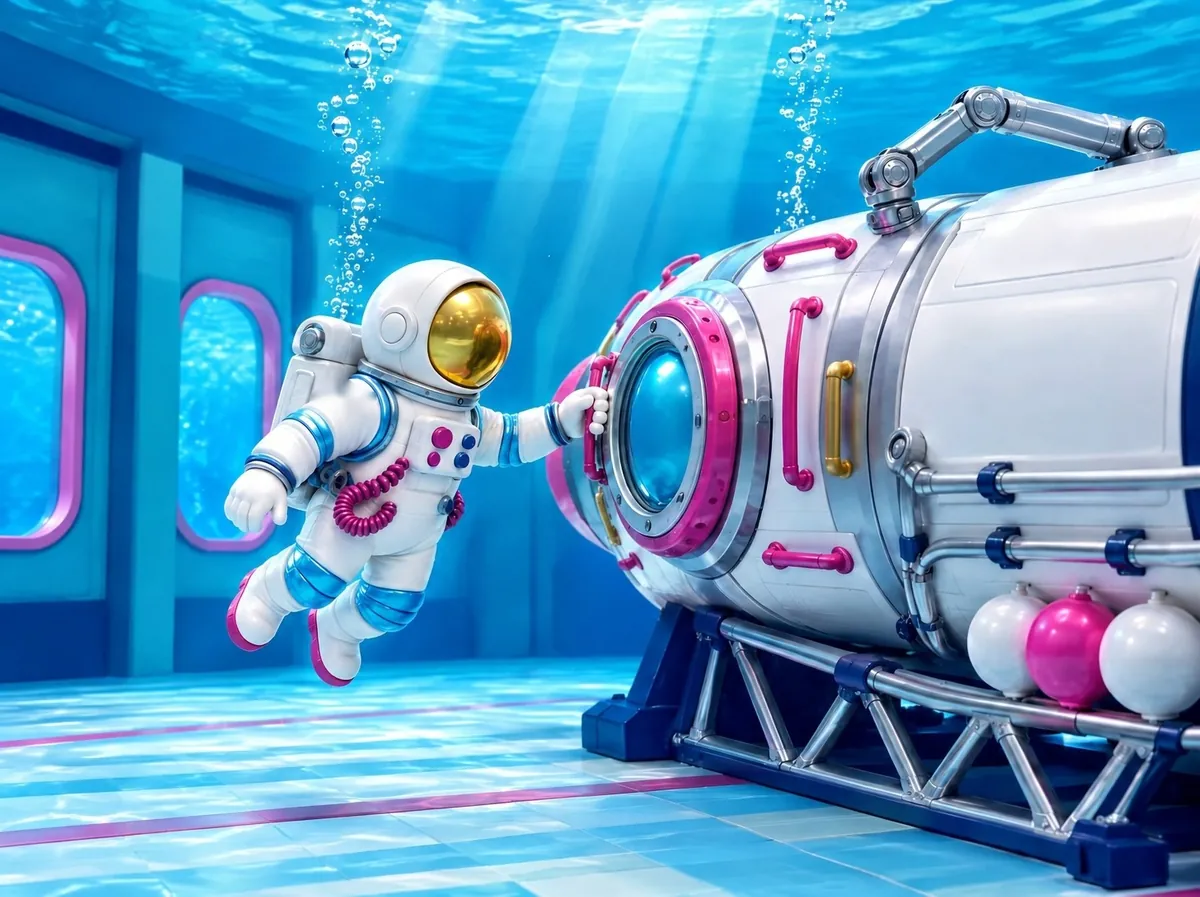
Astronauts practice their spacewalks underwater, in one of the world’s largest indoor pools, NASA’s Neutral Buoyancy Laboratory in Houston, Texas. It holds more than 6 million gallons (23 million liters) of water, and it is 40 feet (12 meters) deep. For every hour of a real spacewalk, astronauts train about seven hours in the pool.
Why water? Weights and floats are added to the spacesuit until the astronaut doesn’t sink and doesn’t rise. The astronaut just hangs in the water, and that feels a lot like floating in space. On the bottom of the pool are full-size copies of space station parts, called mock-ups.
The spacesuit itself is really a small spacecraft, built for one person. A backpack holds the oxygen. Cool water runs through thin tubes in a kind of long underwear, so the astronaut doesn’t get too hot. And the helmet’s see-through face shield, called a visor, has a very thin layer of gold that works like sunglasses.
TODAY’S MINI MISSION · WONDER
Astronauts practice until their hands know the job. What can your hands do without thinking? Zip a coat, brush your teeth, tie a shoe? Ask everyone at dinner, too.
How do astronauts celebrate Christmas in space?
Astronauts celebrate Christmas in space a lot like we do at home: they hang decorations, share a holiday meal with their crewmates, and talk with their families on Earth. A crew has spent every Christmas on the space station since November 2000. Long before that, in 1973, the Skylab crew built their own Christmas tree, and on Christmas Eve 1968, the Apollo 8 crew sent a Christmas message home while circling the Moon.
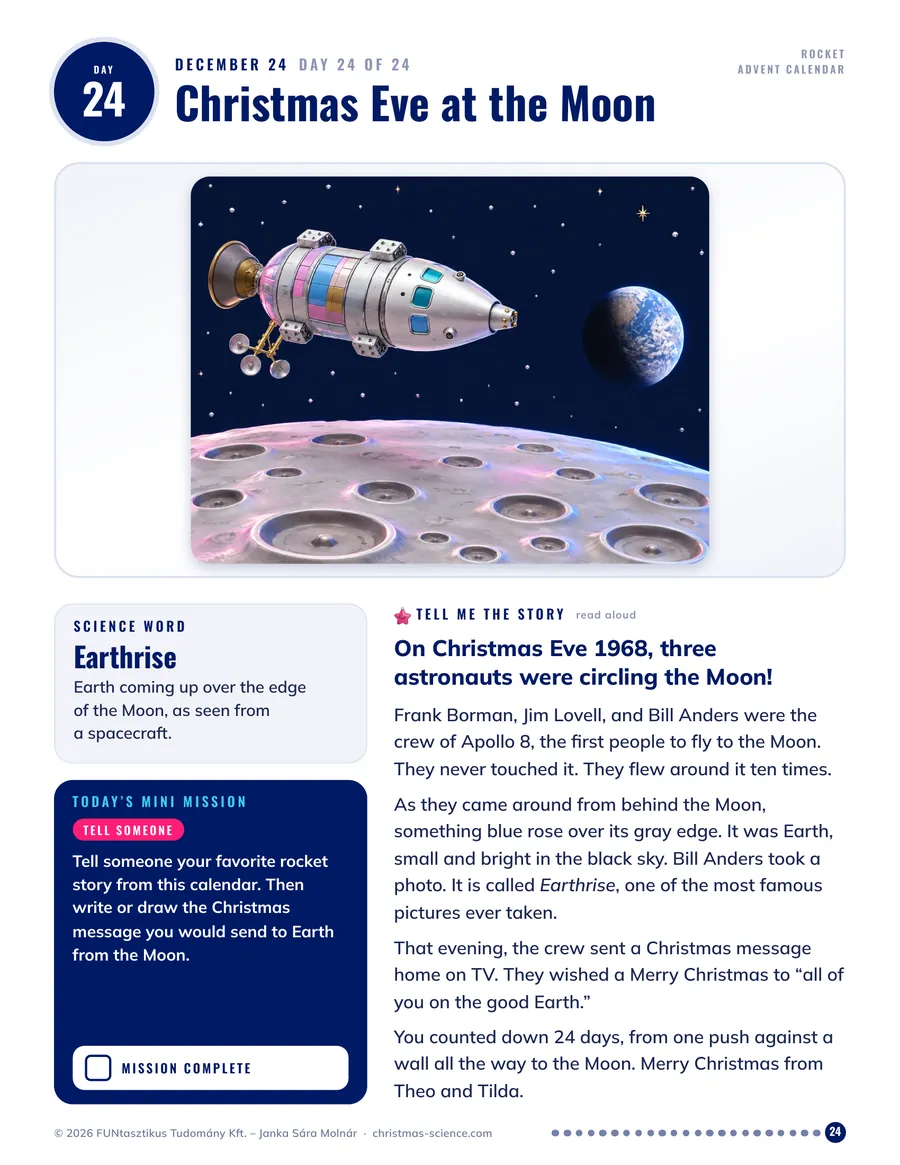
Frank Borman, Jim Lovell, and Bill Anders were the crew of Apollo 8, the first people to fly to the Moon. They never touched it. They flew around it ten times.
As they came around from behind the Moon, something blue rose over its gray edge. It was Earth, small and bright in the black sky. Bill Anders took a photo. It is called Earthrise, one of the most famous pictures ever taken. That evening, the crew sent a Christmas message home on TV. They wished a Merry Christmas to “all of you on the good Earth.”
TODAY’S MINI MISSION · TELL SOMEONE
Tell someone your favorite space story. Then write or draw the Christmas message you would send to Earth from the Moon.
Is there a printable advent calendar about rockets and astronauts?
Yes. The eight stories above come from Theo & Tilda’s Rocket Advent Calendar, a printable advent calendar with 24 true rocket and space stories for kids ages 4 to 9, one for each day from December 1 to 24.
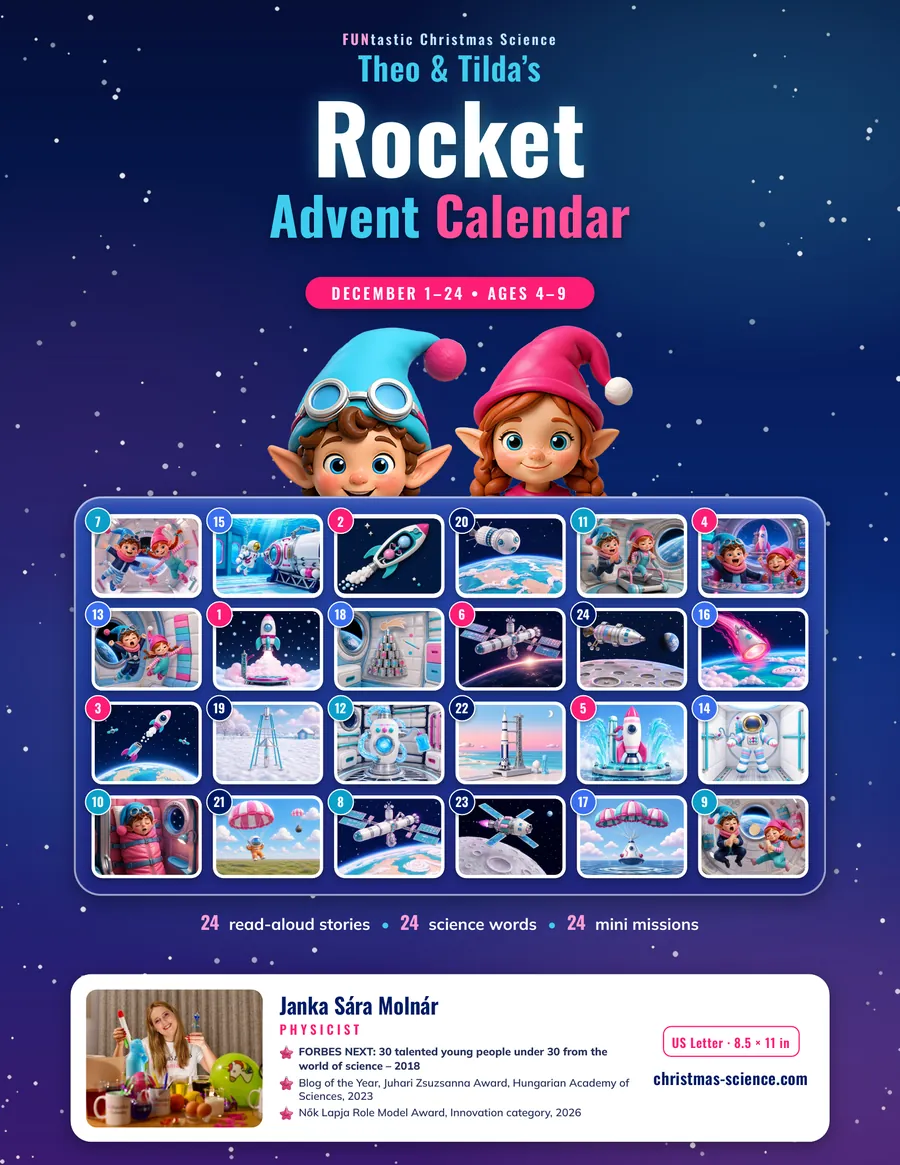
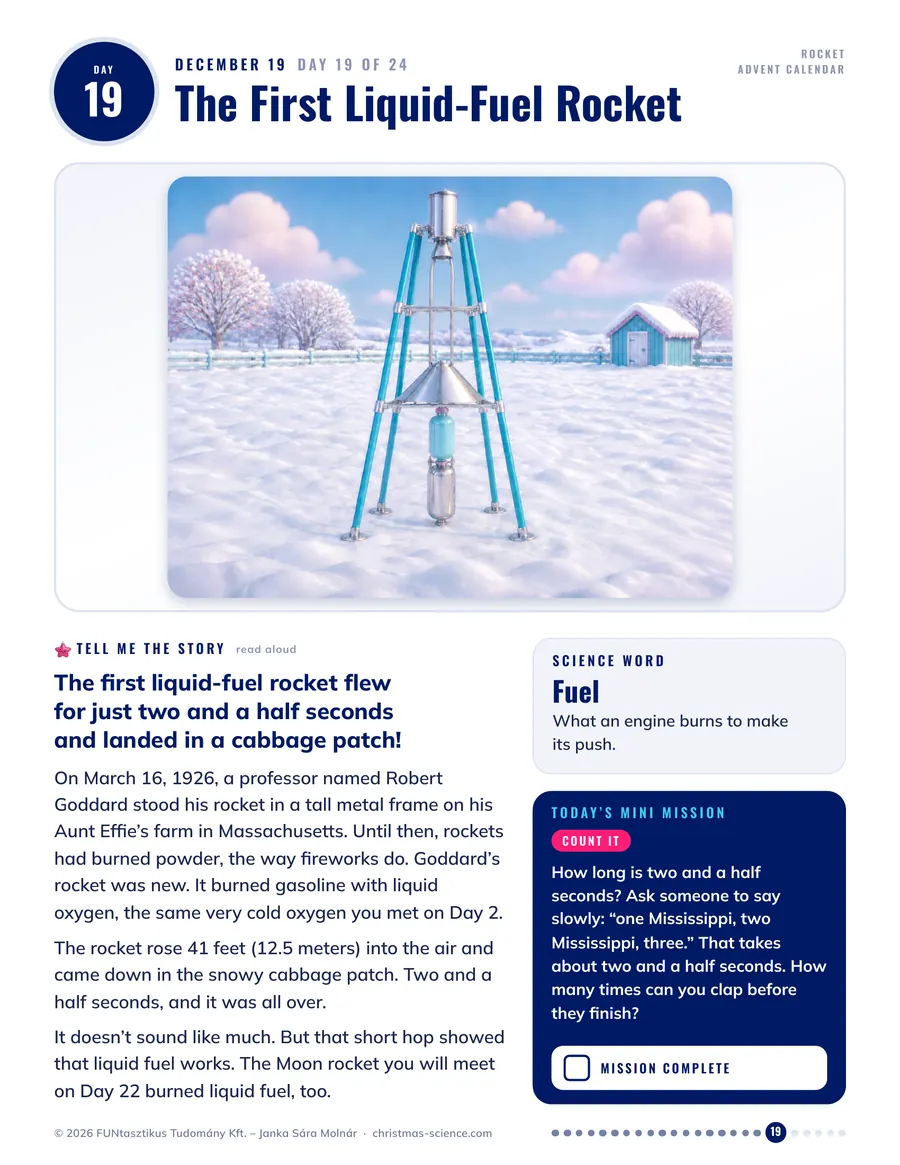
- 24 day pages, each with its own illustration, a one-minute true story to read aloud, a Science word, and a mini mission, like a quiz, a game for two, a drawing, a movement game, or a question for dinner
- Life on the space station: floating, food, sleep, water, exercise, and spacewalks
- How rockets fly, launch day, the trip home with 11 parachutes, and the first people in space
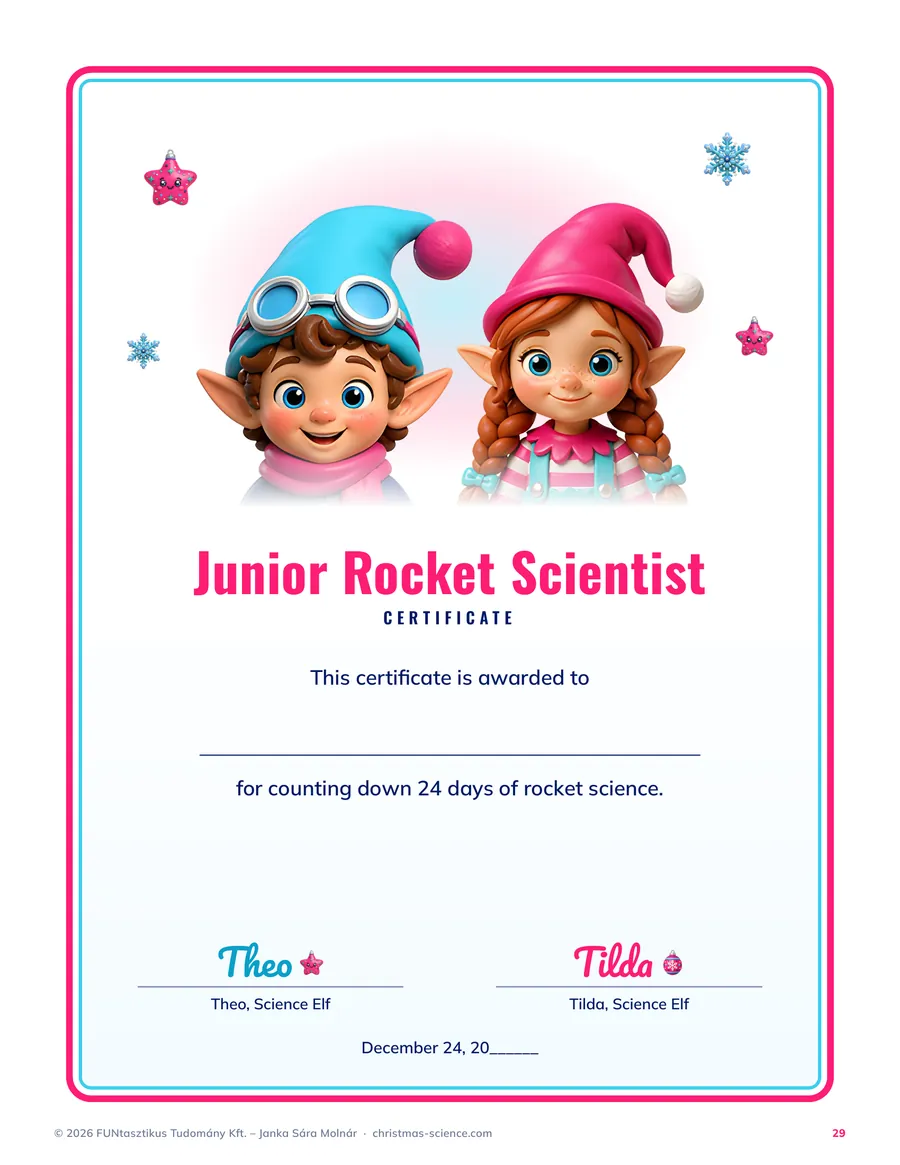
- A Rocket Countdown page to color, with all 24 Science words, and a Junior Rocket Scientist certificate for December 24
- No prep and no supplies to buy. No printer? Read it on a tablet, a laptop, or a phone.

Kids ask big questions about space, and each one is a real science question. “Where do astronauts sleep?” leads straight to gravity, and “What do they drink?” leads to the water that travels around our whole planet. For this calendar, I checked every fact against NASA and other trusted science sources, so when your child asks, “Is that really true?” you can say yes.
Read one page a day together, do the mini mission, and let the questions come. You don’t need to know every answer. It’s fine to say, “I don’t know. Let’s find out.” Scientists say it all the time.
Curious how the rocket gets the astronauts up there in the first place? Read “How Do Rockets Work?” And here are all my printable advent calendars for kids, from true dinosaur stories to animal superpowers.
A tree made of food cans
The Skylab crew saved their empty food cans and built a Christmas tree out of them. They decorated it with colored stickers. On top, where you might put a star, they placed a comet cut out of cardboard.
Why a comet? That winter, a real comet named Kohoutek was passing by, and the crew was studying it from space. On Christmas Day, two of the astronauts even went outside on a spacewalk that lasted seven hours.
Far from home, with no store and no forest, they still made a Christmas tree from what they had.
Ask at dinner tonight: What could we make together from things we already have at home?
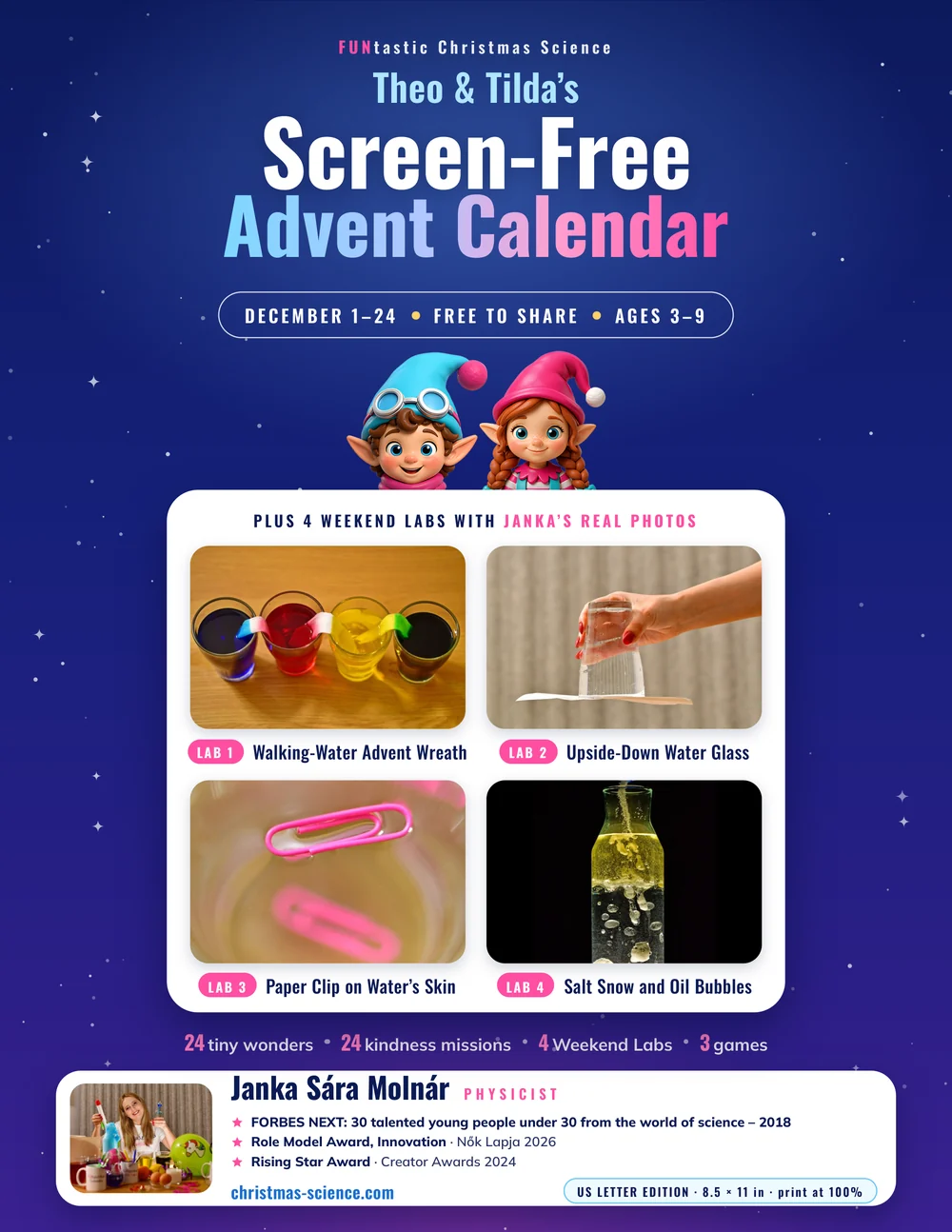
Theo & Tilda’s Screen-Free Advent Calendar
24 tiny wonders and 24 kindness missions, one for every day from December 1 to 24, plus 4 Weekend Labs with my real photos and 3 games. Most tiny wonders take about 10 minutes and use things you probably already have. 22 pages, for ages 3–9.
This calendar is free to share. Print it as often as you like for your family or class, and pass it on to friends, families, and teachers. Please don’t sell it or change it.

Know a family whose kids love space?
Send them tonight’s story. The eight true space stories above are free to read aloud, and each one takes about a minute.
COPY THIS MESSAGE
Paste it into a family group chat, or send it to a friend.
I found eight true space stories to read to the kids: why astronauts float, why they eat tortillas instead of bread, how they sleep on the wall, and the Christmas tree they built from food cans in 1973. A physicist checked every fact. www.christmas-science.com/blog/how-do-astronauts-live-in-space
Quick answers about life in space
How do astronauts live in space?
Most astronauts in space today live on the International Space Station, a science lab that flies around Earth about every 90 minutes. Everything floats there, so they eat tortillas instead of bread, sleep in sleeping bags fastened to the wall, recycle almost all of their water, and exercise for about two hours a day.
Why do astronauts float in space?
Because they are falling. The space station, the astronauts, and everything inside fall together around Earth, moving sideways so fast that they never hit the ground. This is called free fall. Earth’s gravity up there is almost as strong as on the ground.
What do astronauts eat in space?
Many of the foods we eat, packed so they don’t make a mess. They use tortillas instead of bread, because crumbs float away and can get stuck in the machines. Salt and pepper come as liquids, in little dropper bottles.
How do astronauts sleep in space?
In sleeping bags fastened to the wall of a sleep station, a tiny bedroom about the size of a small closet. If the bag weren’t fastened, a sleeping astronaut would drift around and bump into things.
How do astronauts celebrate Christmas in space?
A lot like we do at home: they hang decorations, share a holiday meal with their crewmates, and talk with their families on Earth. In 1973, the Skylab crew even built a Christmas tree out of empty food cans.
What age is the Rocket Advent Calendar for?
Ages 4 to 9. Little ones can enjoy it with a grown-up reading aloud. Each of the 24 day pages has a one-minute true story, a Science word, and a mini mission. The calendar comes as two PDF files, US Letter and A4. No printer? You can read it on a tablet, a laptop, or a phone.

About Janka
Janka Sára Molnár is a physicist and award-winning science communicator from Hungary, and the founder of FUNtastic Christmas Science. As a high school student, she built particle detectors and took them to CERN several times, where she presented them in its teacher program. She graduated from Eötvös Loránd University (ELTE) in Budapest, and for almost 15 years she has run several hundred science shows for children and families.
- FORBES NEXT: 30 talented young people under 30 from the world of science – 2018
- Nők Lapja Role Model Award, Innovation category, 2026
- Women of Excellence Award, 2026
- Creator Awards, Rising Star, 2024
- Blog of the Year, Juhari Zsuzsanna Award, Hungarian Academy of Sciences, 2023
- Winner of the HBO Max reality show A Híd
The rocket and space illustrations and the pictures of Theo, Tilda, and their world were created with AI-assisted tools (Canva) and edited by our team. Physicist Janka Sára Molnár checked every fact in this post against NASA and other trusted science sources. The photos of Janka and of her Water’s Skin experiment are real photos.
Keep reading
More Christmas science ideas from Theo, Tilda, and me.
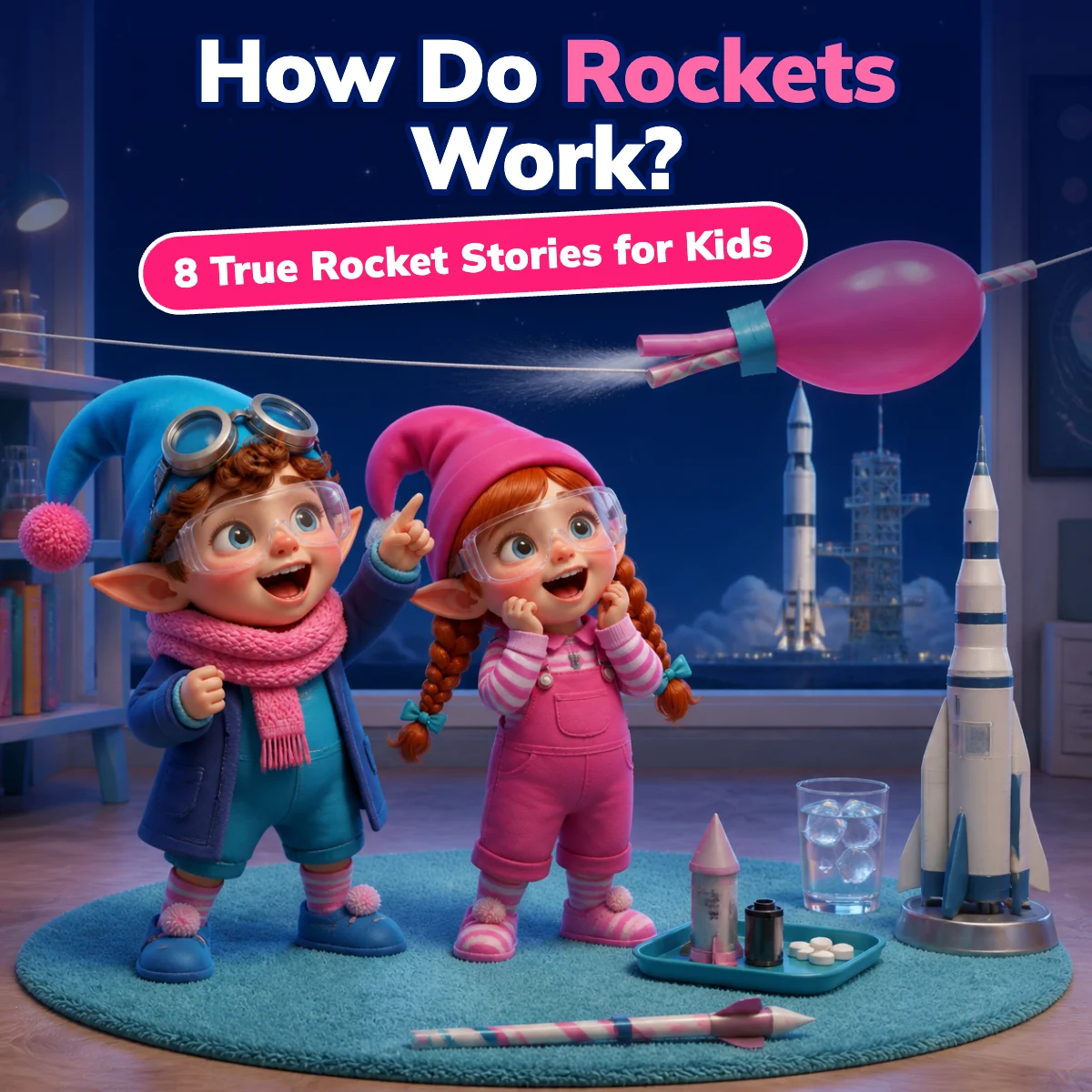 For parents · 14 min readHow Do Rockets Work? 8 True Rocket Stories for KidsHow do rockets work for kids? A physicist explains thrust, liquid oxygen, and rocket stages in 8 true stories to read aloud.Read the post →
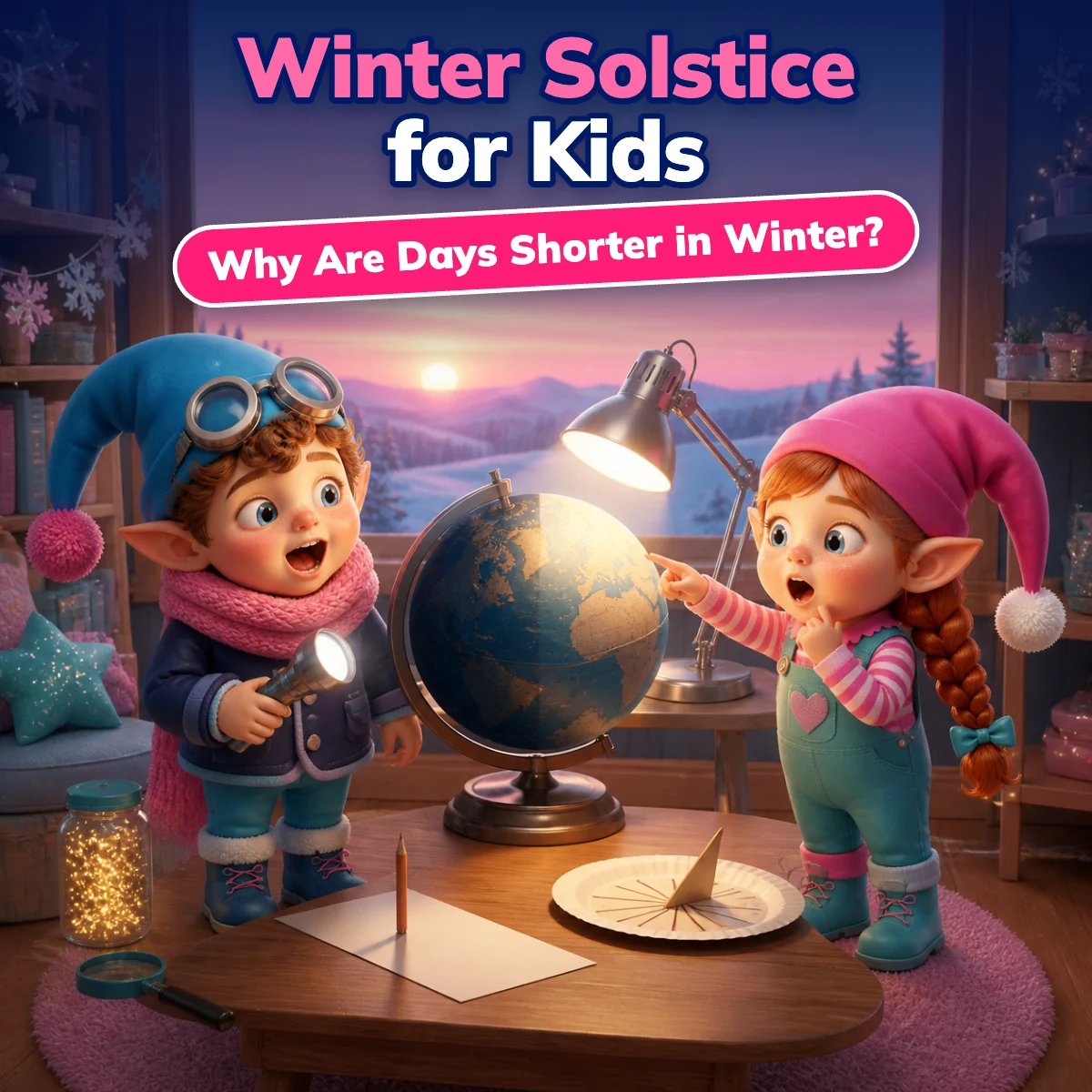 For parents · 11 min readWinter Solstice for Kids: Why Are Days Shorter in Winter?Winter solstice for kids, explained by a physicist: why winter days are short, why Earth is closest to the Sun in January, and 5 true sky stories.Read the post →
 For parents · 11 min readAre Birds Dinosaurs? Yes! How to Explain It to KidsAre birds dinosaurs? Yes. A true story to tell your kids today, with a bird-watching mission, a feather mystery, and the “dinosaurs” that aren’t dinosaurs.Read the post →
© 2026 FUNtasztikus Tudomány Kft. – Janka Sára Molnár