Fun Facts About Ocean Animals for Kids: 8 True Sea Stories to Read Aloud Tonight
An octopus has three hearts. A seahorse dad carries the babies. Some of the white sand on tropical beaches was made by a fish. Here are fun facts about ocean animals for kids: eight true stories from my Ocean Animals Advent Calendar, each short enough to read aloud before bed.
- 8 true sea stories
- Ages 4–9
- About a minute each
- Nothing to buy
Save this for a cozy ocean night, or send it to a friend whose child always runs straight to the touch tank at the aquarium.
A Star with Tube Feet
Let’s start at the beach. One kind of sea star walks on about 15,000 tiny feet! It is the sunflower sea star, the fastest sea star scientists know.
Tube feet are small, soft tubes on the underside of each arm. Many of them work together and pull a sea star over the rocks.
And a sea star is not a fish at all. It has no scales and no fins. That is why scientists like to say “sea star” instead of “starfish.” If a sea star loses an arm, it can grow it back. That takes a long time, often a year or more.
Stop here and try it together: Put both hands flat on the table and wiggle all ten fingers like tube feet. Then let’s wade into the water and meet eight ocean animals, plus one more back on the beach at the end. Our trip ends at the bottom of this page.
Know a little one who checks every tide pool and fills their pockets with shells? Send this to their grown-up. They will love finding out why a sea star is not a fish. Share it
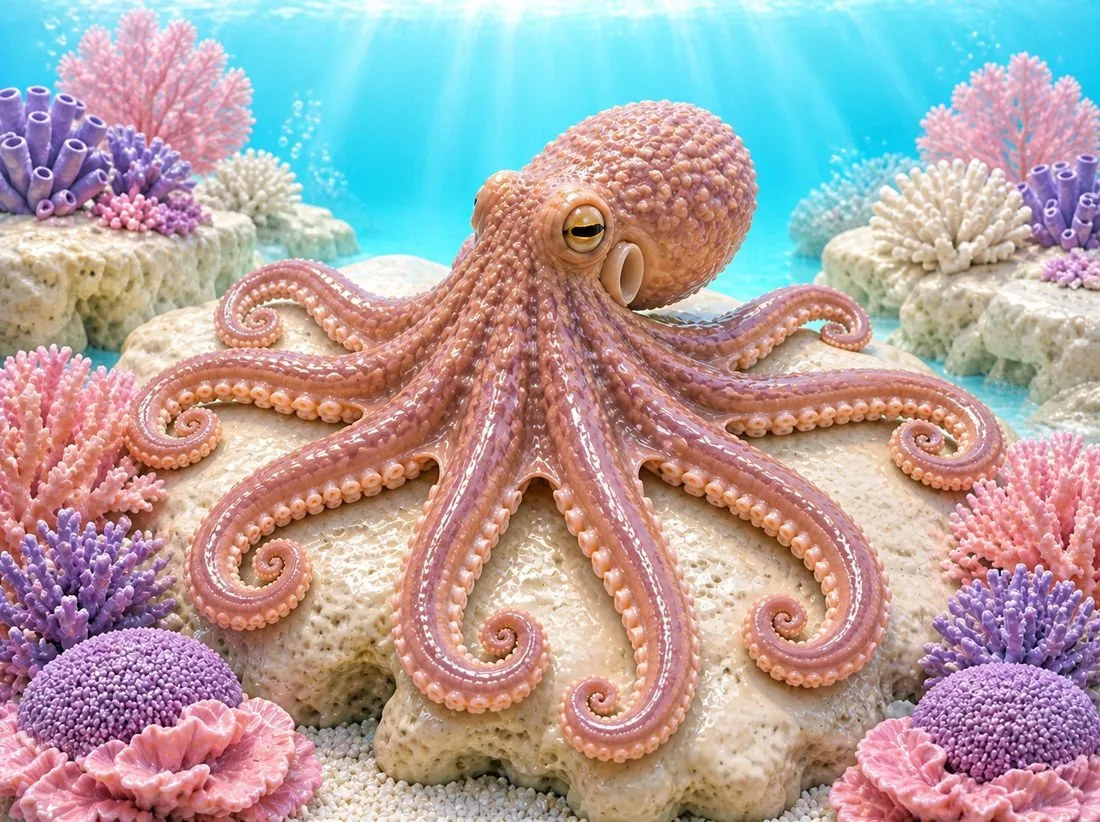
Why does an octopus have three hearts?
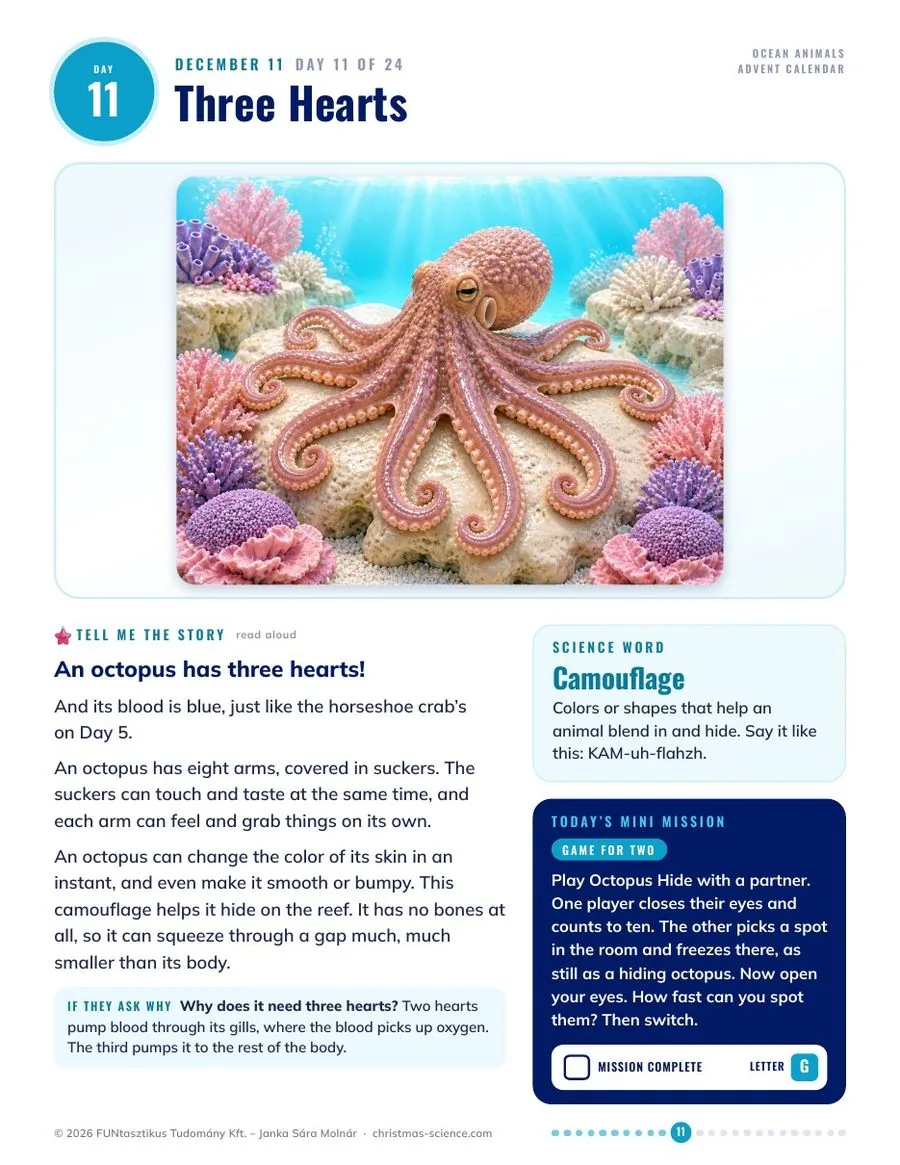
Two of an octopus’s hearts pump blood through its gills, where the blood picks up oxygen. The third pumps it to the rest of the body. And its blood is blue!
An octopus has eight arms, covered in suckers. The suckers can touch and taste at the same time, and each arm can feel and grab things on its own.
It can change the color of its skin in an instant, and even make it smooth or bumpy. This camouflage helps it hide on the reef. It has no bones at all, so it can squeeze through a gap much, much smaller than its body.
TODAY’S MINI MISSION · GAME FOR TWO
Play Octopus Hide with a partner. One player closes their eyes and counts to ten. The other picks a spot in the room and freezes there, as still as a hiding octopus. Now open your eyes. How fast can you spot them? Then switch.
IF THEY ASK WHY
Why is its blood blue? Our blood uses iron to carry oxygen, and that makes it red. An octopus’s blood uses copper, and that makes it blue when it carries oxygen.
Which animal has the thickest fur?
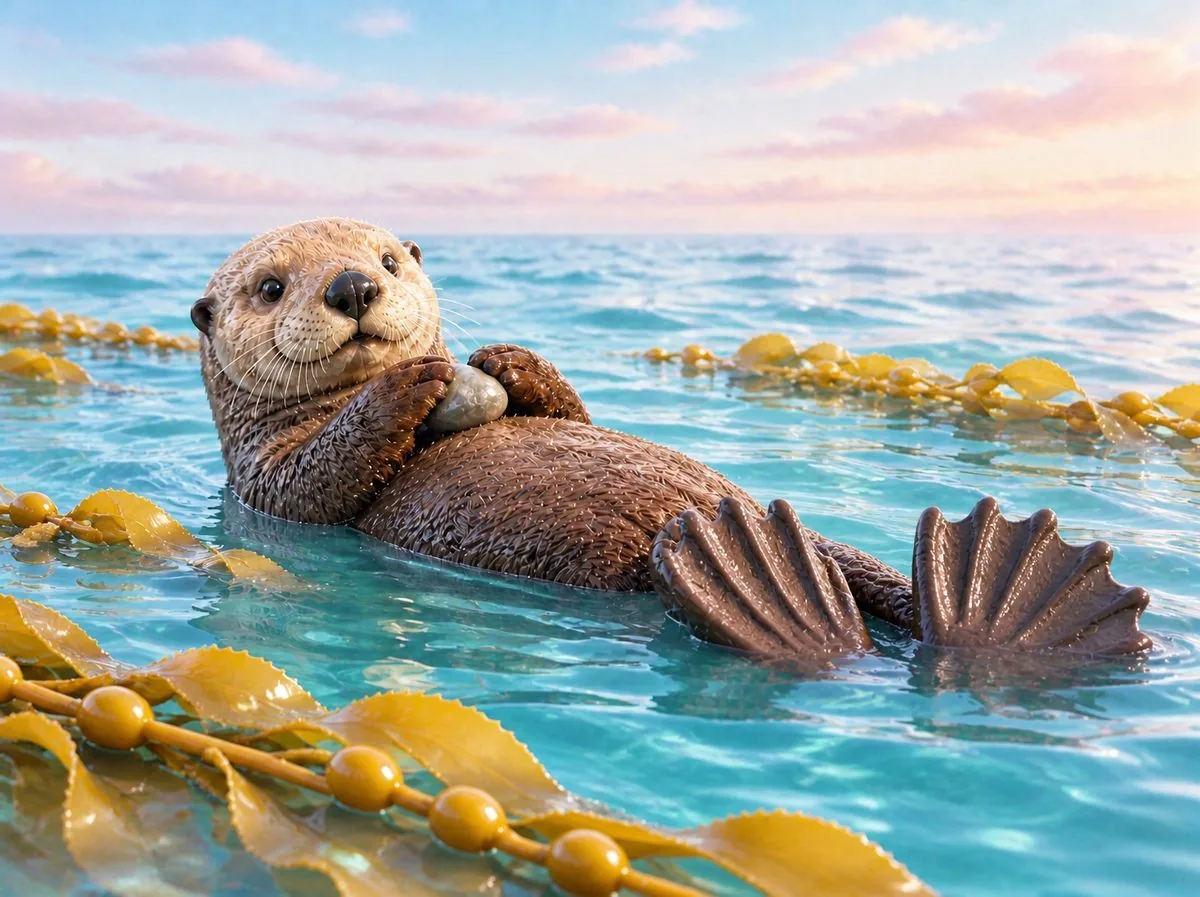
The sea otter. Where its fur is thickest, more than a million hairs grow on a square just one inch (2.5 centimeters) on each side. You probably have about 100,000 to 150,000 hairs on your whole head.
Whales and seals stay warm with a thick layer of fat called blubber. A sea otter has no blubber. Its fur traps a layer of air, and the air keeps the cold water away from its skin.
That is why a sea otter spends hours every day grooming. It combs and fluffs its fur to keep it clean and full of air.
TODAY’S MINI MISSION · DRAW IT
Ask a grown-up to draw a square, one inch (2.5 centimeters) on each side. Now draw as many tiny hairs inside as you can in one minute. How many did you fit?
IF THEY ASK WHY
Doesn’t the fur get wet? The long outer hairs get wet. But the soft fur underneath traps tiny bubbles of air, so the otter’s skin stays dry.
Do seahorse dads have the babies?
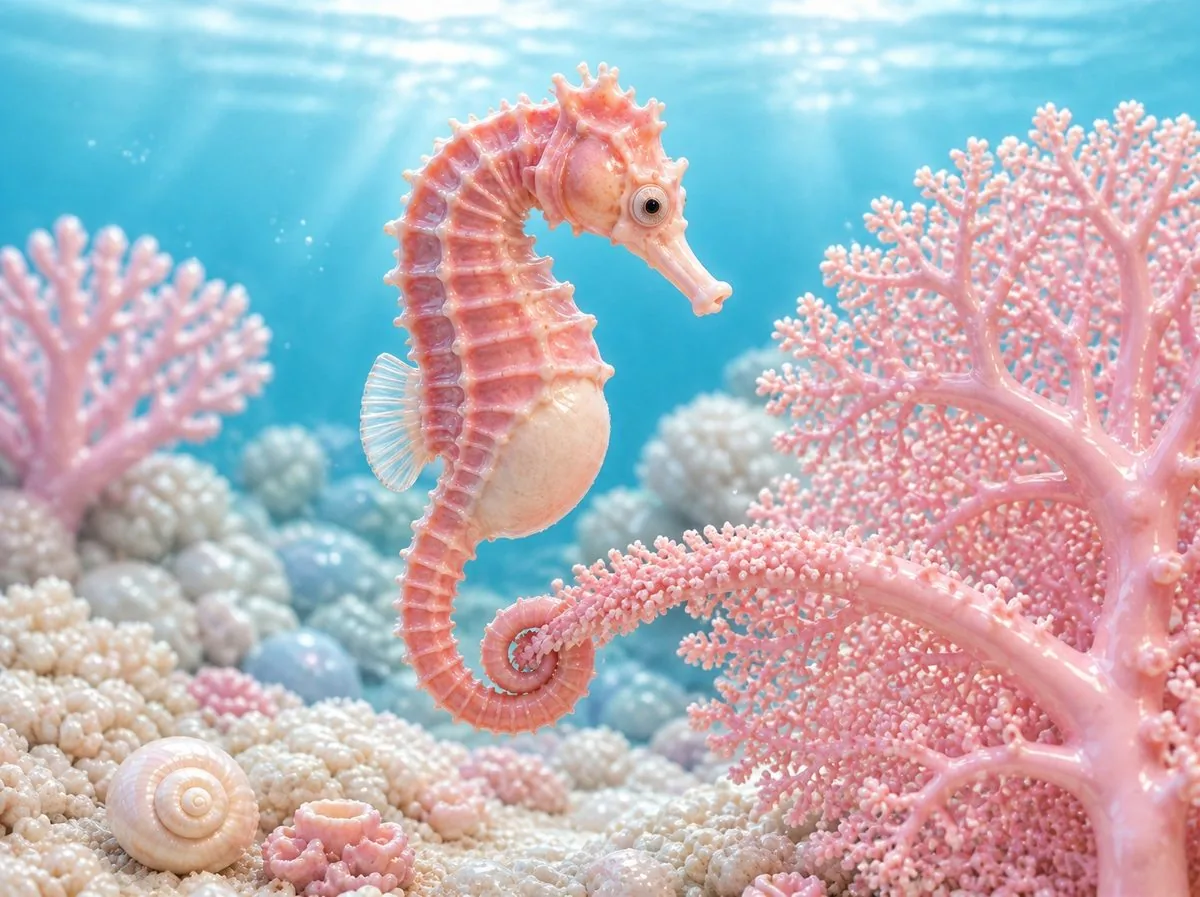
Yes. The mom puts her eggs into a pouch on the dad’s tummy, and the dad carries them until the babies are born. Some kinds of seahorse have more than 1,000 tiny babies at once.
A seahorse is a real fish, even though it swims standing up. It is a slow swimmer, so it holds on to seagrass or coral with its curly tail and waits for tiny animals to drift by. Then it slurps them up through its long snout, like a straw.
TODAY’S MINI MISSION · QUIZ
True or false? A seahorse is a fish.
Answer: True. It has gills and fins, like other fish.
IF THEY ASK WHY
How does a seahorse swim? It flutters a small fin on its back very fast and steers with two little fins near its head.
Know a dad who does the bedtime stories? Send him the seahorse one. He will love reading about a dad who carries the babies. Share it
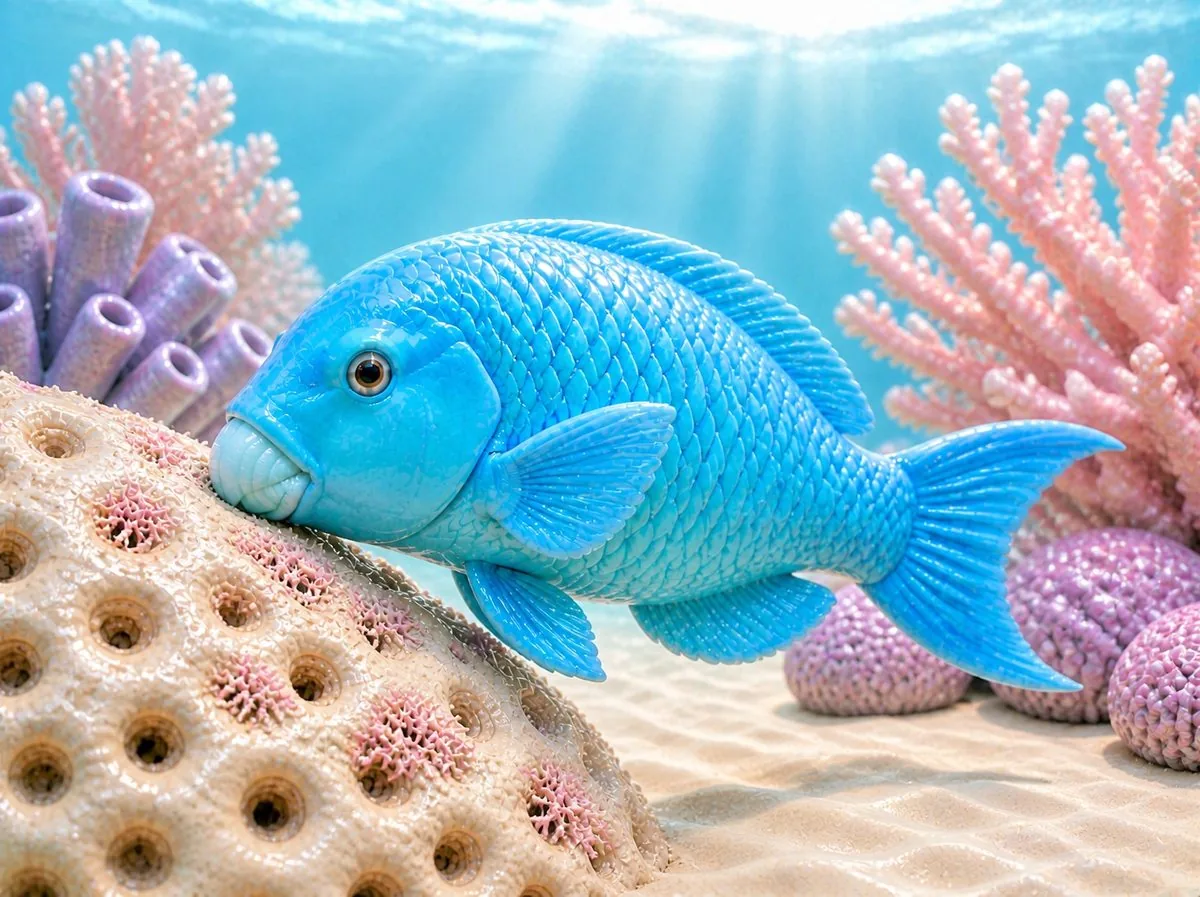
How do parrotfish make sand?
A parrotfish scrapes food off coral and rock and swallows crunchy bits of coral too. Teeth in its throat grind the coral into tiny pieces, and what comes out the other end is sand. In one year, a large parrotfish can make 1,000 pounds (450 kilograms) of sand.
That is about as heavy as 20 kids put together. So some of the white sand on tropical beaches was made by parrotfish!
A parrotfish has about 1,000 teeth, packed together into a hard beak, a bit like a parrot’s. And some parrotfish even sleep in a bubble. At night, they wrap themselves in a see-through blanket of slime.
TODAY’S MINI MISSION · COUNT IT
Count your teeth with the tip of your tongue, or look in a mirror with a grown-up. Most kids have about 20. A parrotfish has about 1,000. How many more is that than yours?
IF THEY ASK WHY
How can its teeth crunch coral without breaking? Parrotfish teeth are made of one of the hardest materials any living thing makes. New teeth also keep growing in to replace the worn ones.
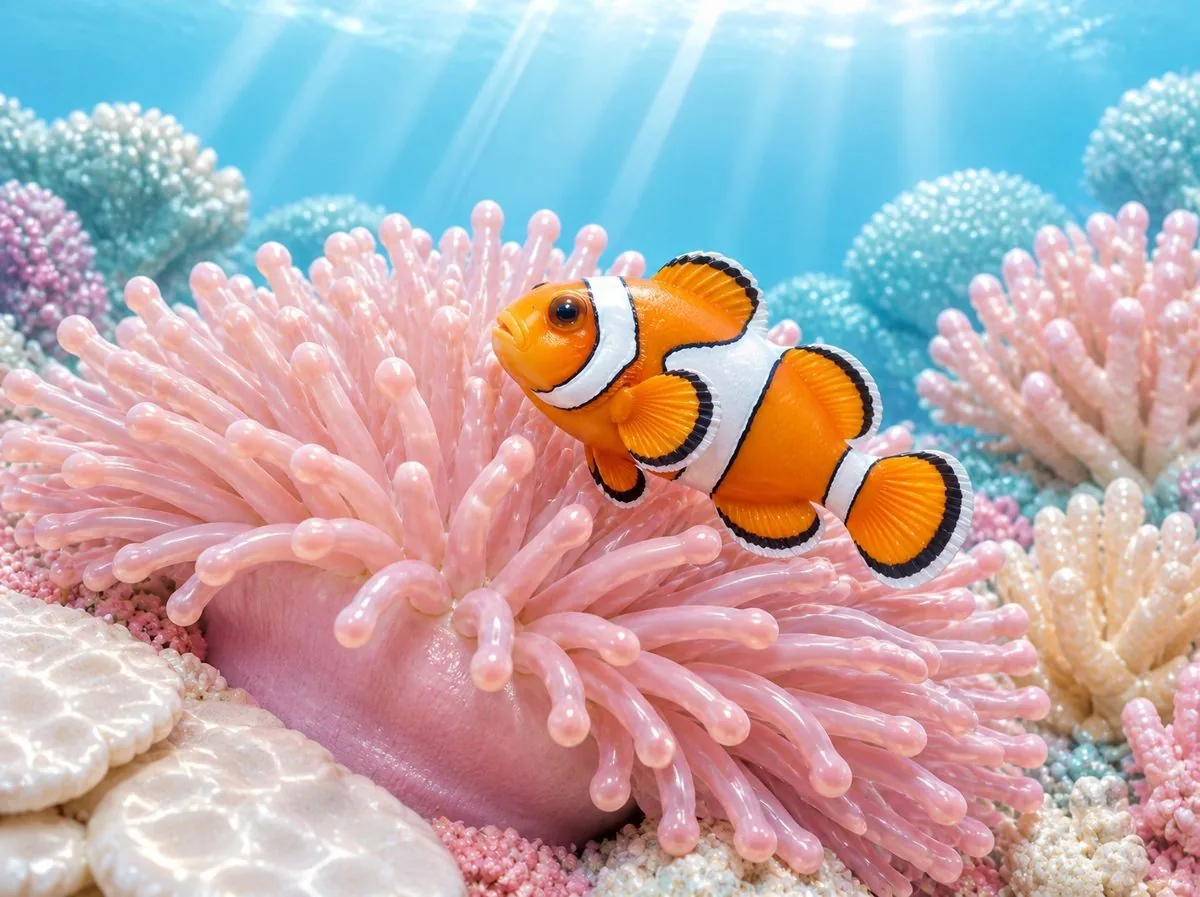
Why don’t clownfish get stung?
Scientists think a special slimy coat on a clownfish’s skin protects it from the stinging tentacles of its sea anemone home.
A sea anemone is a soft animal that looks like a flower. Its tentacles sting most small fish, but the clownfish swims right in. Among the tentacles, it is safe from bigger fish that want to eat it. In return, it chases away some fish that like to nibble on anemones.
Every clownfish grows up as a male first. In each group, the biggest fish is the female. If she is gone, the biggest male can become the new female.
TODAY’S MINI MISSION · QUIZ
Why is a stinging anemone a safe home for a clownfish? A) Bigger fish stay away from the stings B) The water there is warmer C) The anemone hides it inside a hard shell
Answer: A. Bigger fish stay away from the stings.
IF THEY ASK WHY
How does a young clownfish move into a new anemone? It touches the tentacles carefully, a little at a time.
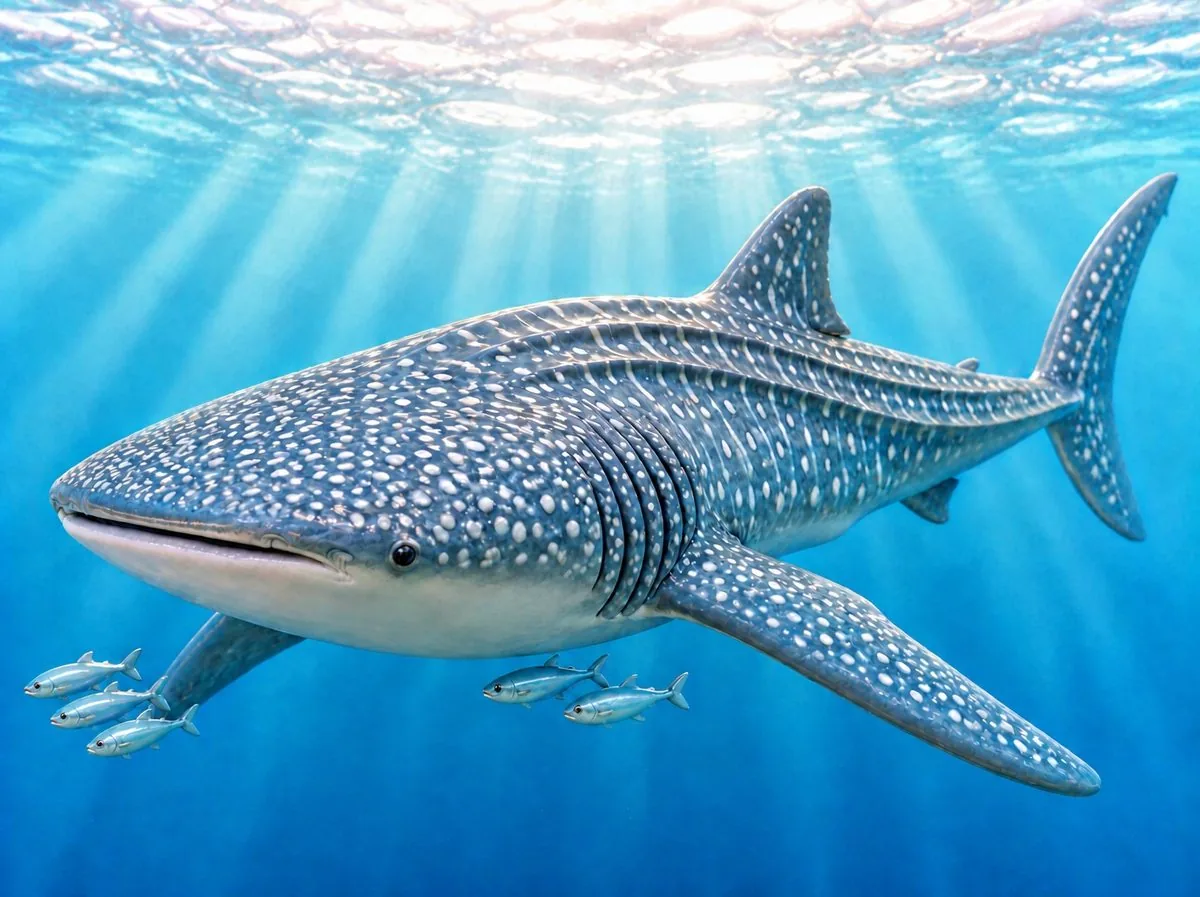
What is the biggest fish in the ocean?
The whale shark. It can grow nearly 50 feet (15 meters) long, longer than a school bus. But it eats mostly plankton, tiny living things that drift in the water. It also eats small fish.
It often swims with its huge mouth open. Water flows into its mouth and out through its gills, and the food gets caught inside, like pasta in a strainer.
Like other sharks, it has no bones. Its skeleton is made of cartilage, the same bendy stuff as the tip of your nose. And every whale shark has its own pattern of spots, like a fingerprint.
TODAY’S MINI MISSION · QUIZ
What is a whale shark’s skeleton made of? A) Bone B) Cartilage C) Shell
Answer: B. Cartilage, like the tip of your nose. Wiggle yours gently!
IF THEY ASK WHY
Is a whale shark a whale? No. It is a shark, and sharks are fish. It is called a whale shark because it is as big as some whales.
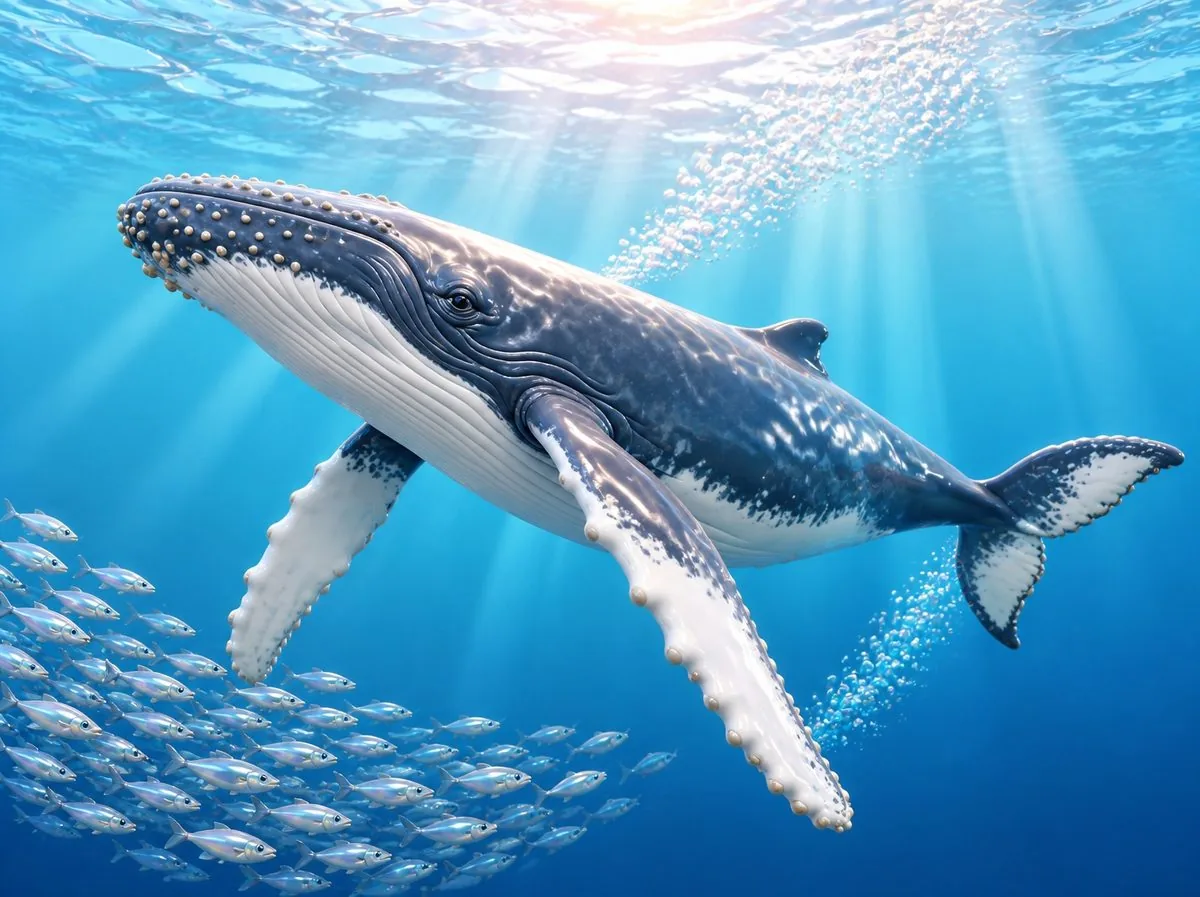
Why do humpback whales sing?
Scientists think the songs have something to do with finding a mate, but they are still studying what the songs mean. The males sing, and one song can last up to 20 minutes.
A song is made of moans, groans, and squeaks, sung in a set order and repeated. It can be heard miles away underwater. The males in one area sing nearly the same song, and the song slowly changes over the years.
Every year, some humpbacks swim 5,000 miles (8,000 kilometers), from warm seas where they have their babies to cold seas where they feed, and then back again. This long trip is called a migration. Their white flippers can be up to 15 feet (4.6 meters) long, about the length of a car.
TODAY’S MINI MISSION · TRY IT
Hum one tune for a whole minute while a grown-up watches the clock. Take a breath whenever you need one. A humpback song can go on for 20 minutes, and the whale comes up to breathe too.
Have a friend who sings their kids to sleep every night? Send them the humpback story. It turns any lullaby into a whale song. Share it
Do jellyfish have brains?
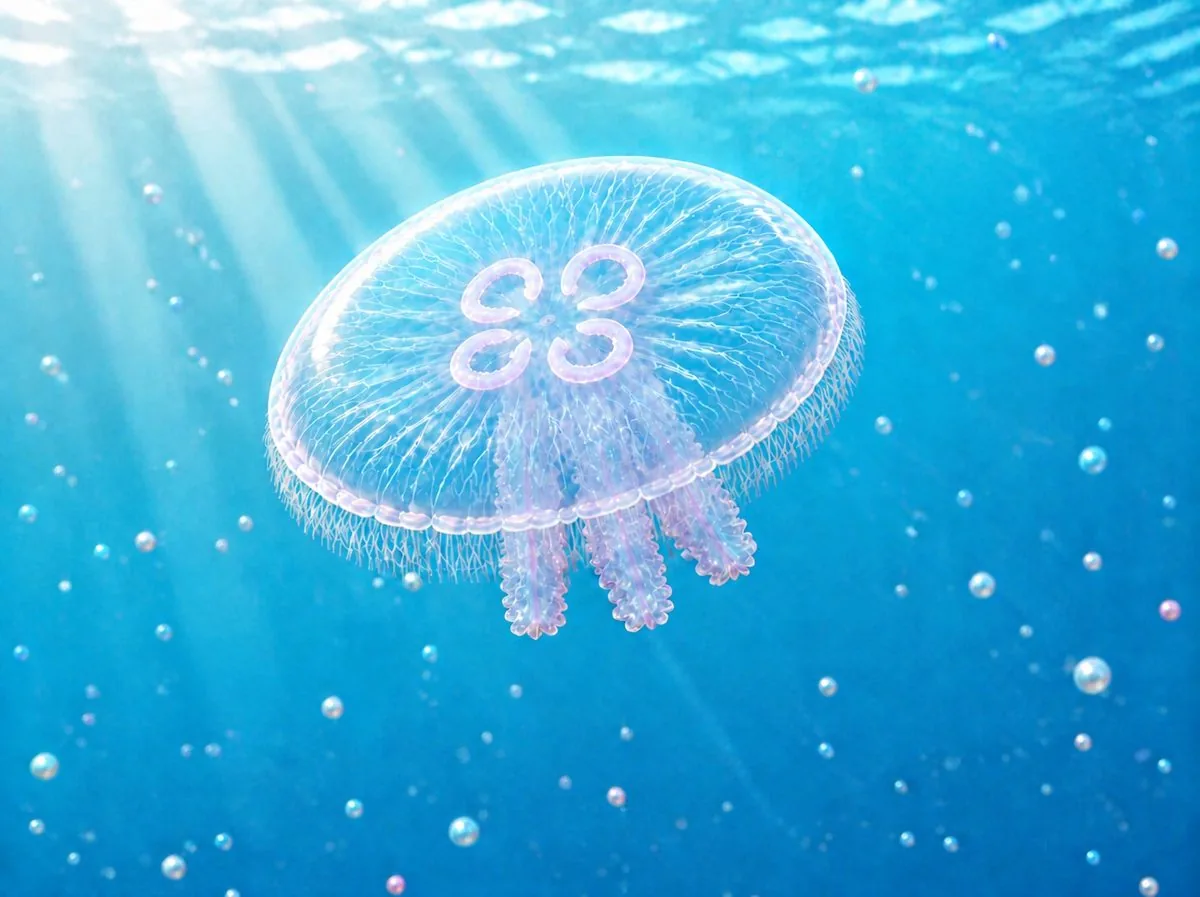
No. A jellyfish has no brain, no heart, and no bones, and it is about 95 percent water. Instead of a brain, it has a net of nerves spread through its body. Jellyfish have been in the ocean for at least 500 million years, long before the dinosaurs.
The nerves sense light and touch, and they tell the bell, the round top part, when to squeeze. Squeeze, open, squeeze, open. Each squeeze pushes water out and moves the jellyfish along.
Jellyfish mostly drift with the currents, the rivers of moving water in the ocean. Their tentacles have stinging cells that catch tiny animals for food. So look, but never touch a jellyfish.
TODAY’S MINI MISSION · DRAW IT
Draw a jellyfish: a round bell on top and wavy tentacles below. The one in the picture has four rings in its bell. Can you draw them too?
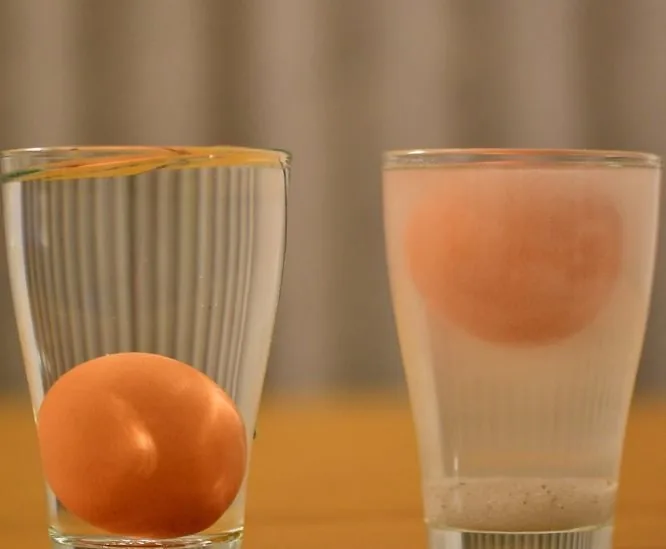
One real experiment: why the sea helps you float
Ocean water is salty, about 3.5 percent salt. Salt makes water denser, and denser water pushes up harder on everything in it. That is why you float a little more easily in the sea than in a lake or a pool.
You can see it in a glass with my Floating Egg, Experiment 11 in Theo and Tilda’s Christmas Science Adventure. Pour about 1 cup (250 mL) of lukewarm tap water into each of two identical clear glasses, and stir 3 tablespoons of salt into one until it dissolves. Use a spoon to gently lower a raw egg into each glass. In plain water, the egg sinks to the bottom. In the salty water, it rises and floats on top.
My glass is much saltier than the sea. A cup of seawater holds only about 1½ teaspoons of salt. So the sea’s push is smaller, but you can still feel it when you swim.
GOOD TO KNOW
- Don’t drink the very salty water.
- If the egg stays down, take it out, stir in 1 to 2 more tablespoons of salt, and try again.
- Use a fresh egg (an old egg can float even in plain water), table salt, and tall glasses that hold at least 12 ounces (350 mL).
- Wash your hands after touching raw eggs, and throw the eggs away afterward.
What’s inside the Ocean Animals Advent Calendar?
Theo & Tilda’s Ocean Animals Advent Calendar is a printable advent calendar with 24 true ocean animal stories for kids ages 4 to 9, one for each day from December 1 to 24. Day by day, it dives from the shore, past the coral reef and the open ocean, all the way down to the deep sea. The stories above are Days 1, 4, 7 to 13, and 15.
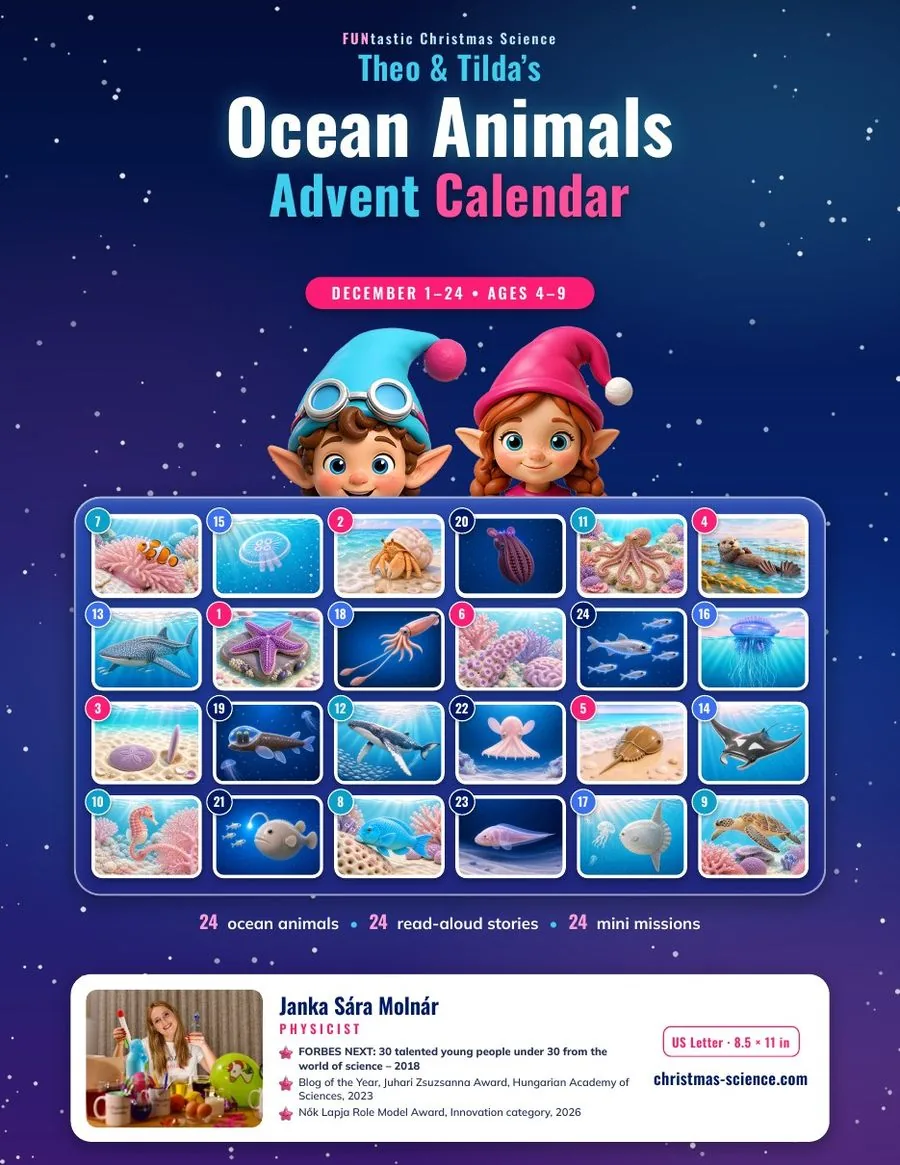
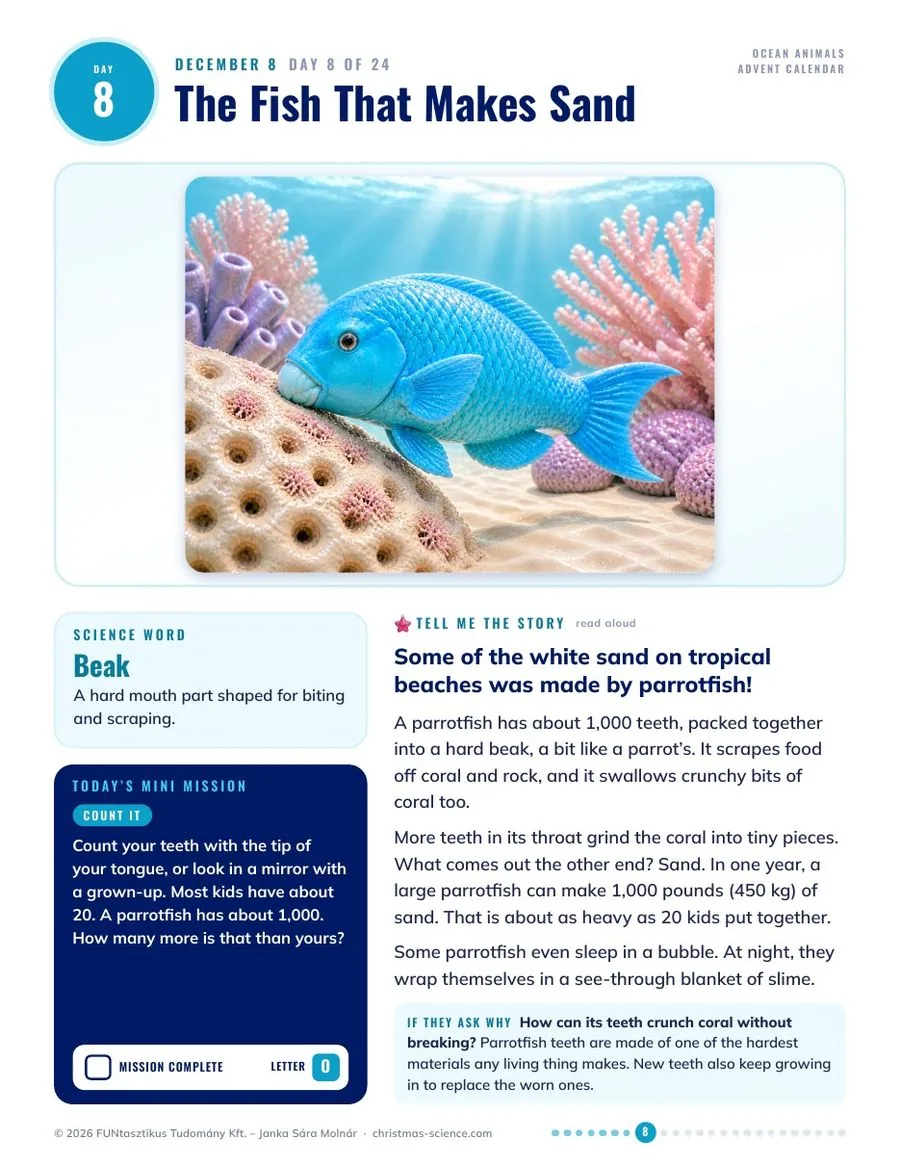
- 24 day pages, each with its own illustration, a one-minute true story, a Science word, a mini mission (a quiz, a game, a drawing, counting, or a question for dinner), and an “If they ask why” helper for the grown-up
- 24 real ocean animals in four zones: the shore, the coral reef, the open ocean, and the deep sea
- An Ocean Explorer Passport: color a star every day, and the 24 letters spell a secret sentence
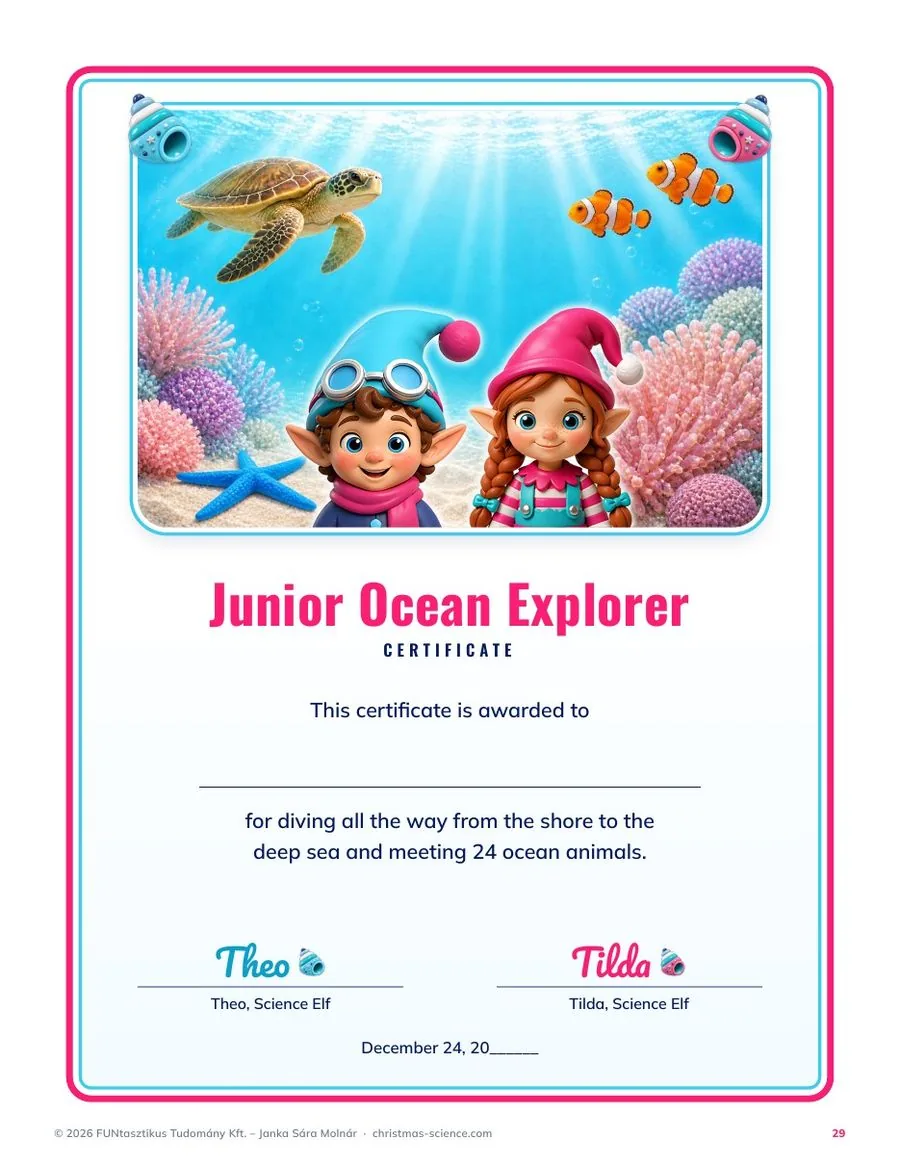
- A Junior Ocean Explorer certificate for Christmas Eve
- Most missions need nothing at all. No printer? Read it on a tablet, a laptop, or a phone.

Children ask the best ocean questions. Is a starfish a fish? Can a fish make sand? Why doesn’t the clownfish get stung? Each day page answers one big question in about a minute, with facts I checked against NOAA, the Smithsonian, and other trusted ocean science sources.
Read it at bedtime, at breakfast, or in the bath, where ocean stories feel right at home. Five minutes together is enough.
Looking for a different theme? Here are all my printable advent calendars for kids, from true dinosaur stories to rockets and planets. And for the dark bottom of the ocean, read seven true stories about deep sea creatures for kids.
Back to the beach
We started at the shore with a sea star, and we end at the shore too, with a sea turtle.
Sea turtles spend almost their whole lives at sea. But a mother comes up onto a beach to lay her eggs in a hole in the warm sand. The temperature of the sand decides if the babies are boys or girls. Warmer sand means more girls.
When the babies hatch, they dig their way out and scurry to the sea, most often at night. How do they find the water in the dark? They crawl toward the brightest direction, which is usually the open sky over the water.
Tonight’s mission: Tell someone at home which ocean animal surprised you most.
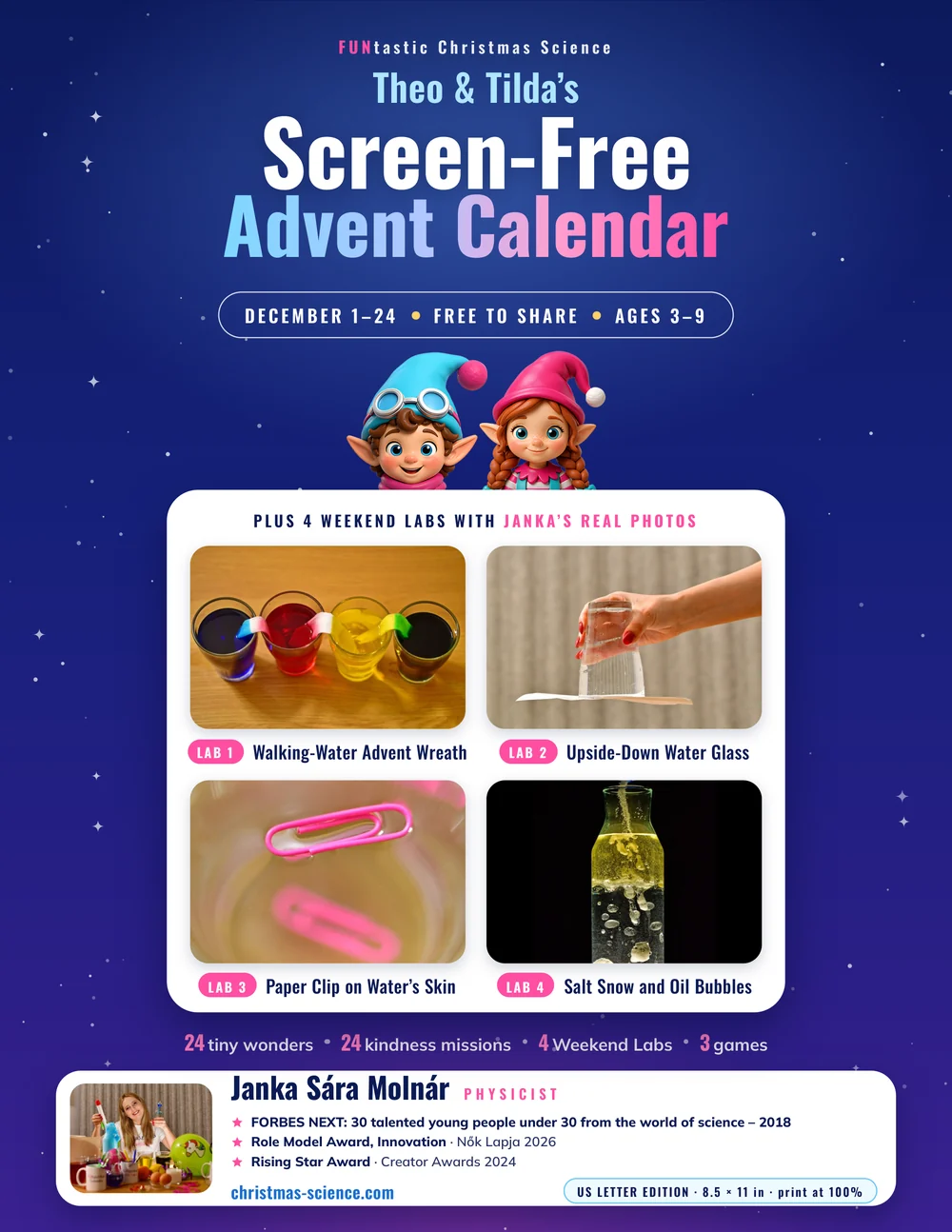
Theo & Tilda’s Screen-Free Advent Calendar
24 tiny wonders and 24 kindness missions, one for every day from December 1 to 24, plus 4 Weekend Labs with my real photos and 3 games. Most tiny wonders take about 10 minutes and use things you probably already have. 22 pages, for ages 3–9.
This calendar is free to share. Print it as often as you like for your family or class, and pass it on to friends, families, and teachers. Please don’t sell it or change it.
Know a family with a little sea animal fan?
Send them tonight’s trip from the beach to the open ocean. The stories above are free to read aloud, and each one takes about a minute.
COPY THIS MESSAGE
Paste it into a family group chat, or send it to a friend.
I found true ocean animal stories to read to the kids tonight: an octopus with three hearts, a seahorse dad who carries the babies, and a fish that makes sand. A physicist checked every fact. www.christmas-science.com/blog/fun-facts-about-ocean-animals-for-kids
Fun facts about ocean animals: quick answers
Is a starfish a fish?
No. A sea star is not a fish at all. It has no scales and no fins, and it is a cousin of sea urchins and sand dollars. That is why scientists like to say “sea star” instead of “starfish.”
Which ocean animal has three hearts?
The octopus. Two hearts pump blood through its gills, and the third pumps it to the rest of the body. Its blood uses copper to carry oxygen, so it looks blue. Its cousins, squid and cuttlefish, have three hearts too.
What is the biggest fish in the ocean?
The whale shark. It can grow nearly 50 feet (15 meters) long, longer than a school bus, yet it eats mostly plankton and small fish.
Why is it easier to float in the sea?
Seawater is about 3.5 percent salt, and salt makes water denser. Denser water pushes up harder, so you float a little more easily in the sea than in a pool.
What age is the Ocean Animals Advent Calendar for?
Ages 4 to 9. Little ones can enjoy it with a grown-up reading aloud. Each of the 24 day pages has a one-minute true story, a Science word, and a mini mission, and the calendar comes as two PDF files, US Letter and A4. No printer? You can read it on a tablet, a laptop, or a phone.
About Janka
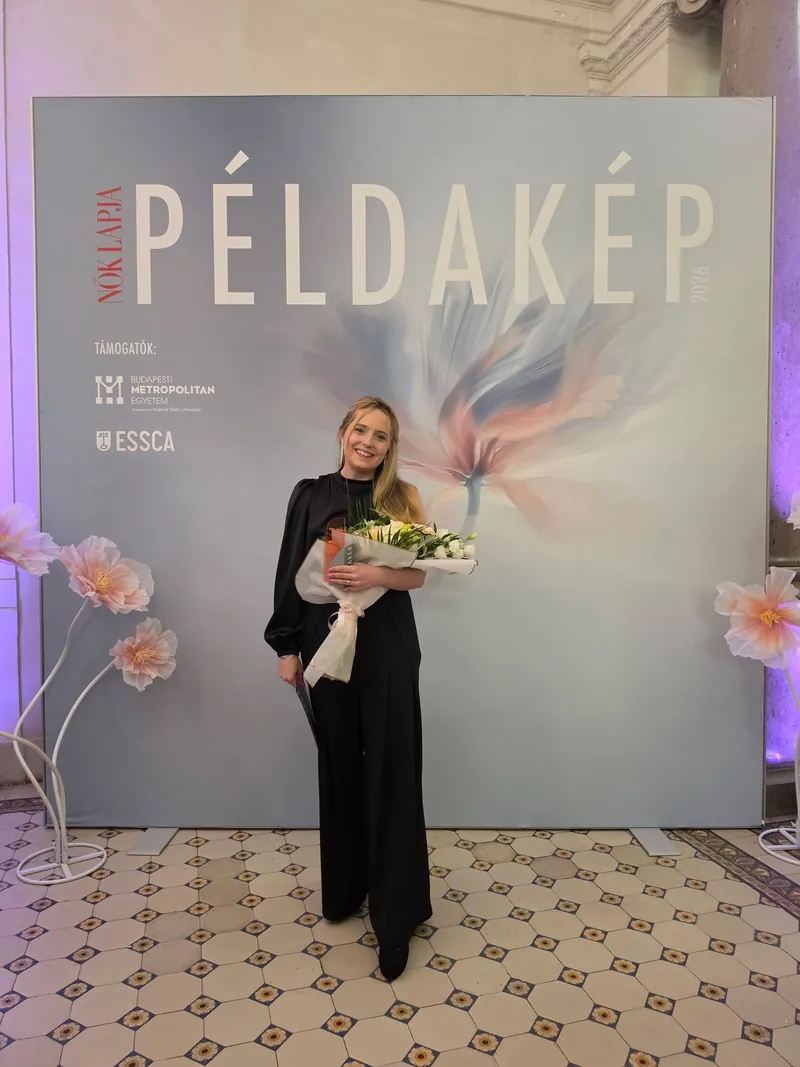
Janka Sára Molnár is a physicist and award-winning science communicator from Hungary, and the founder of FUNtastic Christmas Science. As a high school student, she built particle detectors and took them to CERN several times, where she presented them in its teacher program. She graduated from Eötvös Loránd University (ELTE) in Budapest, and for almost 15 years she has run several hundred science shows for children and families.
- FORBES NEXT: 30 talented young people under 30 from the world of science – 2018
- Rising Star Award, Creator Awards, 2024
- Role Model Award, Innovation, Nők Lapja, 2026
- Juhari Zsuzsanna Blog of the Year Award, Hungarian Academy of Sciences, 2023
- Winner of the HBO Max reality show A Híd (The Bridge)
The ocean illustrations and the pictures of Theo, Tilda, and their world were created with AI-assisted tools (Canva) and edited by our team. Physicist Janka Sára Molnár checked every fact in this post against NOAA, the Smithsonian, and other trusted science sources. The Floating Egg photo is a real photo of her own experiment.
Keep reading
More Christmas science ideas from Theo, Tilda, and me.
 For parents · 14 min readDeep Sea Creatures for Kids (Physicist-Checked)Deep sea creatures for kids: 7 true read-aloud stories, from a fish with a see-through head to the deepest fish ever filmed. Checked by a physicist.Read the post →
 For parents · 11 min readAre Birds Dinosaurs? Yes! How to Explain It to KidsAre birds dinosaurs? Yes. A true story to tell your kids today, with a bird-watching mission, a feather mystery, and the “dinosaurs” that aren’t dinosaurs.Read the post →
 For parents · 22 min read10 Kitchen Science Experiments for Kids, Physicist-Tested10 easy kitchen science experiments for kids 3–9: lava lamp, walking water, bouncy egg, melting ice race, and more. Exact amounts, real photos.Read the post →
© 2026 FUNtasztikus Tudomány Kft. – Janka Sára Molnár