FUNtastic Christmas Science · For teachers in Aotearoa New Zealand
Years 0–3Last weeks of Term 4NZ Curriculum links
Christmas Science Activities for NZ Classrooms: The Last Weeks of Term 4
Christmas experiments that need no snow, with a ready lesson pattern and free NZ Curriculum links, from a physicist who has run hundreds of science shows for children.
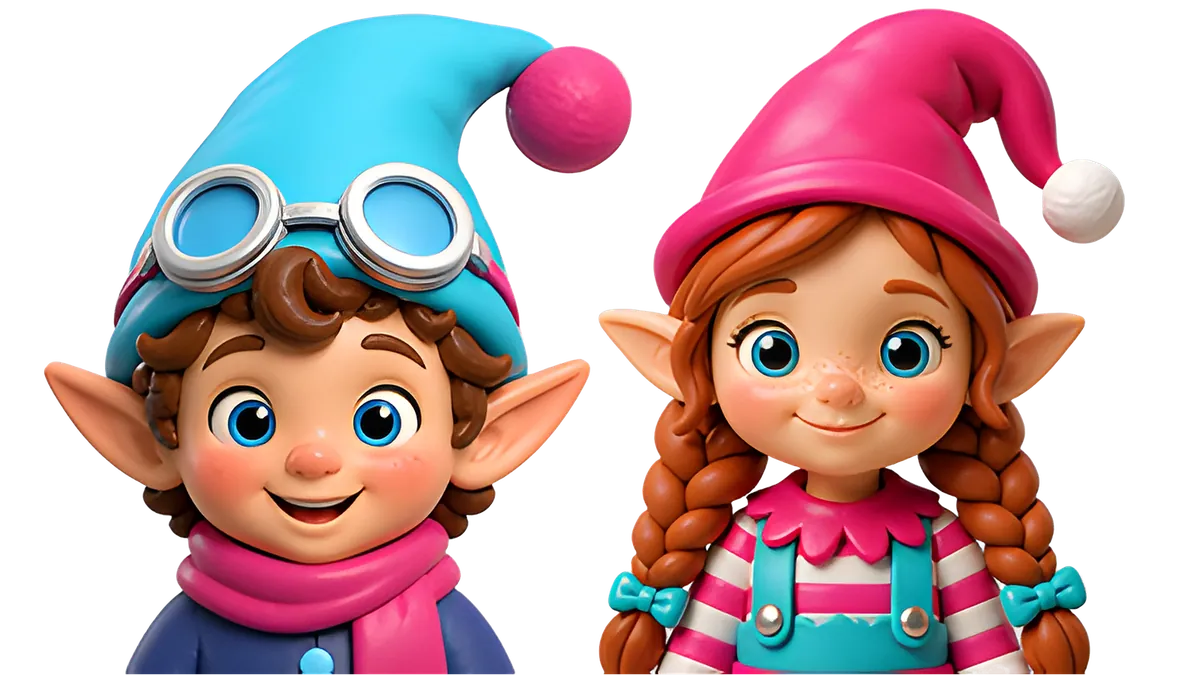
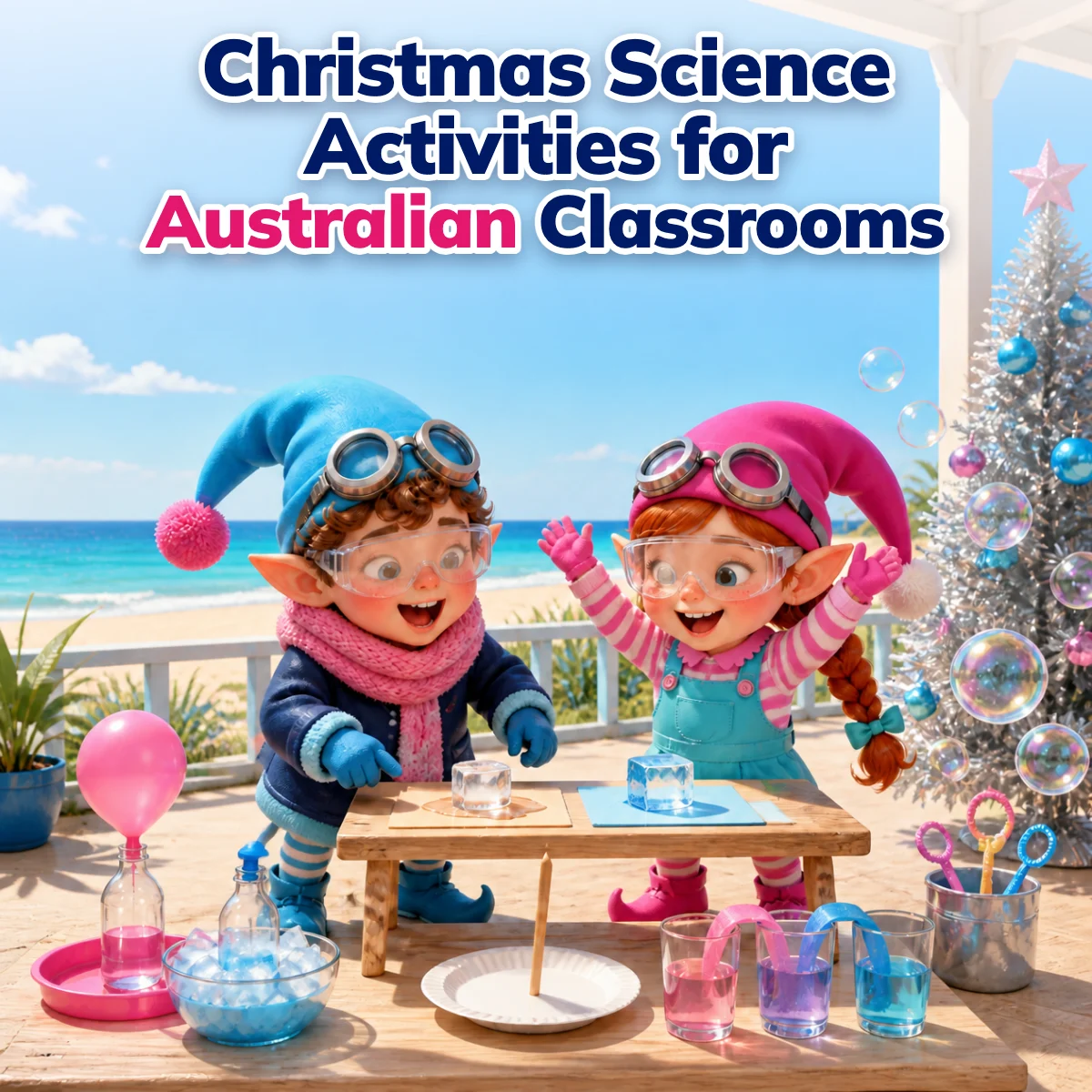
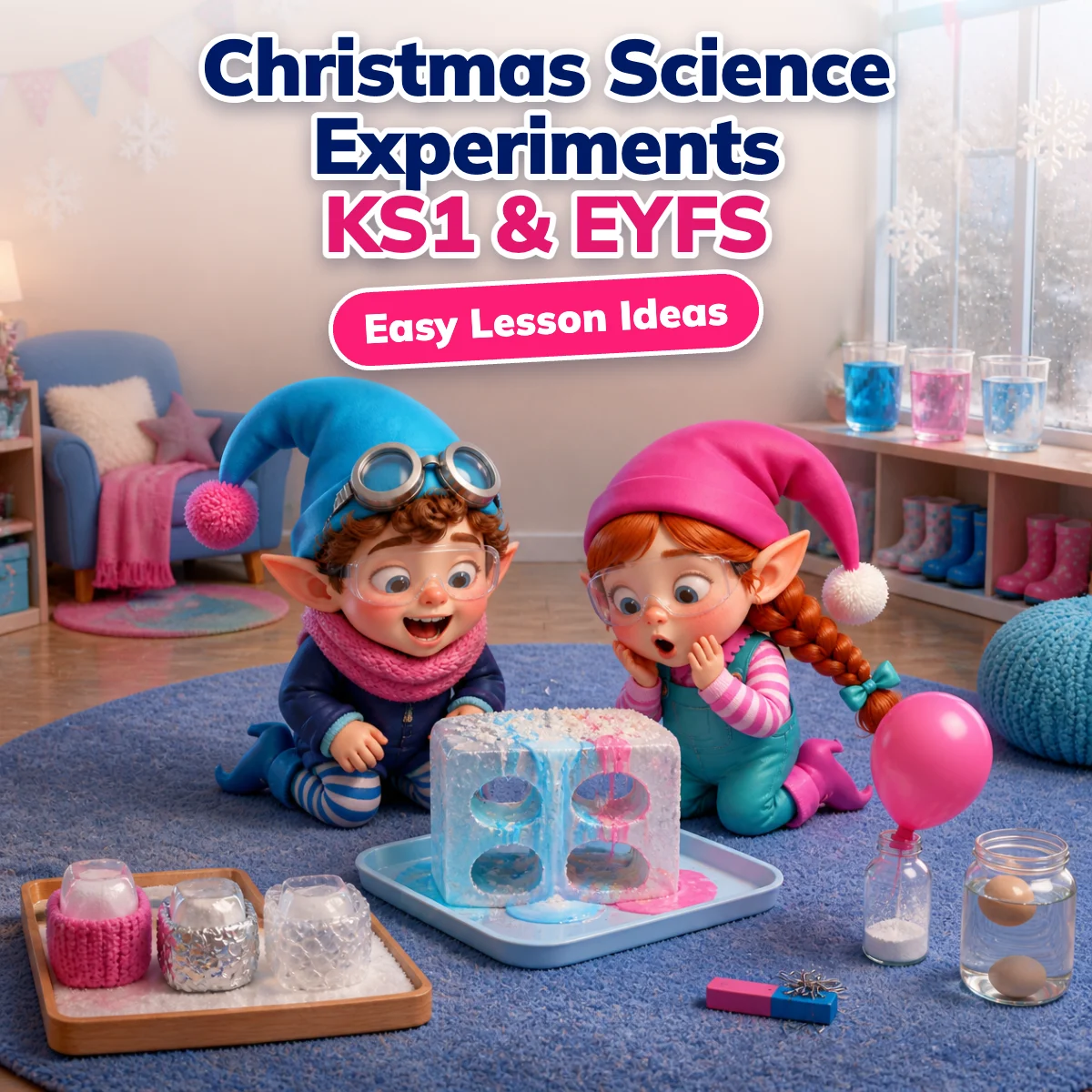
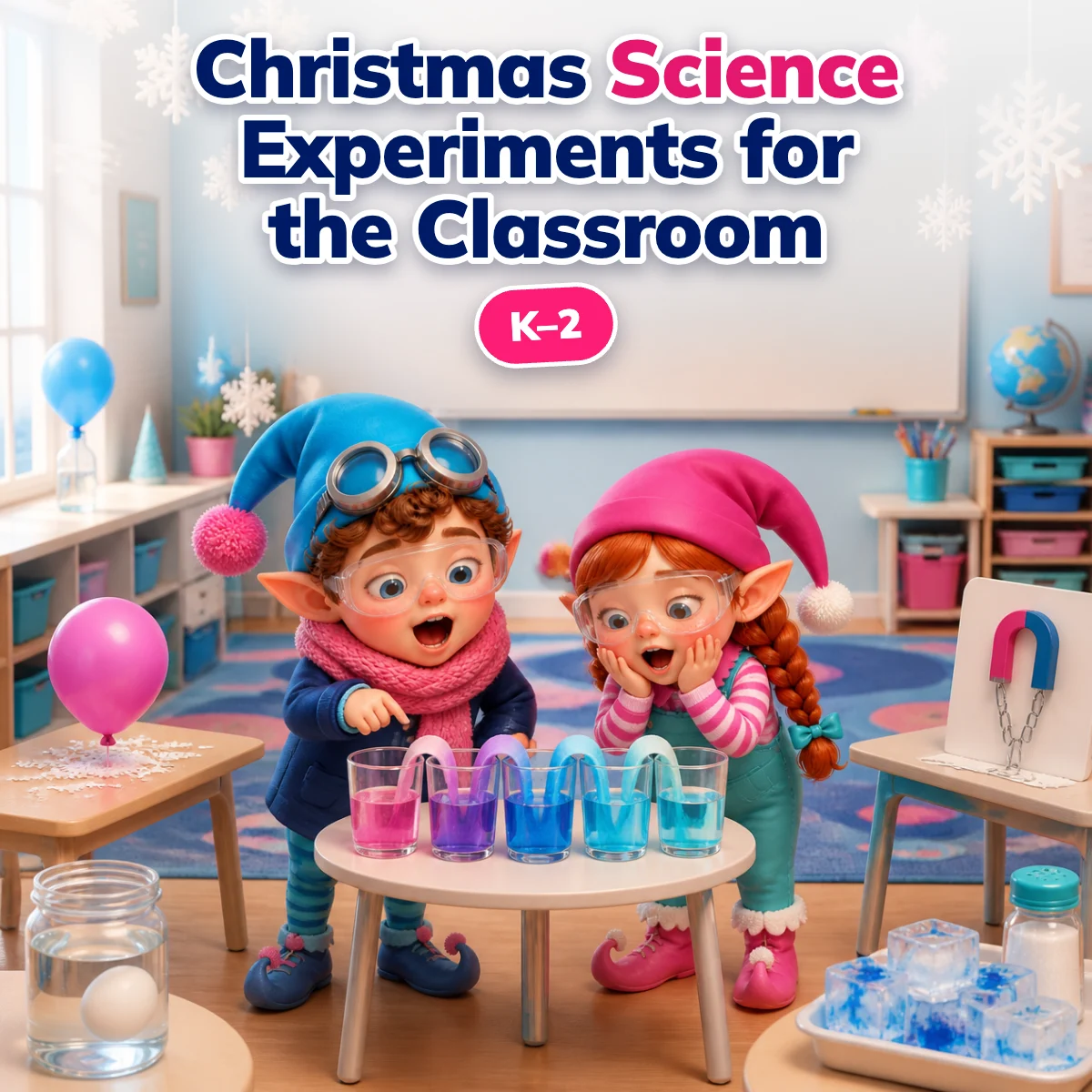
Theo and Tilda, the Science Elves. The illustrations were created with AI-assisted tools (Canva) and edited by our team.
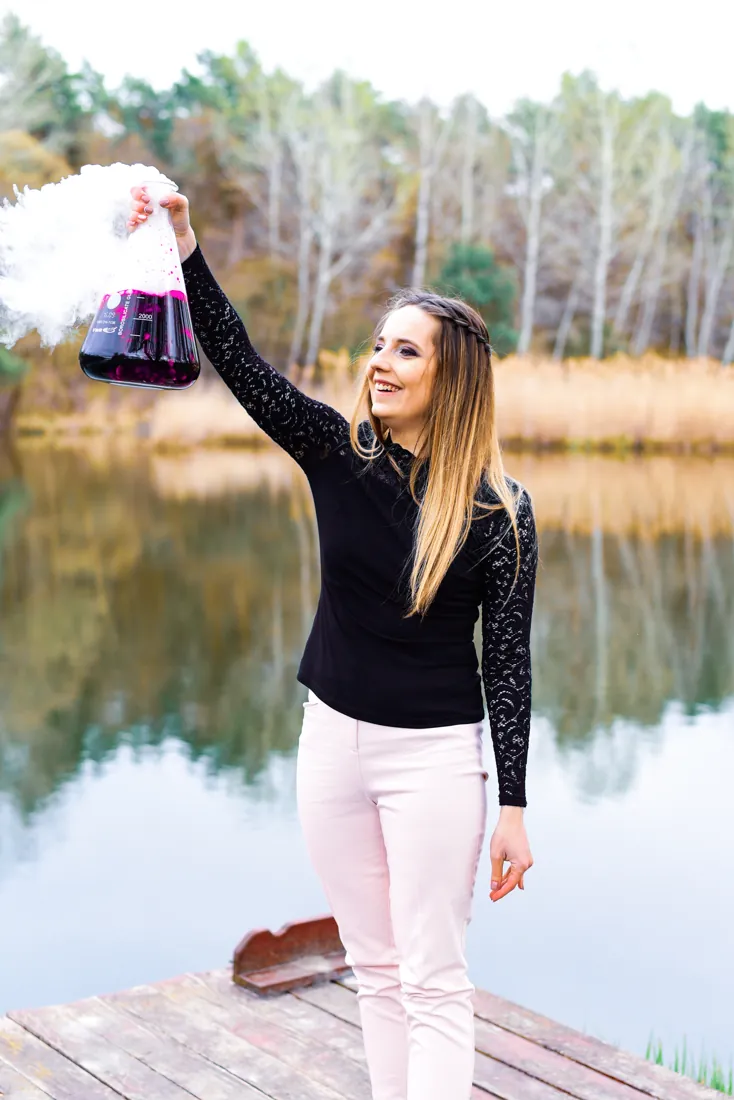
By Janka Sára Molnár, physicist and science communicator
SHARE THIS POST
Save it for your Term 4 planning, or share it with the teacher next door.
At a physics competition around St Nicholas Day, we stuck gummy bears to different metal wires with wax, heated the wires and watched to see which gummy bear fell first.
Which one would you bet on? I’ll tell you what decides it at the end of this post.
In short
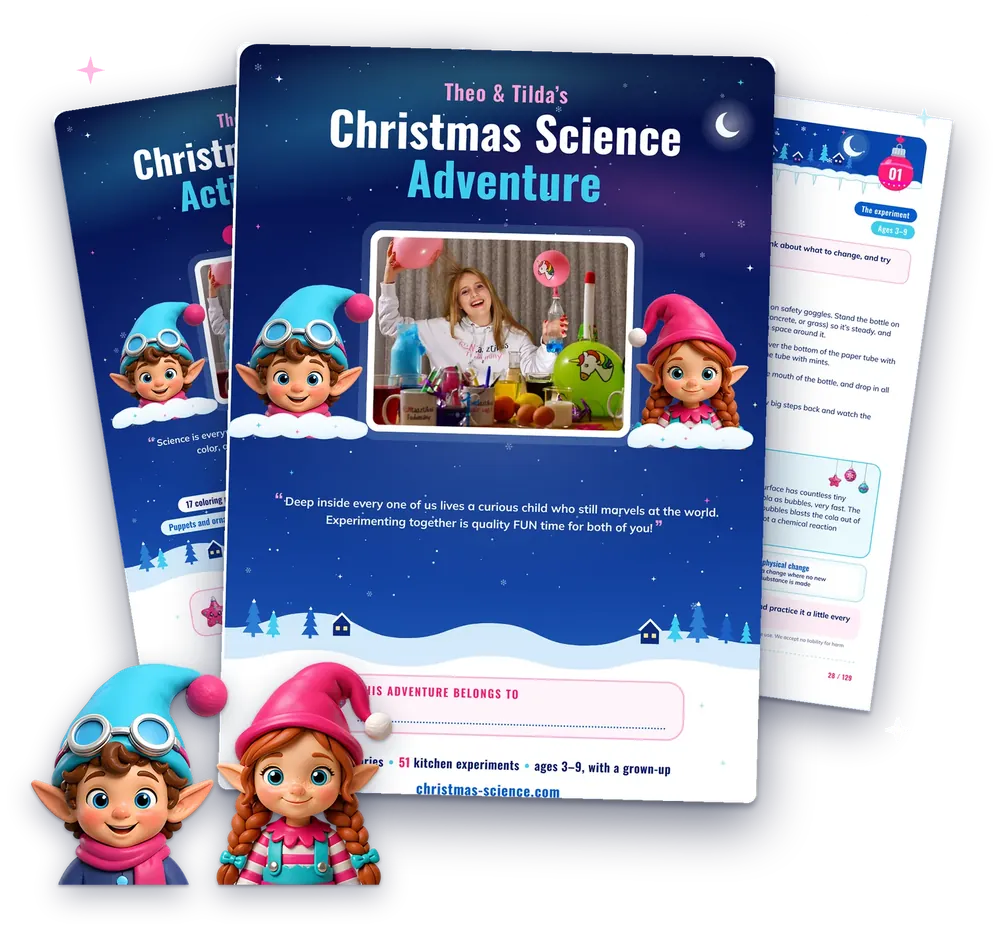
The Christmas science activities that work best in the last weeks of Term 4 are short, low-prep experiments with a surprise in them: ice that melts the “wrong” way, or an egg that learns to swim. My book, Theo & Tilda’s Christmas Science Adventure, has 51 Christmas experiments, 36 of them hands-on for children, each with a read-aloud story, a photo of the result and science words explained for children. A free New Zealand Teacher Guide links every experiment to The New Zealand Curriculum (Levels 1–2) for Years 0–3, and the 28 experiments for ages 3–5 to Te Whāriki.
Know a New Entrants or Year 1–3 teacher who is planning the last weeks of Term 4? Send this to them. Every experiment here works in a Kiwi summer, no snow needed. Share it
Which Christmas science activities work in a Kiwi summer?
Experiments that need no snow or cold weather work best in a Kiwi summer. In New Zealand, Christmas comes in summer, so these six Christmas activities for the classroom use kitchen materials and work with a whole class. The number is the experiment’s number in the book, so you can find it quickly.
10
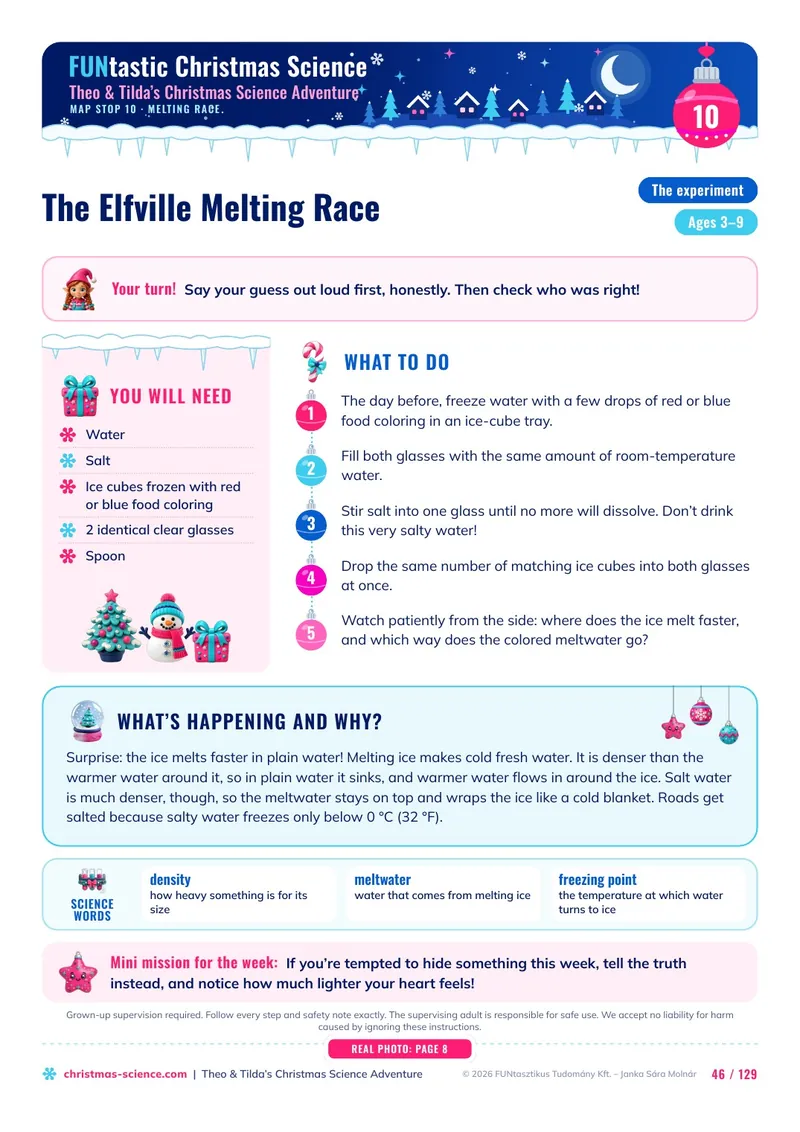
The Elfville Melting Race
Book page 45 · Children do it Green
You need: water, salt, two identical clear glasses, a spoon and ice cubes frozen with a few drops of food colouring the day before. Stir salt into one glass until no more dissolves, then don’t stir again.
The surprise: the ice melts faster in plain water than in the very salty water.
Summer twist: put ice cubes in a sunny spot and a shady spot and ask which melts first. Hats on!
Good to know: nobody drinks the very salty water. Food colouring stains, so cover the table.
Material World · Nature of Science
12
Magic Snow: Runny or Rock-Hard?
Book page 49 · Children do it Green
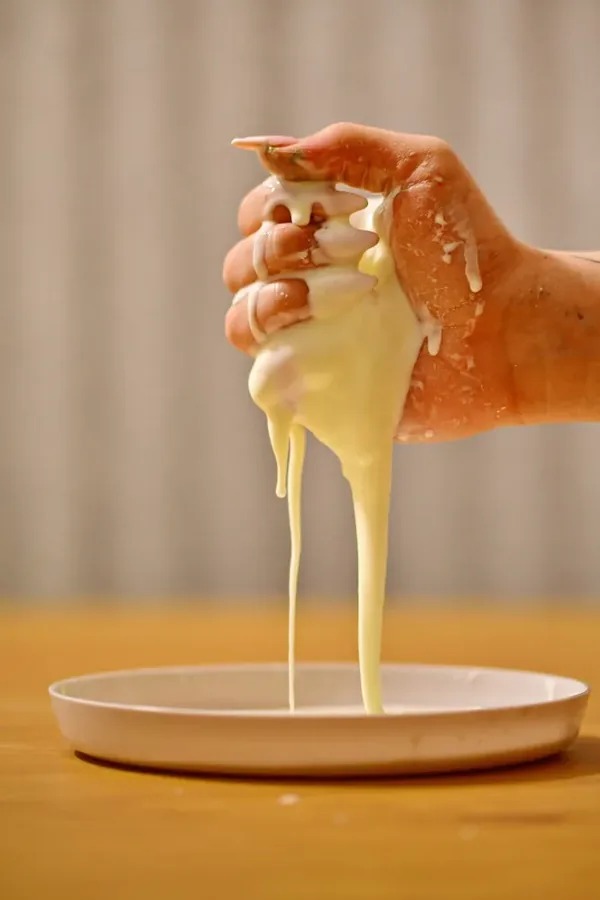
You need: about 1 cup of cornflour, about ½ cup of water, a bowl, a spoon and a tray. Use maize cornflour, because in New Zealand some cornflour is made from wheat.
The surprise: squeeze it fast and it feels solid, open your hand and it oozes away. Snow for a summer Christmas.
Good to know: leftovers go in the rubbish bin, never down the sink. Check for wheat allergies if your cornflour is wheaten.
Material World · Physical World
11
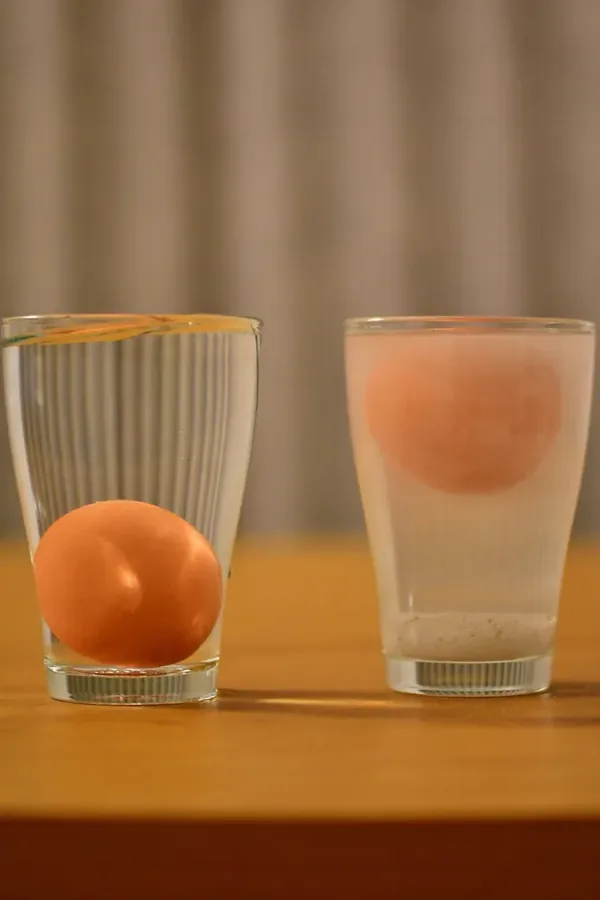
The Egg Who Learned to Swim
Book page 47 · Children do it, ages 4+ Green
You need: two fresh raw eggs, two identical clear glasses, about 250 mL of lukewarm water in each, 3–5 tablespoons of salt and a spoon.
The surprise: the egg sinks in plain water and floats in salty water. If it stays down, take the egg out, stir in 1–2 more tablespoons of salt and try again, just like Theo in the story.
Good to know: check for egg allergies, nobody drinks the salty water, and wash hands after touching raw egg. Use fresh eggs, because an old egg can float even in plain water.
Material World · Physical World
46
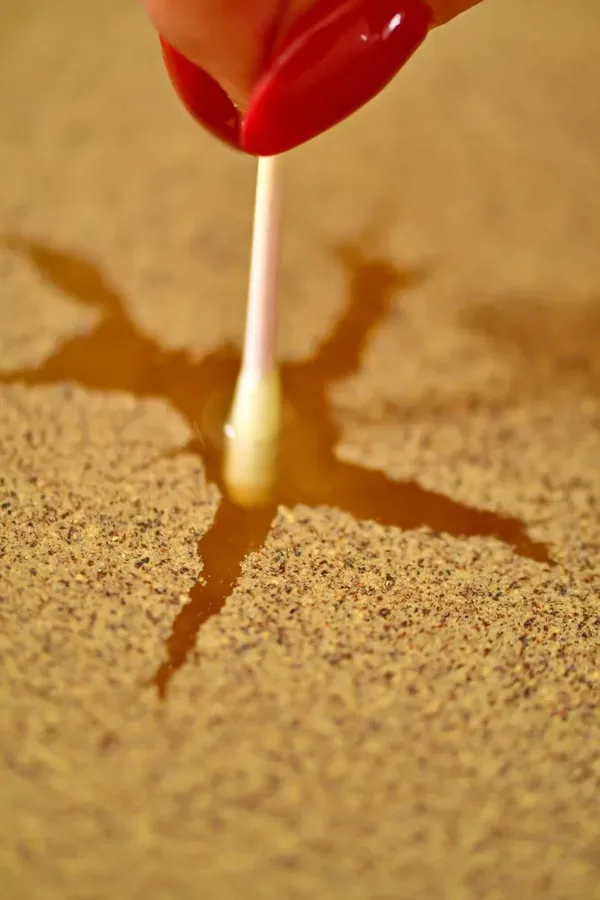
Pepper Skaters on the Pond
Book page 117 · Children do it Green
You need: a bowl of water, ground pepper, a cotton bud and one drop of dishwashing liquid.
The surprise: one soapy touch in the middle, and the pepper rushes to the edge of the bowl.
Good to know: change the water before you repeat it, or it won’t work again.
Material World · Nature of Science
44
Golden Snowfall in a Glass
Book page 113 · An adult does some steps Amber
You need: water, a pinch of turmeric, a clear flat-bottomed glass and a phone torch in a zip-lock bag.
The surprise: in a darkened room, the tiny specks catch the beam and sparkle gold.
Good to know: an adult sets the glass over the light. Turmeric stains, so cover the table.
Physical World (light) · Nature of Science
41
The Walking-Color Advent Wreath
Book page 107 · Children do it Green
You need: six matching clear glasses on a tray, water, pink and blue food colouring and paper towels folded into strips.
The surprise: the water climbs up the paper, and where pink meets blue, it turns purple.
Classroom tip: try it with every other glass empty. In a few hours the water walks into them, so set it up before morning tea and check after lunch. Food colouring stains, so use the tray and aprons.
Material World
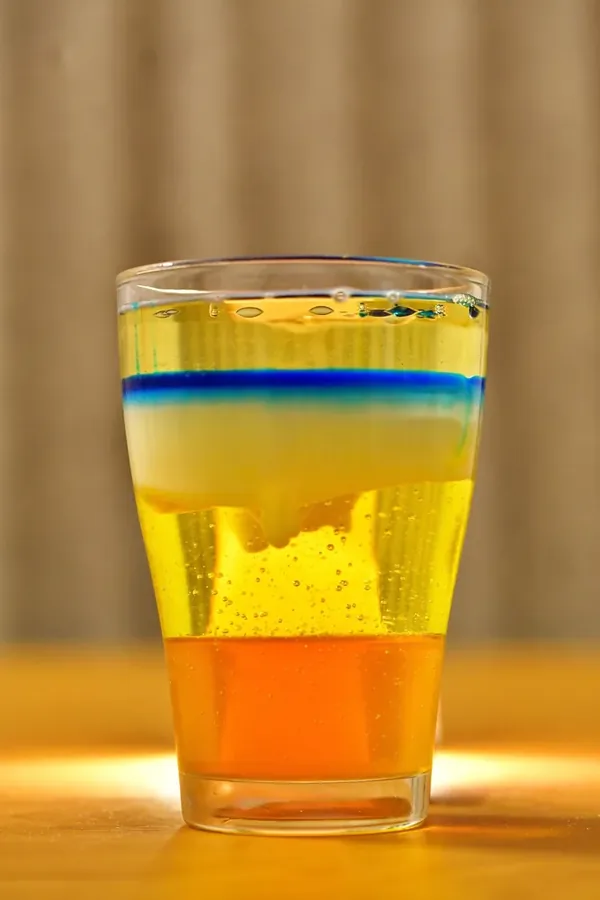
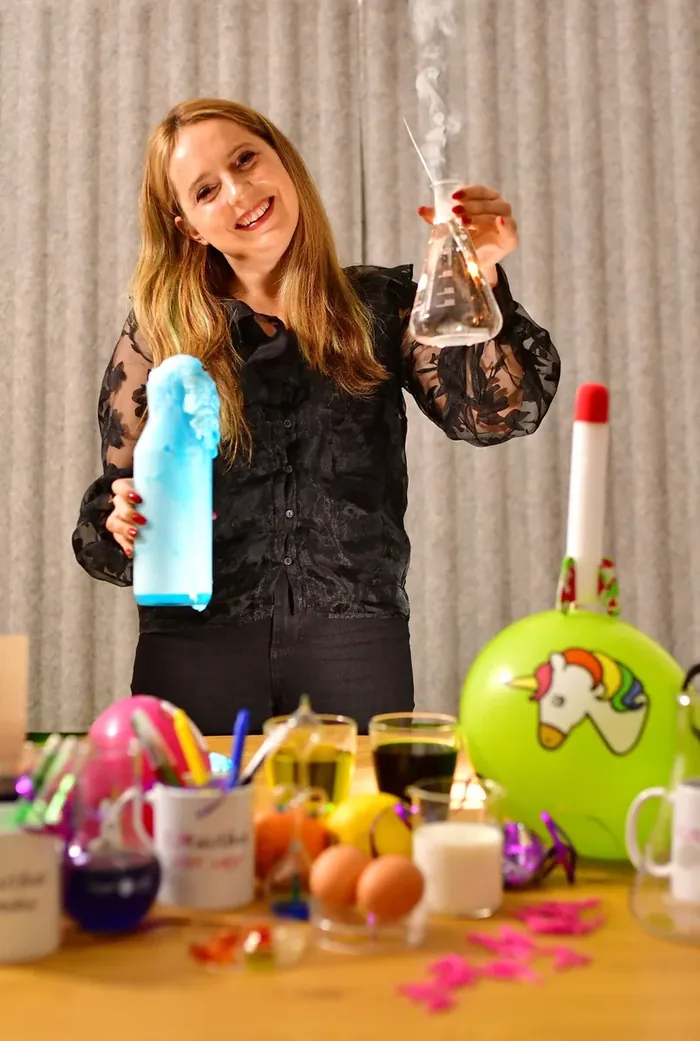
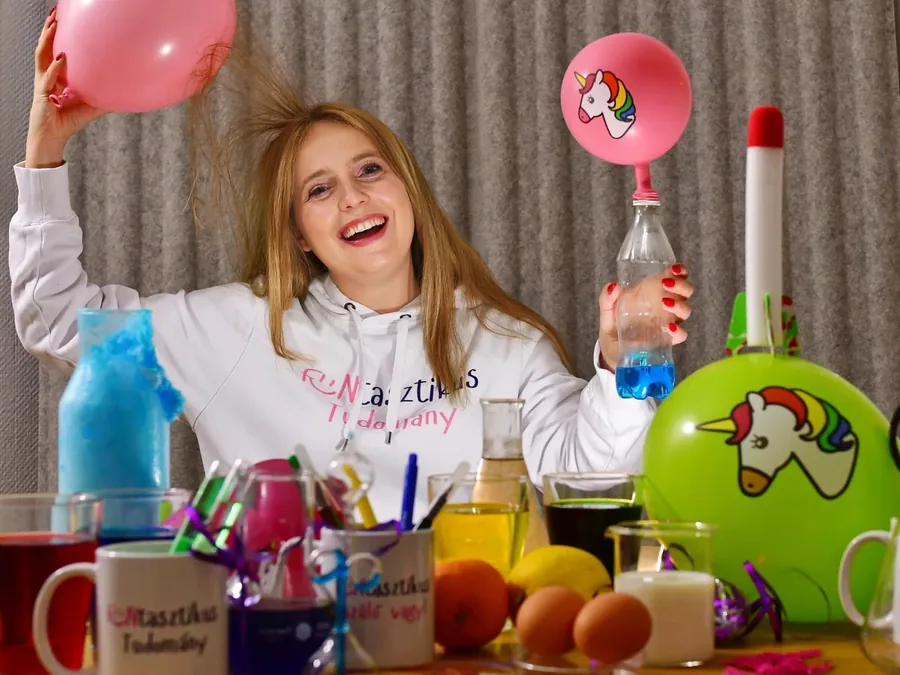
Results from my own lab: the floating egg, Magic Snow, Pepper Skaters and the Liquid Tower. Every experiment in the book has a photo like these, so children know what to look for.
51 stories and experiments + 68-page Activity Pack · US$13.99 until 24 December
How do Christmas science activities link to the NZ Curriculum?
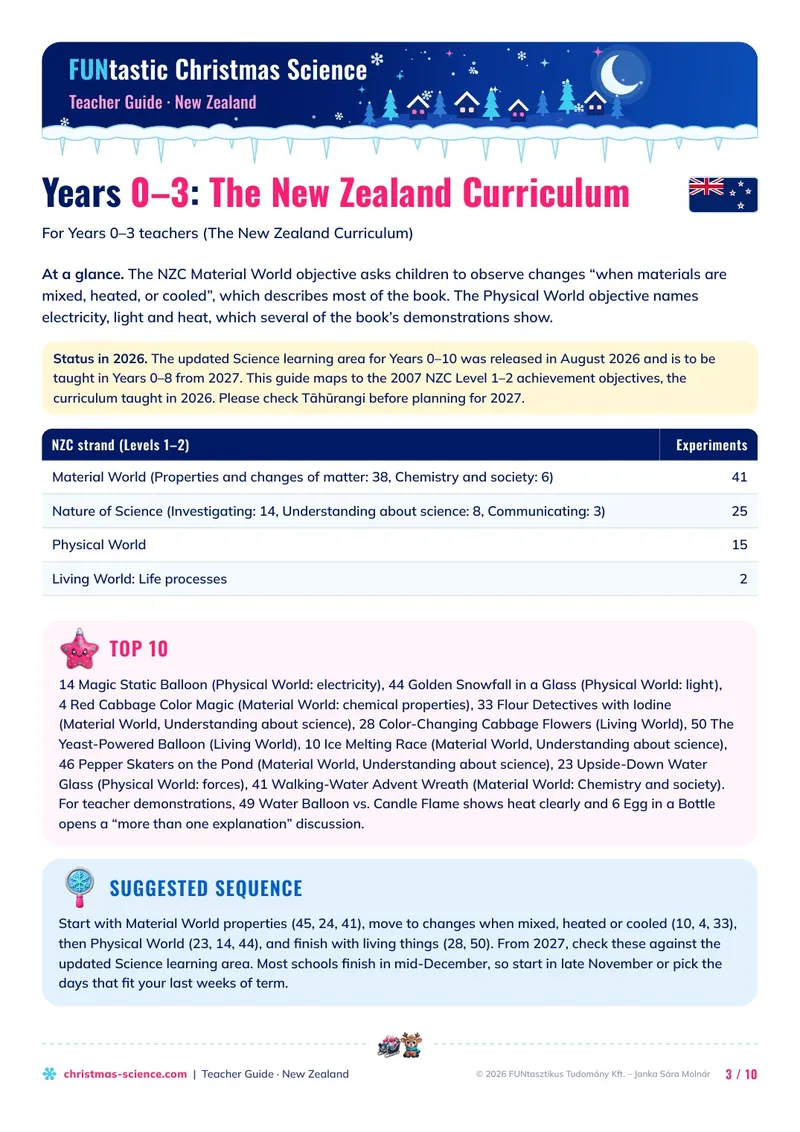
Most of the experiments link to the Material World strand. I mapped every experiment to NZ Curriculum science for Years 0–3 in a free New Zealand Teacher Guide (10 pages, A4). It uses the Level 1–2 achievement objectives of The New Zealand Curriculum (2007), the science curriculum taught in 2026.
Material World: the objective asks children to observe changes “when materials are mixed, heated, or cooled”. That describes most of the book: 41 of the 51 experiments link here.
Nature of Science: 25 experiments, across investigating, understanding about science and communicating.
Physical World: 15 experiments, for example Static Balloon (electricity) and Golden Snowfall (light).
Living World: two experiments, Cabbage Flowers and Yeast Balloon.
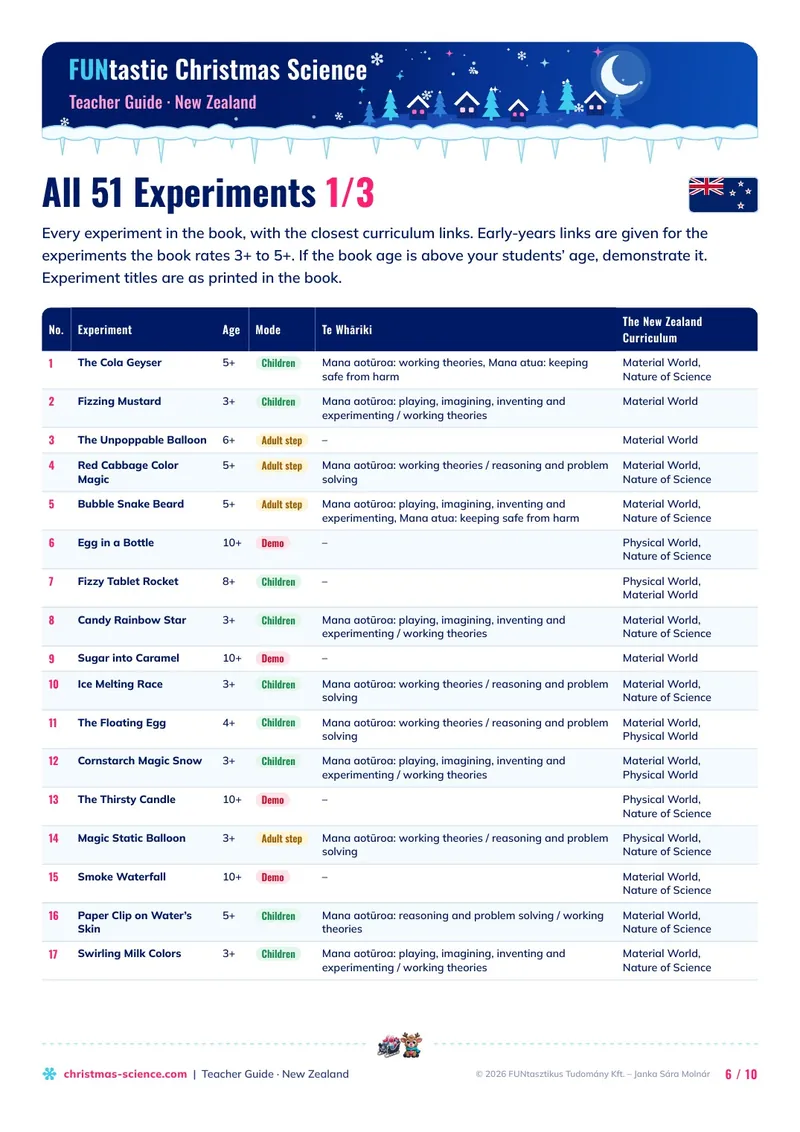
The guide has a table of all 51 experiments with the age, who does it (children, an adult step or a teacher demonstration) and the closest curriculum links. There is a Te Whāriki page for kaiako in early learning services too.
From 2027, schools are expected to start using the updated Years 0–10 Science learning area, so check the links on Tāhūrangi when you plan next year. The guide is an independent alignment guide, checked against the official documents on 6 November 2026, and it is not endorsed by any curriculum authority.
Two pages of the free NZ Teacher Guide: the Years 0–3 curriculum page and the first page of the table of all 51 experiments.
What does a Christmas science lesson look like, step by step?
Here is the lesson pattern from the teacher guide, worked through with The Elfville Melting Race. It fits a 35–50-minute lesson. With the youngest, keep the story, one prediction and the experiment, about 15–20 minutes.
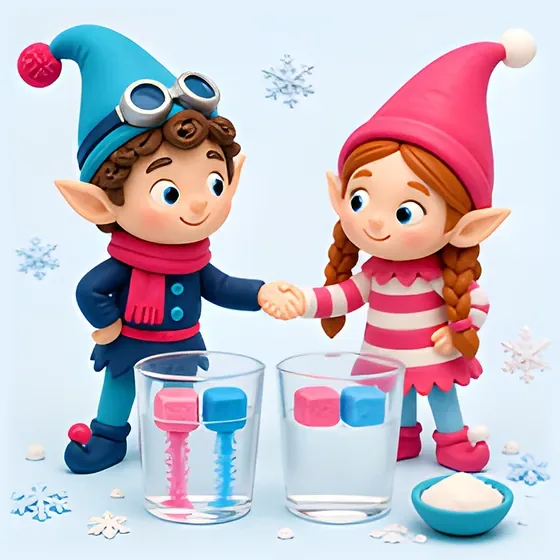
Theo and Tilda shake on their bet in The Elfville Melting Race.
Story time5–8 min Read the story aloud. Tilda is sure ice melts faster in salt water and bets on it. Theo already knows the answer and keeps quiet. Ask: “How do you think Theo felt while he stayed quiet?”
Wonder question2 min “Where will the ice melt faster: in plain water or in salt water?”
Predict5 min “I think … will happen because …” Early years: thumbs up or down. The book tells children: “Say your guess out loud first, honestly.”
Do and observe10–15 min Groups of three or four (pairs with an adult in early years). Share and rotate the roles: Story Keeper, Materials Manager, Scientist, Observer and Recorder, Safety Captain, Reporter. Adults do every step marked for adults. Watch from the side: which way does the coloured meltwater go?
Explain5–10 min Compare the result with the predictions, then read “What’s happening and why?”. Melting ice makes cold fresh water. It is denser than the warmer water around it, so in plain water it sinks, and warmer water flows in around the ice. Salt water is much denser, so the cold meltwater stays on top and wraps the ice like a blanket. Science words on the page: density, meltwater, freezing point.
Connect the value3 min This story’s value is honesty: “We wrote down what really happened, even when our guess was wrong.”
Reflect and record5 min A drawing, a sentence stem or a simple table.
My tip: a wrong prediction is good science. Celebrate it out loud, it shows children that scientists learn from surprises.
Planning Term 4 with your syndicate? Share this lesson pattern with them. Share it
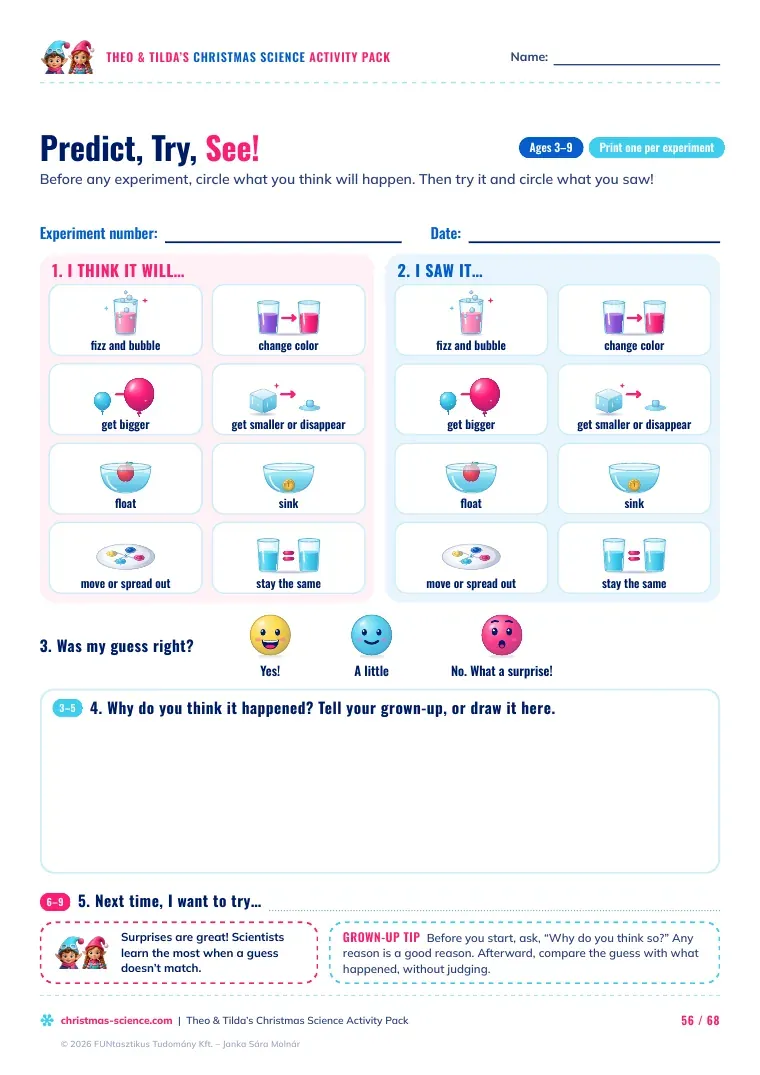
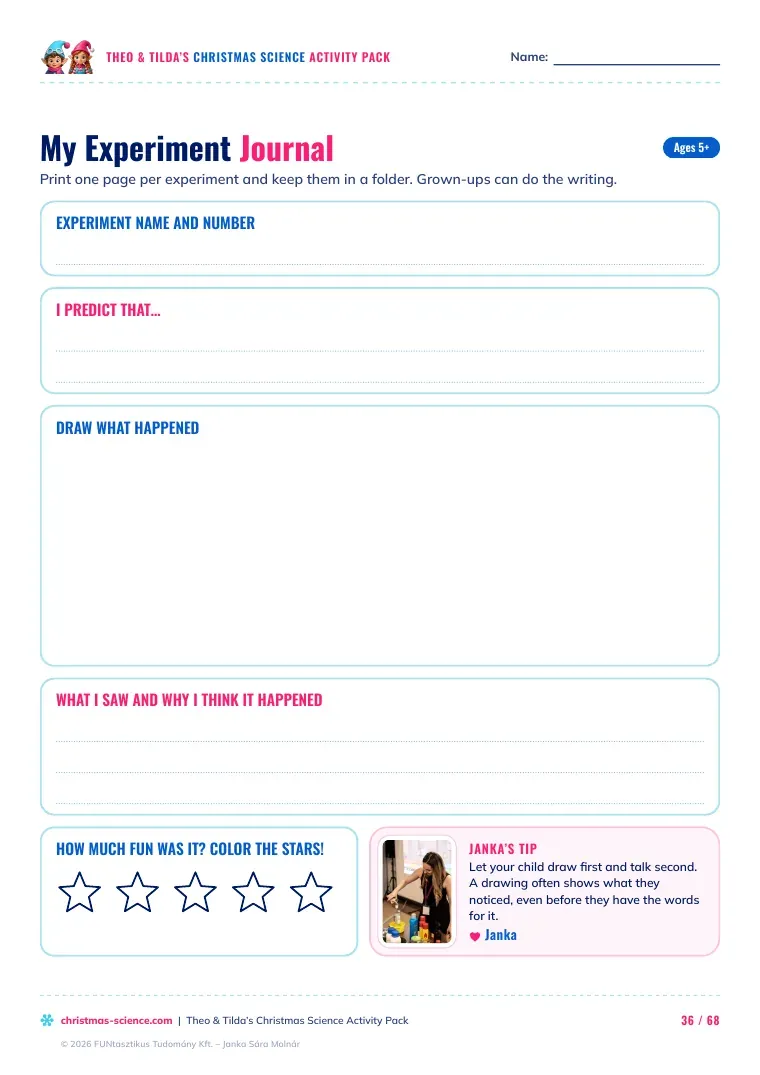
From the Activity Pack: the “Predict, Try, See!” sheet for step 3 and the experiment journal for step 7.
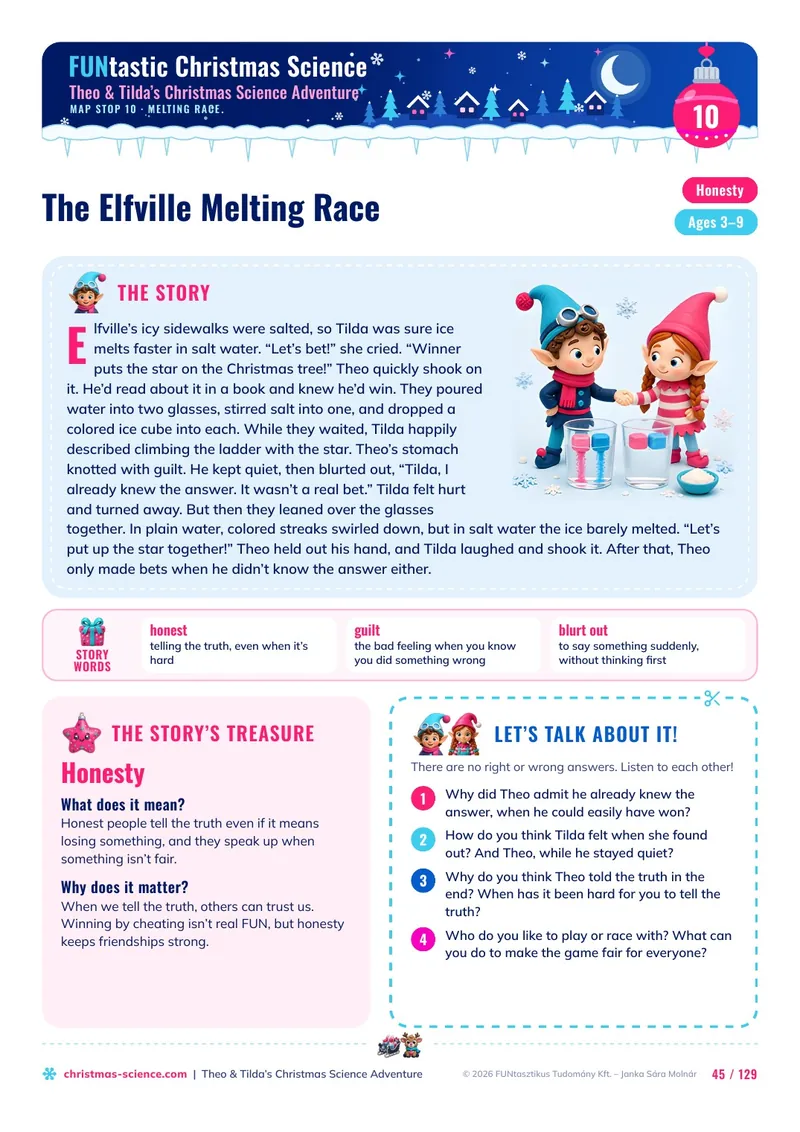
Two pages from the book: the story, talk questions and story words, then the experiment, the “why” and the science words.
How do you keep Christmas science safe in a classroom?
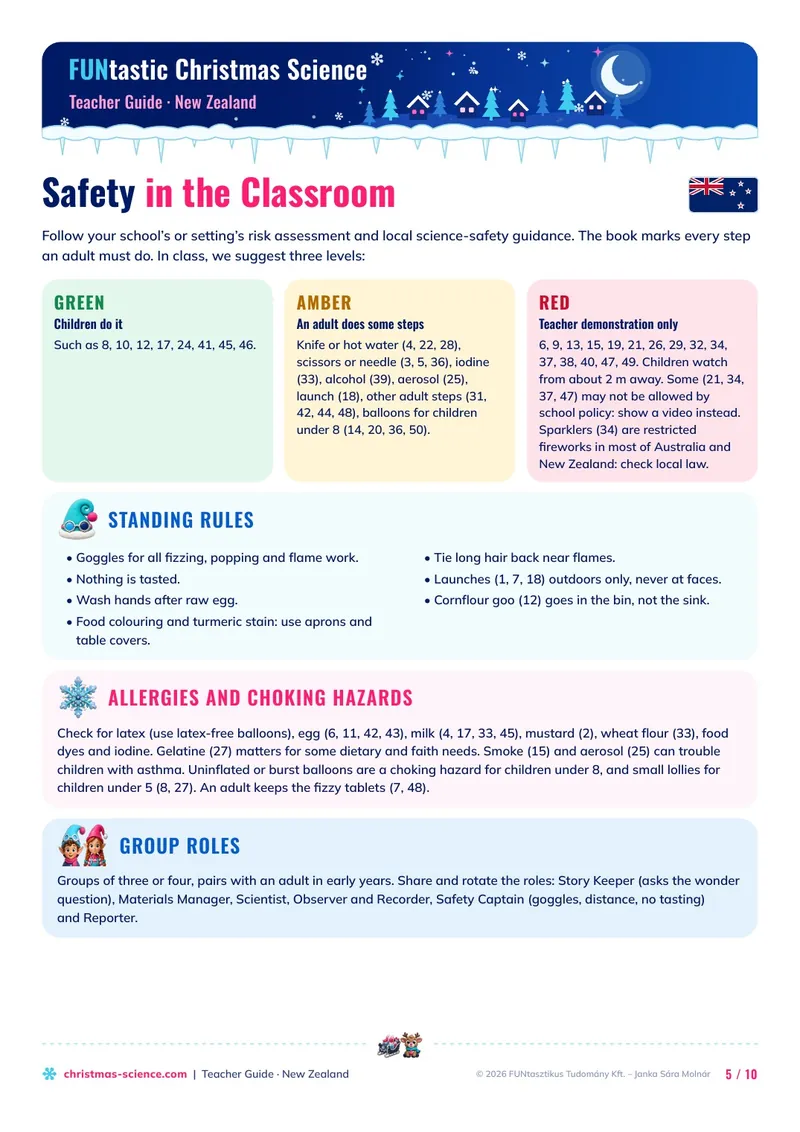
The book marks every step an adult must do. In the teacher guide I sorted all 51 experiments into three levels, so you can see at a glance what fits your class. Always follow your school’s risk assessment and local science-safety guidance.
Green
Children do it. For example 8, 10, 12, 17, 24, 41, 45 and 46.
Amber
An adult does some steps: a knife or hot water, scissors, iodine, balloons for children under 8, and a few others.
Red
Teacher demonstration only: the 15 experiments with a flame or a short circuit. Children watch from about 2 metres away. If your school policy doesn’t allow one, show a video instead. Sparklers (34) count as fireworks, so check your school policy and local rules.
Standing rules: goggles for fizzing, popping and flame work. Tie long hair back near flames. Nothing is tasted. Launches (1, 7, 18) happen outdoors only, never at faces. An adult keeps the fizzy tablets (7, 48). Wash hands after raw egg. Food colouring and turmeric stain, so use aprons and table covers.
Allergies: check for latex (use latex-free balloons), egg, milk, mustard, wheat flour, food dyes and iodine. The giant gummy bear contains gelatine, which matters for some dietary and faith needs. Smoke and aerosol experiments (15, 25) can trouble children with asthma.
Choking: uninflated or burst balloons are a choking hazard for children under 8, and small lollies for children under 5.
Teacher aide helping out? Send them the three safety levels before the first experiment. Share it
The safety page of the NZ Teacher Guide.
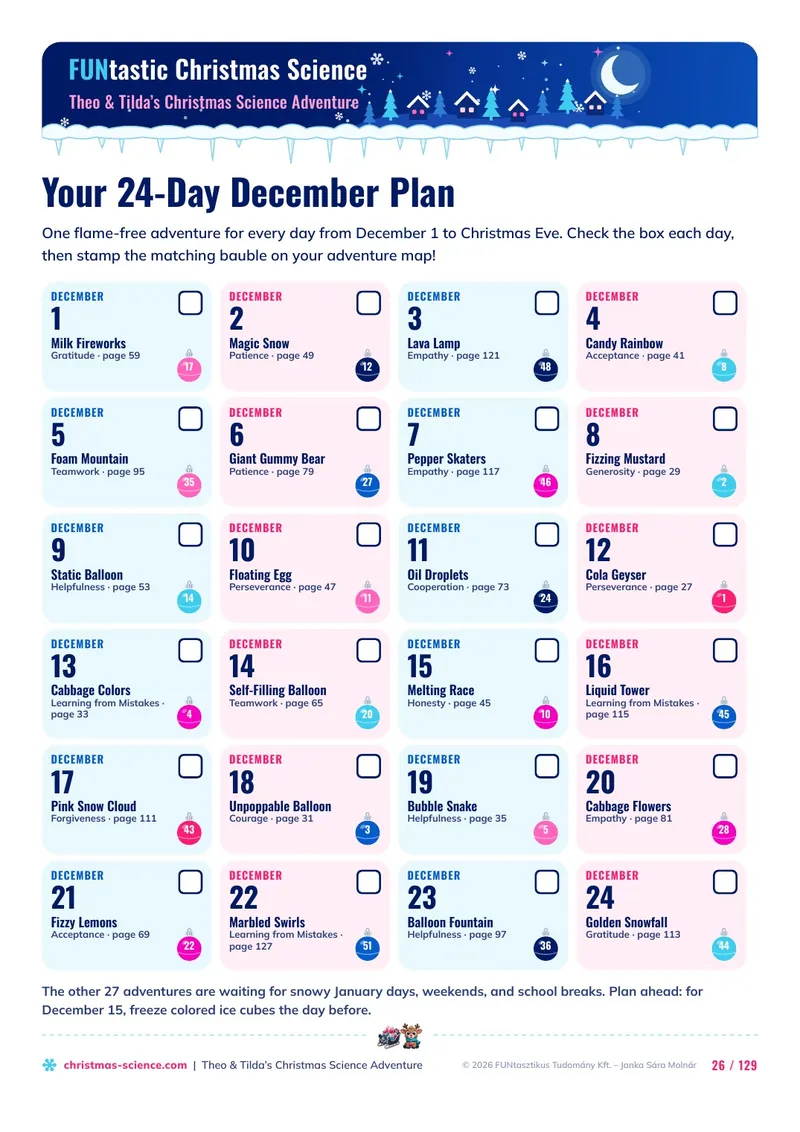
Want to try it with your class first? Days 1–5 of the December plan are free: Milk Fireworks, Magic Snow, Lava Lamp, Candy Rainbow and Foam Mountain.
Plan backwards from your last day: start in late November, or pick the Term 4 activities that fit your last weeks. State and state-integrated schools finish no later than Friday 18 December 2026, and the exact last day varies by school. If you need end-of-year activities for primary school that still teach science, this is the order the teacher guide suggests:
First Materials
45 Liquid Tower, 24 Oil Droplets, 41 Walking Water
23 Upside-Down Glass, 14 Static Balloon, 44 Golden Snowfall
To finish Living things
28 Cabbage Flowers, 50 Yeast Balloon
Copy this plan into your Term 4 planner, or send it to a colleague who teaches the same year group. Share it
From the second group on, several experiments have adult steps, so check each one’s safety level first.
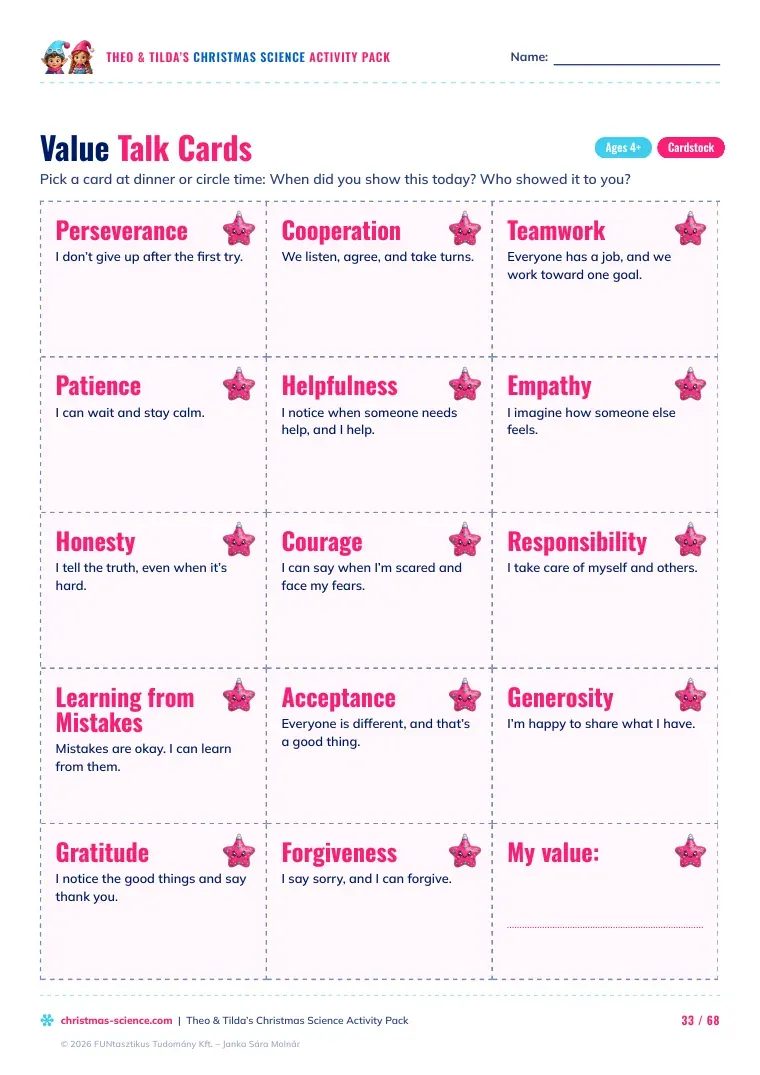
Every story is built around one value, from honesty and patience to courage and forgiveness. After the experiment, a five-minute talk is enough. Feel: how did the character feel? Think: what choice did they make? Do: when could we make that choice today? My advice for Years 0–3: link each story value to your class treaty. The guide pairs every value with the closest key competency or hauora idea, for example honesty with Managing self and Relating to others.
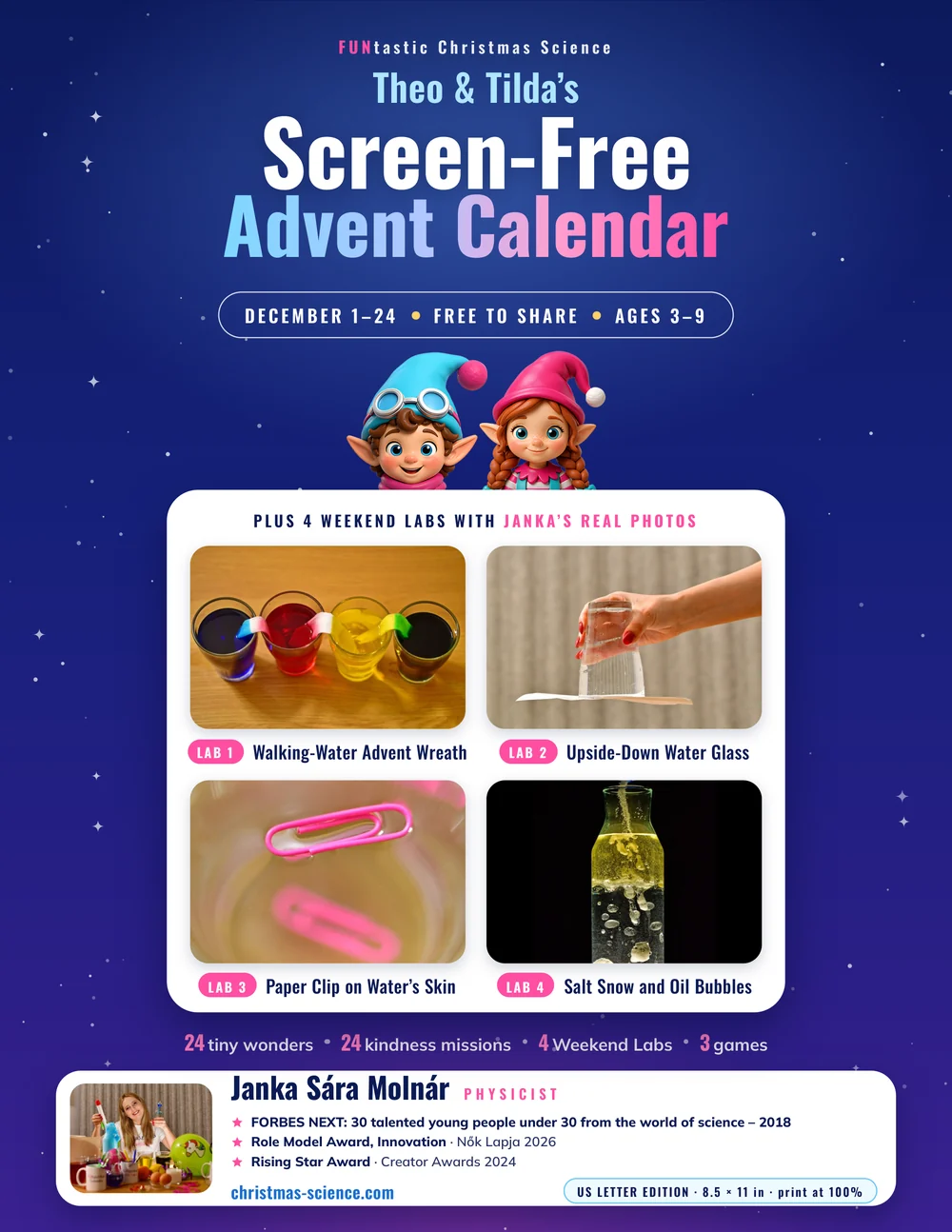
Left: the 24-Day December Plan in the book. Right: Theo & Tilda’s Screen-Free Advent Calendar, free to download and share.
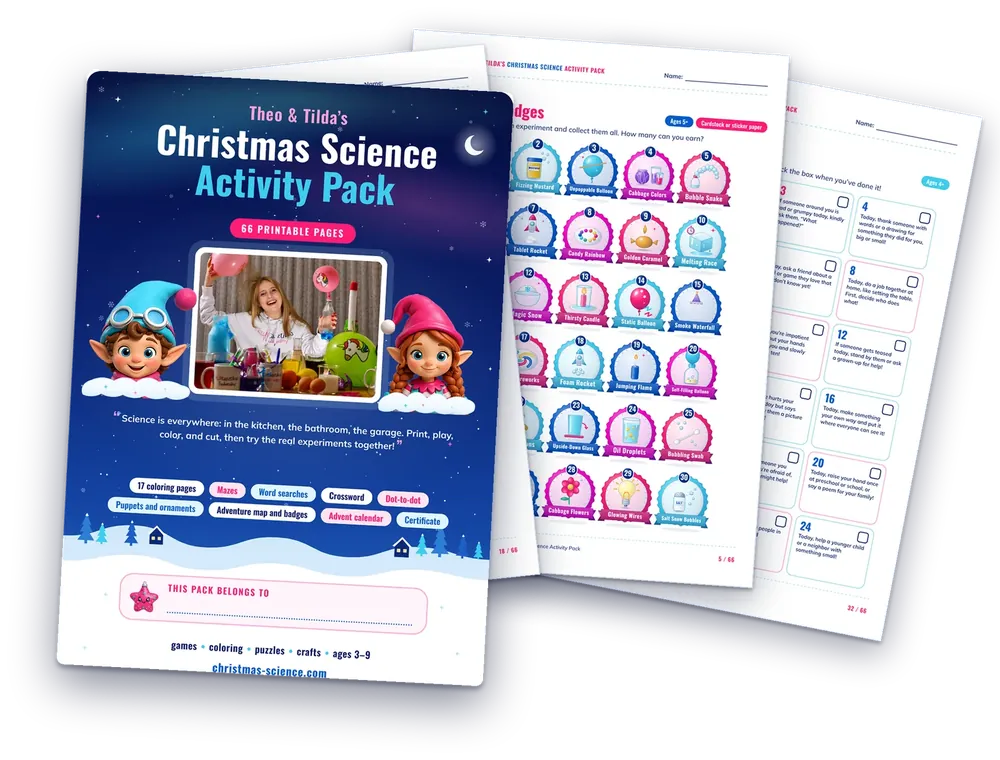
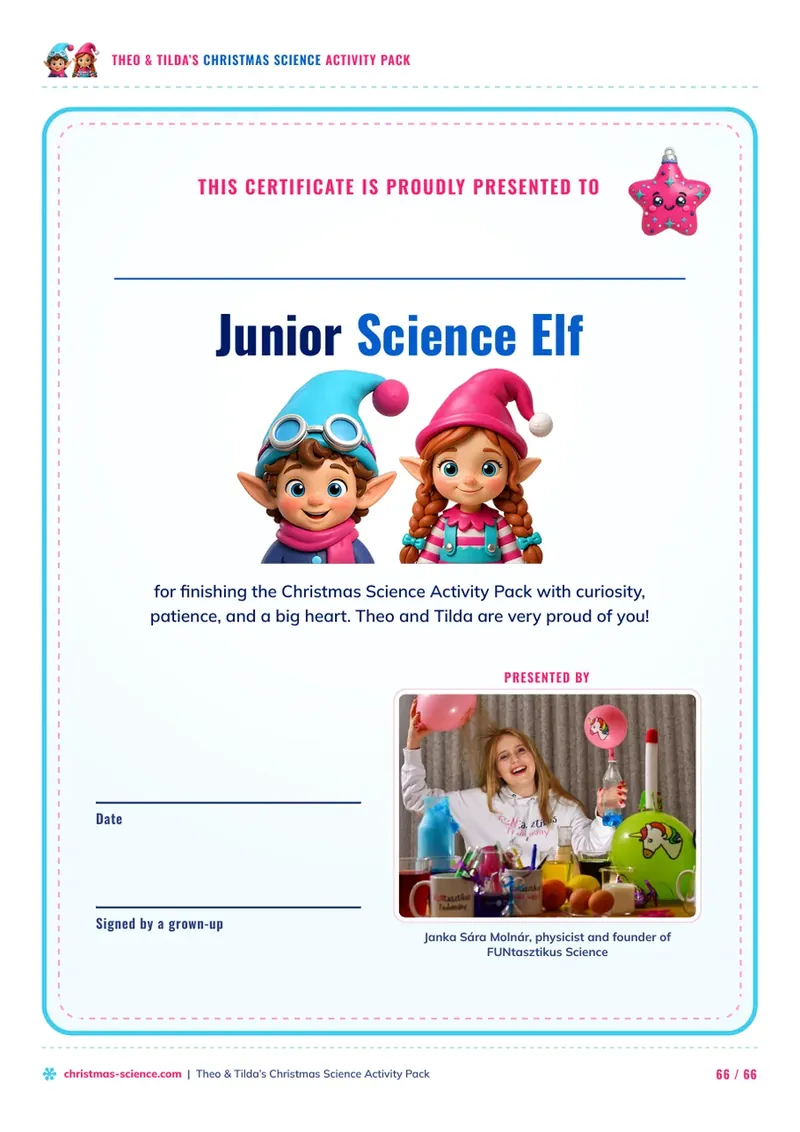
For the end of the year, the bundle adds the 68-page Activity Pack: an experiment journal, “Predict, Try, See!” sheets, science word cards, value talk cards, Elf Lab Mysteries, a family science quiz night and a certificate you can hand out on the last day.
FREE TO DOWNLOAD · FREE TO SHARE
Theo & Tilda’s Screen-Free Advent Calendar
24 tiny wonders and 24 kindness missions, one for every day from 1 to 24 December, plus 4 Weekend Labs with my real photos and 3 games. Most tiny wonders take about 10 minutes and use things you probably already have. 22 pages, for ages 3–9.
One card can open each morning until your last day of term.
This calendar is free to share. Print it as often as you like for your family or class, and pass it on to friends, families, and teachers. Please don’t sell it or change it.
Inside the Activity Pack: the value talk cards and the certificate for every little scientist.
One purchase covers one teacher with their own class. Print as many copies as you need, but please don’t share the file. The book and the Activity Pack come in A4 and US Letter. In New Zealand, print the A4 files. One price for everyone: until 24 December the book is US$11.99 and the bundle US$13.99, only US$2 more. After that, they will be US$14.99 and US$17.99.
Book + 68-page Activity Pack · US$13.99 until 24 December
Back to the gummy bears
What decides which bear falls first?
Metals conduct heat at different rates. If the wires are the same length and thickness and are heated the same way, the heat reaches the gummy bear first along the best heat conductor. The wax there melts first, and that gummy bear drops first.
It was my first really cool experiment, and I still remember that feeling. I would love as many children as possible to feel it this December.
With love from Hungary, Janka
Know a teacher who’d love this?
If the gummy bears made you smile, pass this post on to a colleague. The lesson pattern, the safety levels and the free NZ Teacher Guide are all here for them.
COPY THIS MESSAGE
Paste it into your syndicate group chat, or send it to a colleague.
Found this for the last weeks of Term 4! Christmas science activities that need no snow, written for NZ classrooms (Years 0–3), with a ready lesson pattern, safety levels and free NZ Curriculum links. www.christmas-science.com/blog/christmas-science-activities-nz-classrooms
What are easy Christmas science experiments for the classroom?
Pick ones with kitchen materials and a clear surprise. The Elfville Melting Race (ice melts faster in plain water than in very salty water), The Egg Who Learned to Swim (an egg floats in salty water), Pepper Skaters on the Pond (one drop of soap sends pepper to the edge) and Magic Snow (cornflour goo that feels solid when you squeeze it fast) all work with a whole class. They are four of the 51 Christmas science experiments for kids in Theo & Tilda’s Christmas Science Adventure, each with a story, steps and a photo of the result.
Which NZ Curriculum strand do Christmas science experiments fit?
For Years 0–3, 41 of the 51 experiments link to the Level 1–2 Material World objective about changes when materials are mixed, heated or cooled, and 25 to Nature of Science. 15 link to the Physical World (electricity, light, forces) and two to the Living World. The free NZ Teacher Guide maps all 51 experiments. From 2027, schools are expected to start using the updated Years 0–10 Science learning area, so check Tāhūrangi when you plan.
Can I use one copy with my whole class?
Yes. One purchase covers one teacher with their own class or group. Print as many copies as you need, but please don’t share the file with other teachers. The NZ Teacher Guide is free: print it and share it with colleagues.
What age is the book for?
Ages 3–9, always with a grown-up. 36 experiments are hands-on for children, and 15 are teacher demonstrations. The NZ Teacher Guide covers early learning services and Years 0–3.
About Janka
Janka Sára Molnár is a physicist and award-winning science communicator from Hungary, and the creator of FUNtastic Christmas Science. For almost 15 years she has run hundreds of science shows for children. As a high school student, she spent years building multiwire proportional chambers, a kind of particle detector, and took them to CERN several times, where she also presented them in the CERN teacher programme.
Rising Star Award, Creator Awards 2024 · Women of Excellence Award, Szakmai Elit 2026 · Role Model Award, Innovation, Nők Lapja 2026 · Juhari Zsuzsanna Blog of the Year Award, Hungarian Academy of Sciences 2023 · FORBES NEXT: 30 talented young people under 30 from the world of science – 2018 · Winner of the HBO Max reality series A Híd
FROM THE BLOG
Keep reading
More Christmas science ideas from Theo, Tilda, and me.
The illustrations of Theo, Tilda and their world were created with AI-assisted tools (Canva) and edited by our team. The experiment photos are real photos of Janka’s own experiments.
Grown-up supervision required for every experiment. Follow every step and safety note in the book.
We use a few cookies to keep the site running. With your OK, we also use Google Analytics to see which pages help families most, and the Meta pixel to see which Facebook and Instagram posts bring you here and to show our experiments to more families.Cookie Policy