Save it for a rainy afternoon, or send it to a parent friend.
Fizzy Mustard for Two
The Christmas market smelled of roasted chestnuts and hot dogs. Tilda had just gotten the last bottle of mustard when she saw Zack, the new boy at elf preschool, standing alone with a plain hot dog.
“It’s mine!” Tilda thought, hugging the bottle tight.
Then she remembered how lonely she had felt on her first day at preschool…
What did Tilda do next, and how did a spoonful of baking soda join in? The end of the story is waiting right after the twelve experiments.
Send this to a friend whose kids ask “Is it Christmas yet?” every morning. Twelve fizzy experiments are a good way to fill the wait. Share it
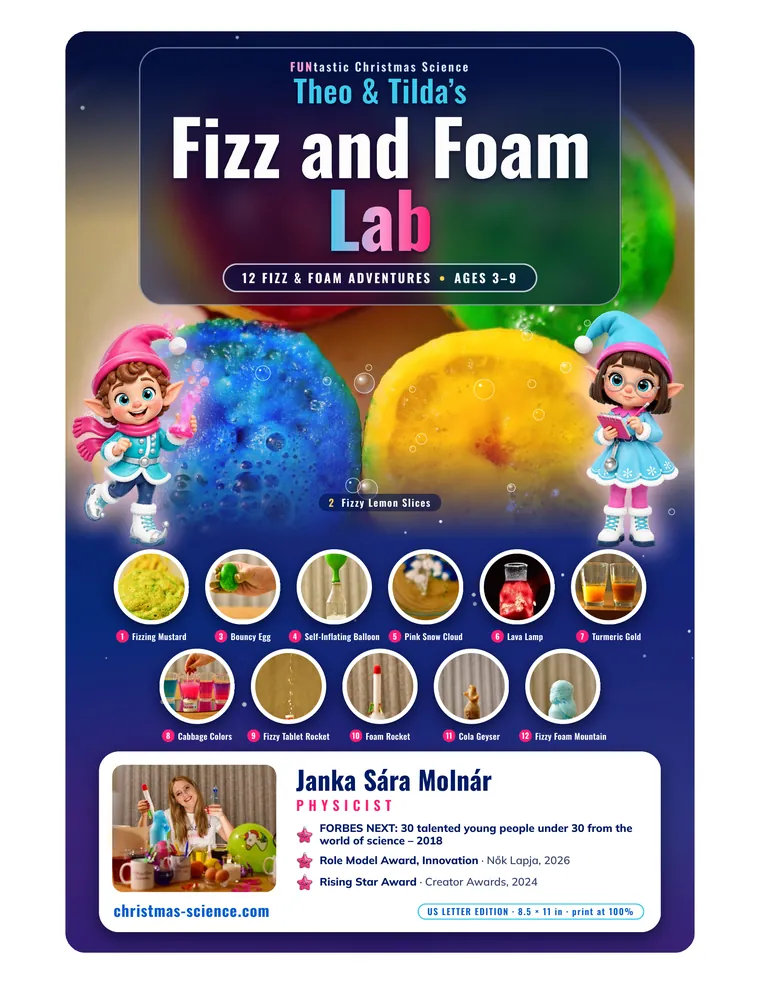
Fizzy science experiments for kids all run on the same idea: an acid meets baking soda (or, in the bouncy egg, the eggshell), and together they make carbon dioxide gas. Those gas bubbles are the fizz. The twelve below come from my Fizz and Foam Lab booklet: Fizzing Mustard, Fizzy Lemon Slices, Bouncy Egg, Self-Inflating Balloon, Pink Snow Cloud, Lava Lamp, Turmeric Gold, Cabbage Colors, Fizzy Tablet Rocket, Foam Rocket, Cola Geyser, and Fizzy Foam Mountain. They work for ages 3–9, most of what you need is already in your kitchen, and you can do one a day or several on a fizzy weekend in December.
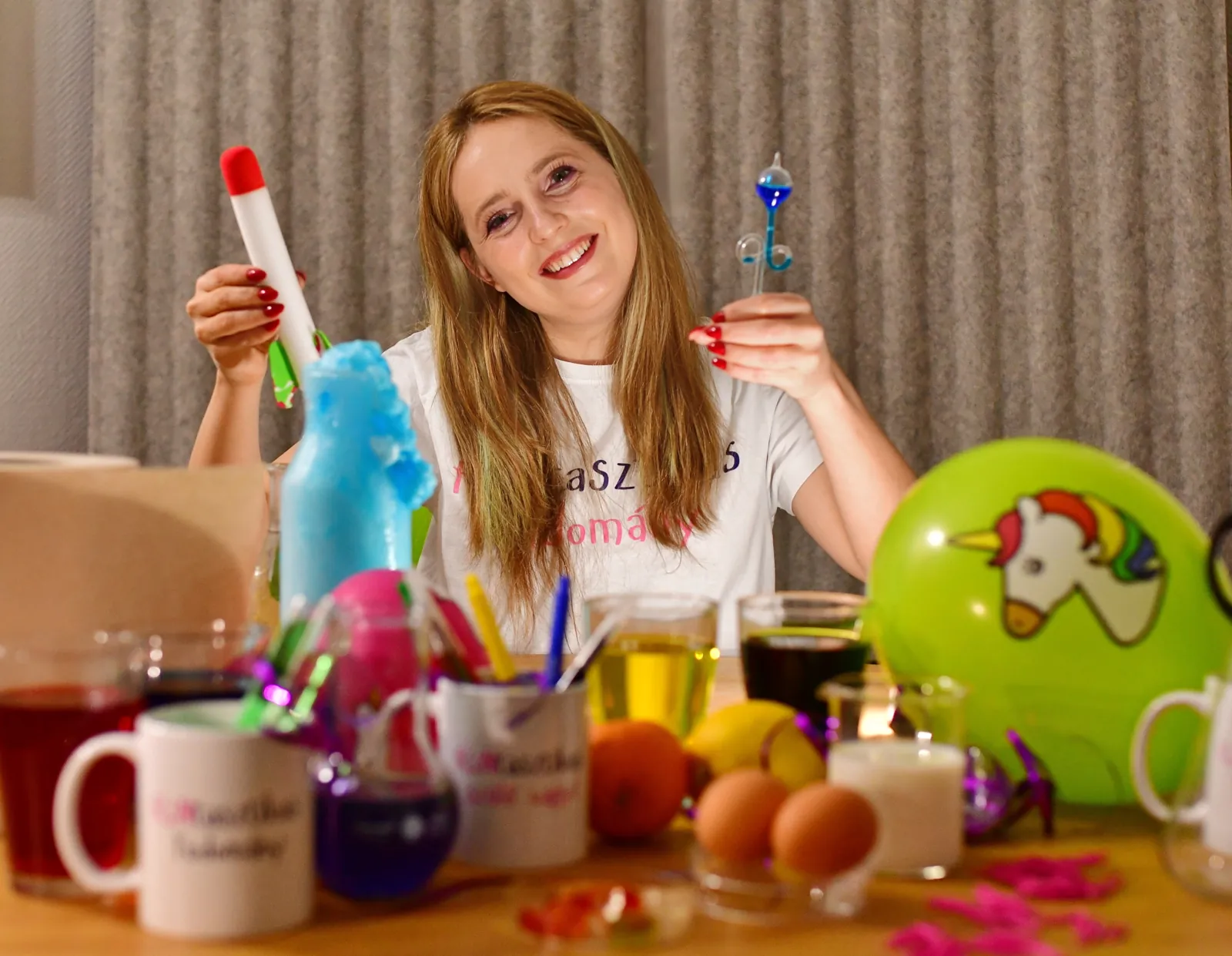
I’m Janka, a physicist from Hungary. I have run several hundred science shows for children and families, and all twelve experiments in this post were done for real in my lab. Below you’ll find the exact amounts and the small tricks that turn a sad little fizz into a loud “Wow!”
What makes things fizz, and how can kids test it?
Baking soda is slightly basic. When it meets an acid, the two react and make carbon dioxide, the same invisible gas that puts the bubbles in soda. So anything with enough acid in it fizzes. That is why mustard fizzes: most mustard contains vinegar.
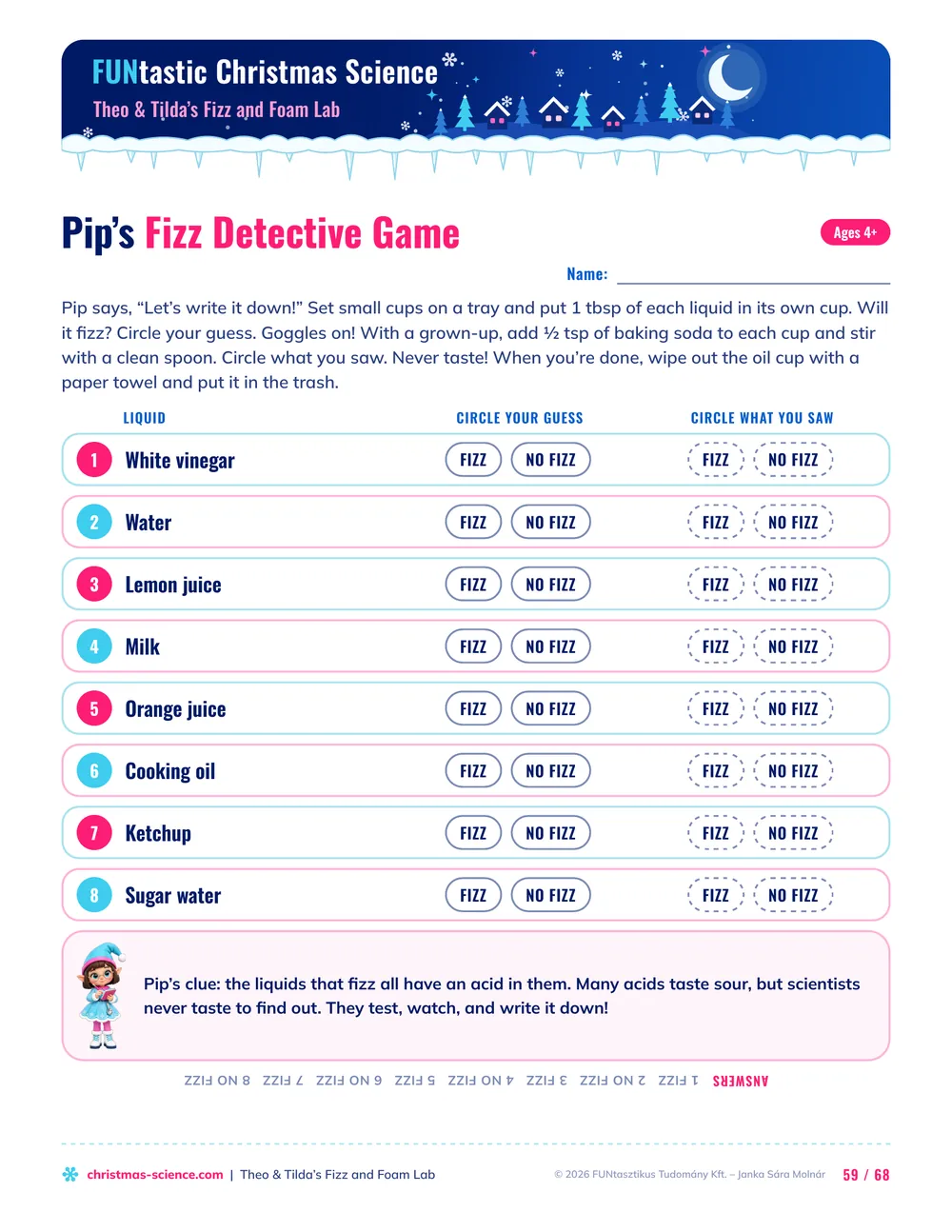
Set 8 small cups on a tray and put 1 tablespoon of a different liquid in each: white vinegar, water, lemon juice, milk, orange juice, cooking oil, ketchup, and sugar water. Your child circles a guess for every cup: fizz or no fizz? Then, goggles on, add ½ teaspoon of baking soda to each cup together and stir with a clean spoon.
Answer key for grown-ups: vinegar, lemon juice, orange juice, and ketchup fizz. Water, milk, cooking oil, and sugar water don’t. Pip’s clue: the liquids that fizz all have an acid in them. Many acids taste sour, but scientists never taste to find out. They test, watch, and write it down.

- Buy baking soda, not baking powder. Baking powder is baking soda mixed with a dry acid and starch, so a spoonful has less baking soda and gives a weaker fizz. It even fizzes in plain water, which would spoil Pip’s detective game.
- Use plain white vinegar, not cleaning vinegar.
- Put a tray under everything. Fizz loves to escape!
- Ask “What do you think will happen?” before every experiment. Let children guess first, then watch, then explain. That is how real scientists work.
- Let small hands do the sprinkling, pouring, and stirring. You keep it safe.
- Safety goggles for everyone, every day. Nobody tastes or sniffs anything from an experiment, not even the cola, and everyone washes hands afterward.
- Check for allergies. Day 1 uses mustard, Days 3 and 5 use egg, Day 4 uses a balloon (choose a latex-free one if needed), and Pip’s game uses milk. Children with these allergies should not touch them.
- Little ones under 6: use plastic cups instead of glass, wipe up spills at once, and keep tablets, caps, mints, and raisins away from mouths.
Send these tips to a friend who is planning a kitchen science afternoon. The baking soda tip alone saves a flop. Share it
First aid, from the booklet’s Safety First page: splashes in the eyes, rinse with lukewarm running water for 15 minutes. If something is swallowed, or you are worried, call your doctor or poison control right away (US: 1-800-222-1222).
The detective game, the two-page shopping list, and all twelve fizzy days, ready to print. $4.99.
Which baking soda experiments are easiest for preschoolers?
Start with Fizzing Mustard and Fizzy Lemon Slices. They are Fizzy Days 1 and 2 in the booklet, they need just a few teaspoons of baking soda, and little hands do all the sprinkling.
Fizzing Mustard
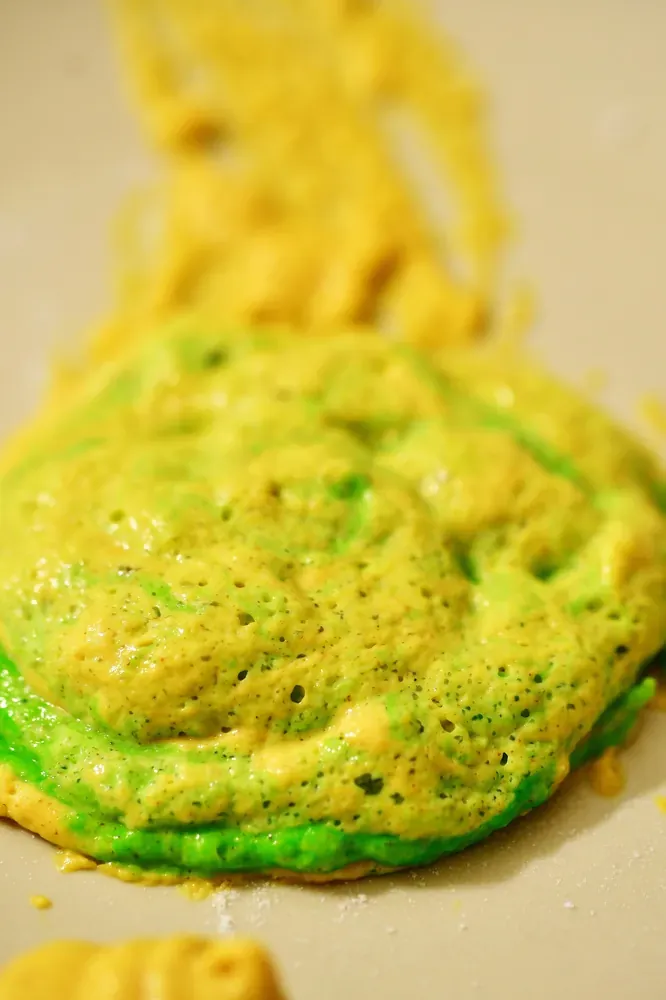
Put 2 tablespoons of mustard in a bowl and, if you like, stir in a drop of food coloring. Goggles on, sprinkle in 1 teaspoon of baking soda and mix. The thick mustard traps the gas bubbles, so instead of a quick splash you get a slow, crackly foam. Ask your child to listen for the soft crackling, but to keep their face back. In my lab, one drop of coloring turned my mustard foam bright green.
Try ketchup instead of mustard. Ketchup has vinegar in it too. Does it fizz as much as the mustard?
Fizzy Lemon Slices
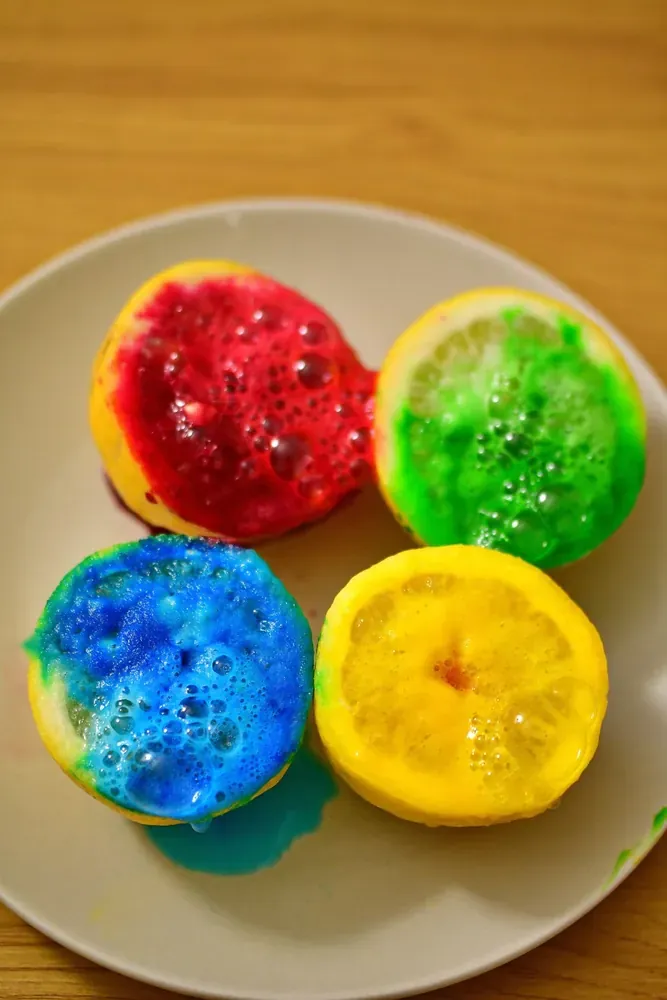
A grown-up cuts a lemon into thin slices and lays them side by side on a tray. Your child drips 1–2 drops of food coloring onto the center of each slice, mixing up the colors. Then, goggles on, your child sprinkles about ½ teaspoon of baking soda on each one. My trick: press the slice gently with the back of the spoon. More juice comes out, and it fizzes harder. The colors ride along in the bubbles, so children can see exactly where the fizzy juice flows.
Ask a grown-up to slice an orange and a lime too. Which fruit fizzes the most? Line them up from most to least fizz. (Grown-ups: lemons and limes have the most citric acid, which is why they taste the sourest.)
Don’t rub your eyes, wash your hands at the end, and don’t eat the lemon.
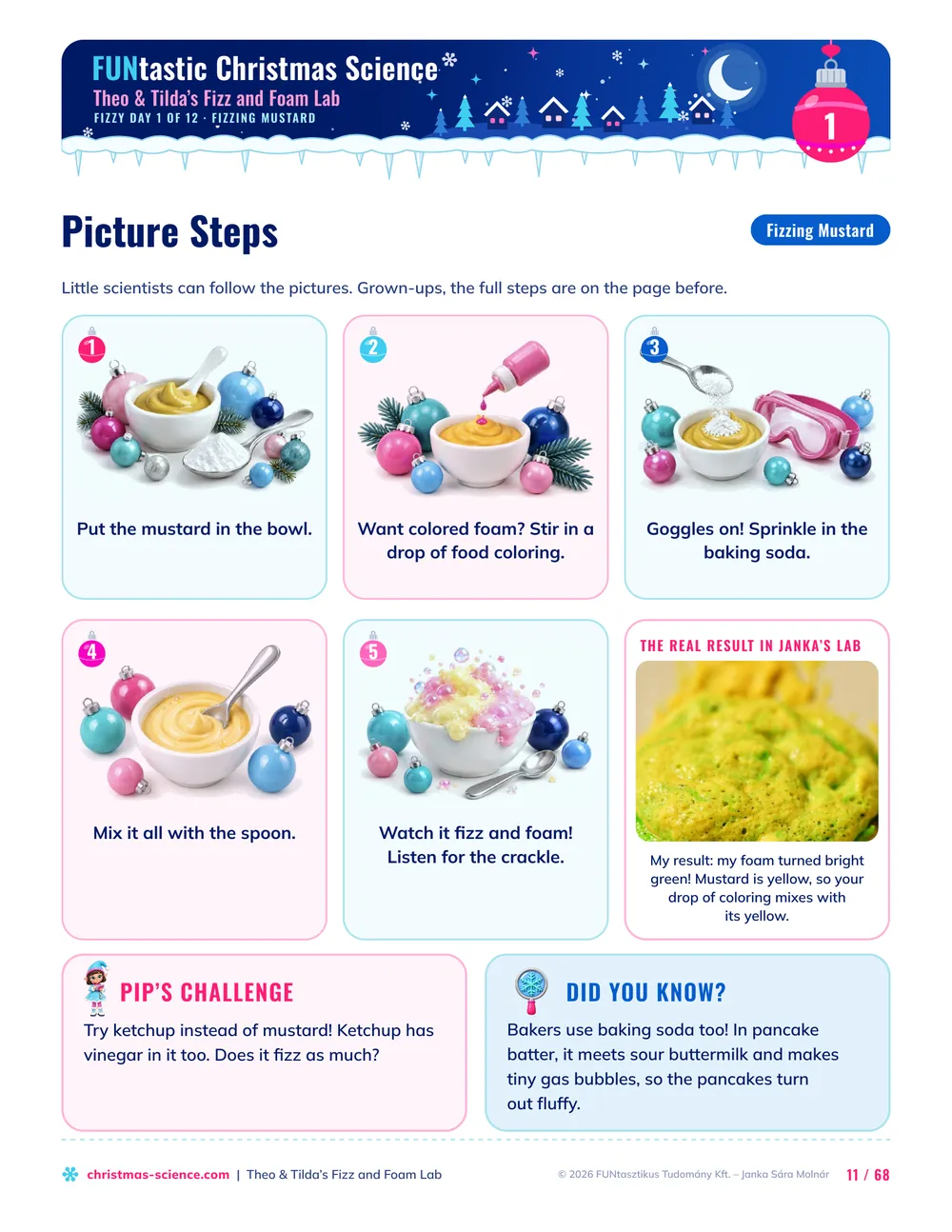
Picture steps for little hands, real photos, and talk questions in every adventure.
How do you make a foam mountain that spills over the bowl?
Add dish soap. Baking soda and vinegar alone make a fast fizz that is gone in seconds. A few drops of dish soap make a stretchy skin around every gas bubble, so the bubbles don’t pop right away. They pile up into a foam that climbs out of the bowl.
This is Fizzy Day 12 in the booklet, the grand finale. Put a bowl on a tray or in the sink and add 2–3 tablespoons of baking soda. Stir in a few drops of dish soap and a little pink or turquoise food coloring. Goggles on, pour about 120 mL (½ cup) of white vinegar onto the mixture all at once, then step back. Don’t taste the foam. For my photo, I used a tall bottle in a glass bowl, and the foam climbed out and spilled over.
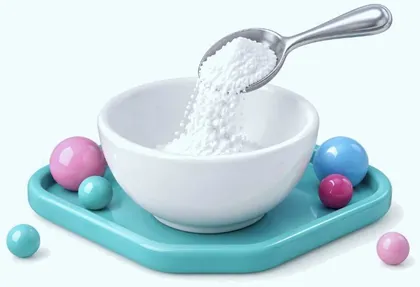 Put the bowl on a tray. Add the baking soda.
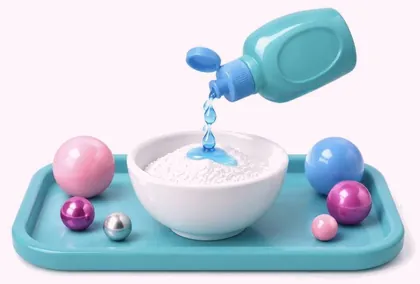 Stir in a few drops of dish soap.
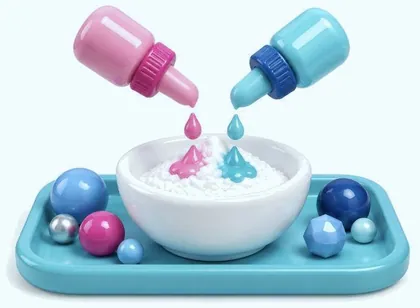 Add a little pink or turquoise coloring.
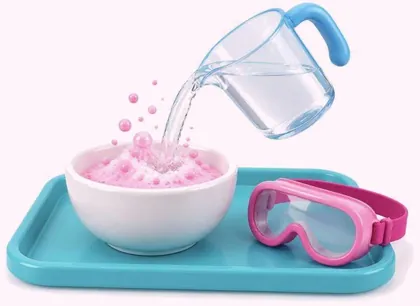 Goggles on! Pour in all the vinegar at once.
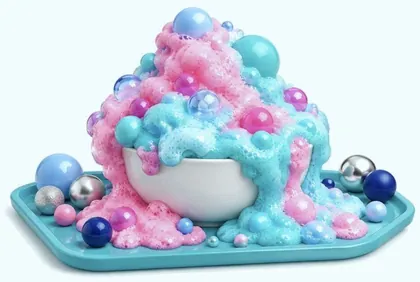 Step back and watch the foam mountain grow!
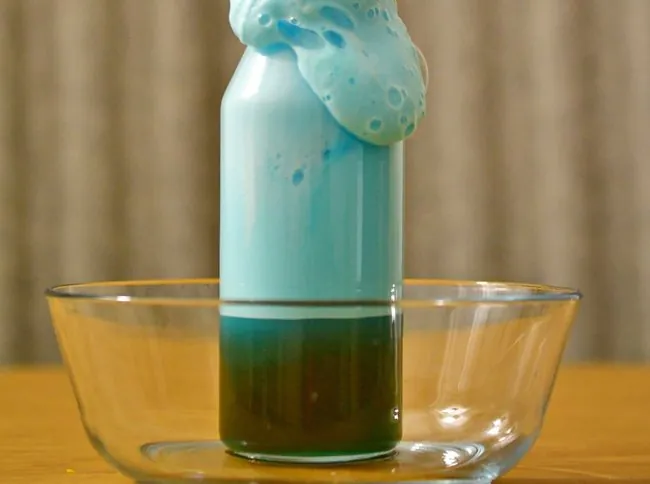
Make a second mountain without dish soap. How is the foam different? Which mountain lasts longer?
Children will call it a volcano, and that’s fine. The booklet adds the honest science: it only looks like one. In a real volcano, gases escaping from hot magma cause the eruption.
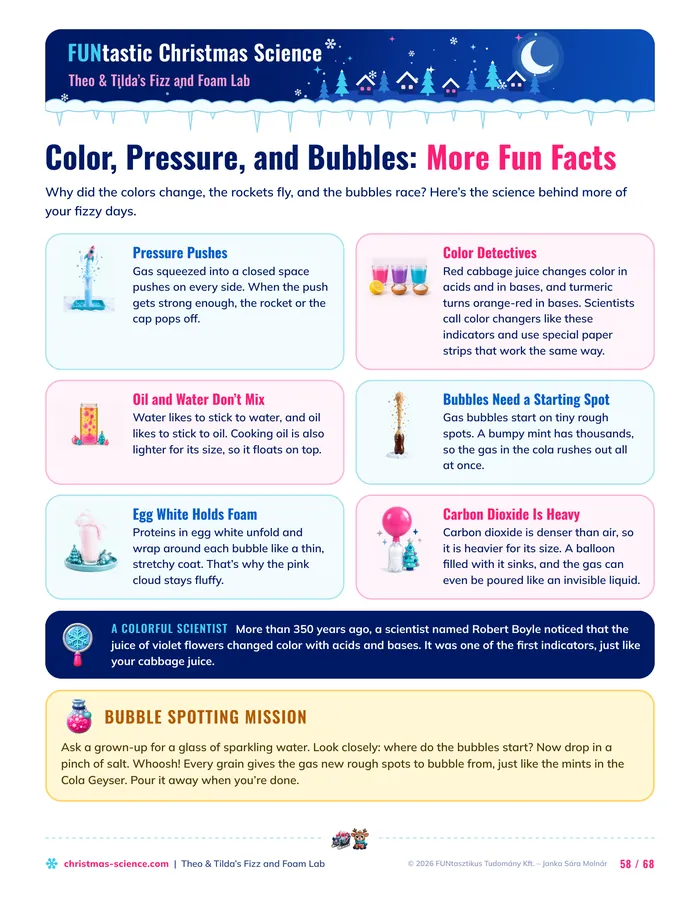
Ask a grown-up for a glass of sparkling water and drop in 5 raisins. Bubbles stick to the raisins and lift them up. At the top, the bubbles pop, and the raisins sink back down. How many times does one raisin go up? When you’re done, throw the raisins away.
Know a family that loves a good mess? The foam mountain is for them. Send it over. Share it
Step-by-step pictures for the foam mountain and every other fizzy day.
Can you really make an egg bounce?
Yes. The bouncy egg experiment needs a raw egg, white vinegar, and 2–3 days of patience. Eggshell is mostly calcium carbonate, the same stuff as limestone. The acid in vinegar dissolves it, and children can watch it start: tiny bubbles form on the shell almost right away.
Gently place the raw egg in a clear glass and cover it completely with vinegar. Cover the glass loosely, never airtight. The next day, a grown-up swaps the vinegar for fresh vinegar. After 1–2 more days the shell is gone. Lift the egg out with a spoon and gently rub off any soft bits of shell under cold water. Goggles on! Squeeze it softly, then bounce it from just above the tray. Raw egg can carry germs, so wash hands with soap and water after touching it, don’t eat the egg, and throw it away after playing.
Why doesn’t it fall apart? The thin membrane under the shell doesn’t dissolve, and it holds the egg together. Water seeps in through it, because the egg has less water inside than the vinegar does. That is osmosis, and it makes the egg swell a little.
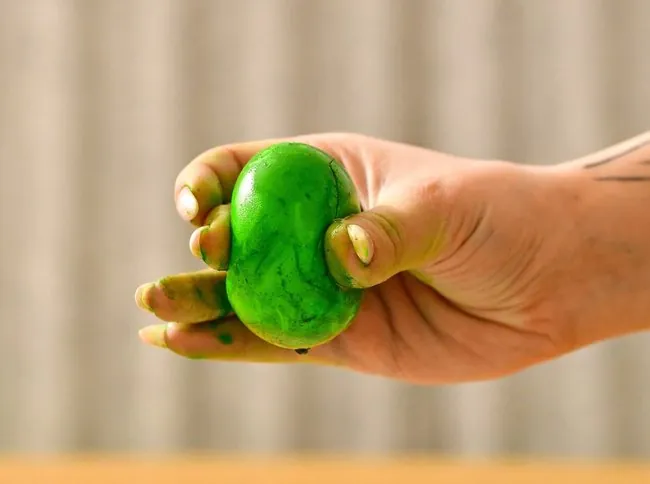
Before soaking, wrap a string around the fattest part of the egg and mark it. Do it again at the end. Did your egg grow?
In the booklet, the egg goes into the vinegar on Fizzy Day 3. You do the self-inflating balloon and the pink snow cloud on Days 4 and 5 while it soaks, then you bounce it. Buy one spare egg. While you wait, try Fizzwick’s “Count the Days” mission: wait without asking “Is it ready yet?” and mark the days on a calendar instead.
The day-by-day plan, field journal pages, and Fizzwick’s Count-to-Five patience mission.
Can baking soda and vinegar blow up a balloon?
Yes, all by themselves. This is Fizzy Day 4 in the booklet. Goggles on, pour about 100 mL (a scant ½ cup) of white vinegar into a small 500 mL (16.9 fl oz) plastic bottle. A grown-up stretches a pink or turquoise balloon by blowing it up and letting the air out a few times. Then you use a dry funnel to put 2 teaspoons of baking soda into the balloon, and the grown-up stretches its mouth over the bottle’s neck so it droops to one side. Hold it tight on the neck, lift the balloon, and the powder falls into the vinegar. Fizz! The balloon blows itself up. When the fizzing stops, the grown-up takes the balloon off, pointing the bottle away from faces.
Two teaspoons of baking soda can make up to about 2 liters of carbon dioxide gas, far more space than the powder took up, so the gas fills the balloon. Ask your child whether it will float to the ceiling. It won’t: carbon dioxide is heavier than air. Uninflated or broken balloons are a choking hazard for children under 8, so the grown-up handles the empty balloon and throws away broken pieces at once.
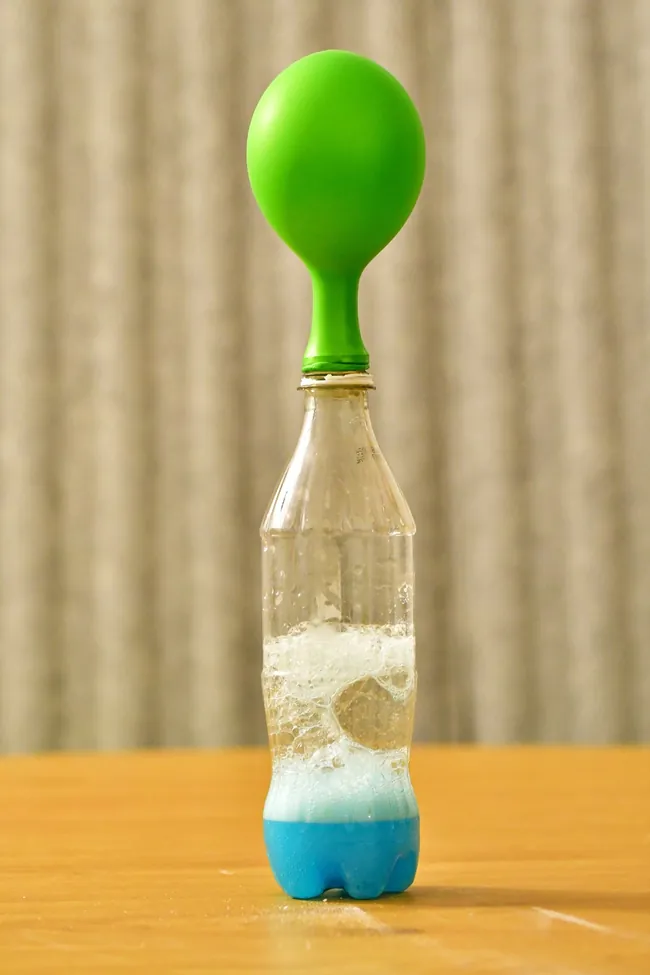
Set up a second bottle with fresh vinegar and only 1 teaspoon of baking soda. Measure around both balloons with string. Which one grew bigger?
A Pink Snow Cloud in a glass
Fizzy Day 5 shows why egg white matters in the kitchen. Before you start, a grown-up separates an egg in the kitchen, and you pour the white into a tall glass on a tray. Add a few drops of pink food coloring and 1 teaspoon of baking soda, and stir a little. Goggles on, pour in 4–6 tablespoons of vinegar. A fluffy pink cloud billows up over the top, and it stays fluffy, because the proteins in egg white wrap every bubble in a thin, stretchy skin. The same proteins hold meringues in shape. It has raw egg in it, so nobody tastes the foam, and everyone washes their hands at the end.
Make a second cloud with 2 tablespoons of water instead of the egg white. Which foam rises higher? Which one lasts longer?
The balloon, the snow cloud, and ten more fizzy days with picture steps and real photos.
How do you make a lava lamp with a fizzy tablet?
You need a tall glass jar without a lid, cooking oil, water, food coloring, and one plain fizzy vitamin C tablet. Fill the jar about ¾ full with oil, then add water until it’s almost full, and watch the water sink below the oil. Drip in a few drops of food coloring. They sink through the oil and color the water. Goggles on: a grown-up breaks the tablet in half and drops in one half.
The tablet makes carbon dioxide bubbles in the water. Each bubble carries a blob of colored water up through the oil. At the top, the gas escapes, and the blob sinks back down. Oil and water don’t mix, and oil is lighter for its size, so it always ends up on top. When the bubbling stops, the grown-up can drop in the other half. Afterward, pour the oil into a bottle with a cap and put it in the trash. Oil never goes down the sink.
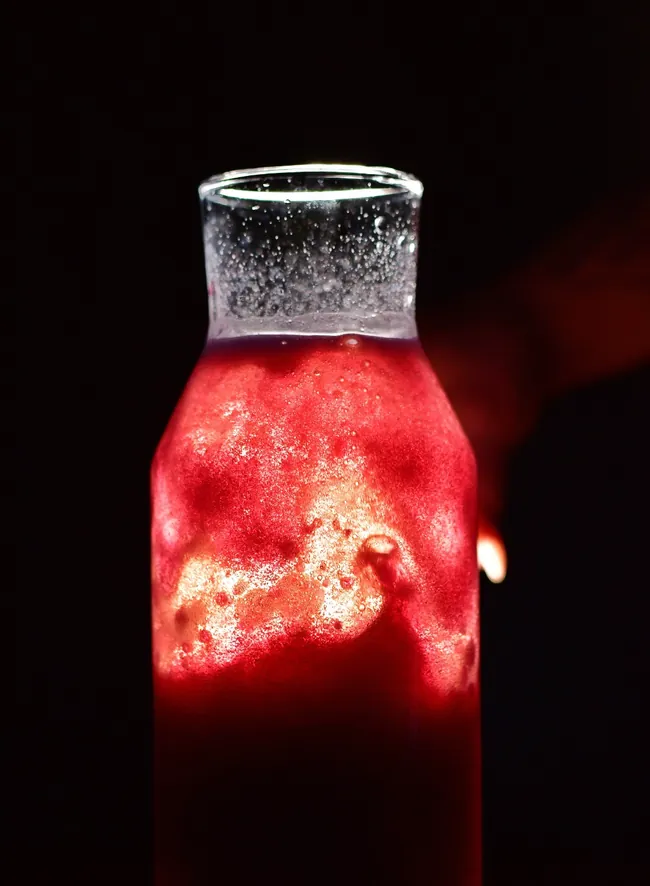
Dim the lights and shine a flashlight through the side of the jar. Then ask a grown-up to add the other half of the tablet.
In the booklet’s story, Pip notices that Dad stopped whistling after his old lava lamp broke, and the elves make him a new one. It’s a lovely one to make for someone you’d like to cheer up.
Which kitchen ingredients change color like magic?
Turmeric and red cabbage. Both are indicators: their color shows whether a liquid is an acid or a base. They are Fizzy Days 7 and 8 in the booklet.
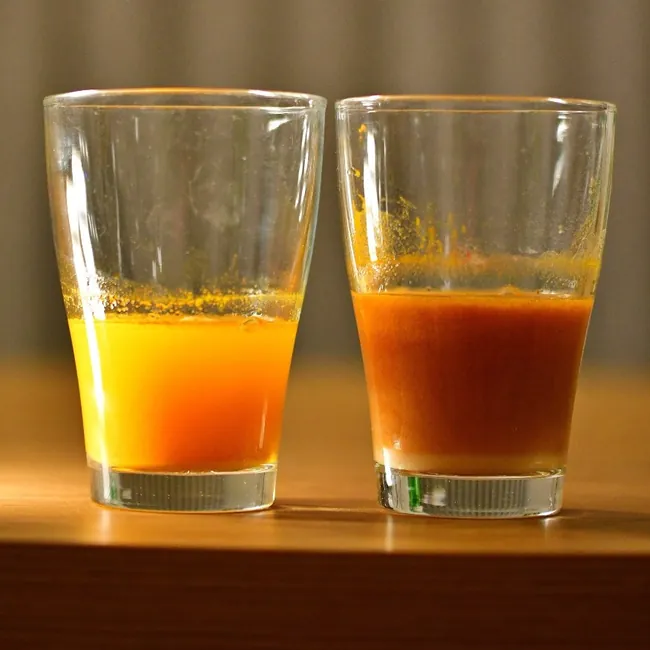
Turmeric Gold: goggles on, stir ½ teaspoon of ground turmeric into a glass of water, about 250 mL (1 cup). It turns yellow. Pour half into a second glass and set both in front of white paper. A grown-up adds 2 tablespoons of vinegar to the first glass: it stays yellow. Stir ½ teaspoon of baking soda into the second glass: it turns orange-red! Then the grown-up adds vinegar a spoonful at a time until the fizzing stops, and it turns yellow again. Turmeric stains, so wipe up spills right away.
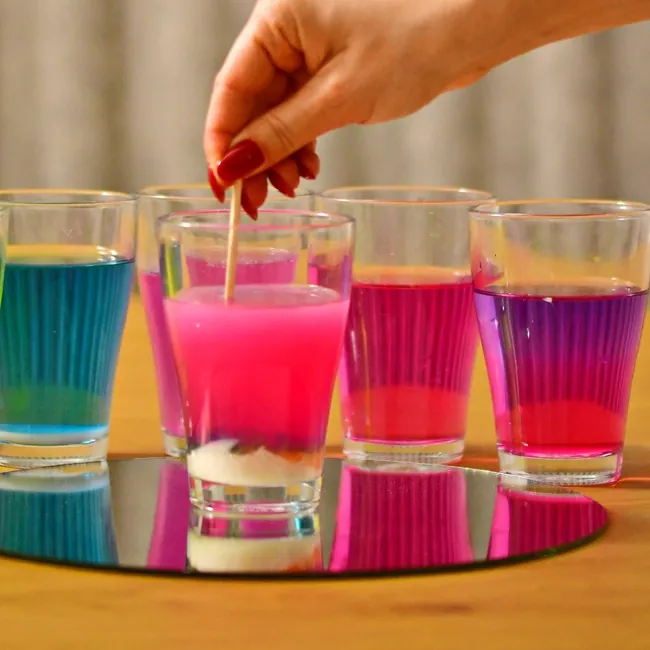
Cabbage Colors: a grown-up chops 2–3 red cabbage leaves, puts them in a heatproof bowl, and covers them with about 300 mL (1¼ cups) of hot water from the kettle. After 10 minutes, the grown-up strains the purple juice into a pitcher, and it cools for about 20 minutes. Pour about 2 cm (¾ in.) into each of 3 glasses in front of white paper. Goggles on: lemon juice turns the first glass pink, a pinch of salt leaves the second purple, and a pinch of baking soda turns the third blue-green. Test more kitchen liquids, like vinegar, milk, or tea, but never cleaning products.
Talk cards, a field journal page, and a challenge for every color-changing day.
How does a fizzy tablet rocket work?
A fizzy vitamin C tablet contains baking soda and citric acid. In water, they react and make carbon dioxide gas. In a closed tube, the pressure keeps building until it pops the cap off. The gas and water shoot down, and the tube flies the other way: up! That is action and reaction, and real space rockets work the same way. In the booklet, this is Fizzy Day 9, the first of three outdoor days.
Use a film canister or tablet tube with a snap-on cap, not a screw cap. Go outside and put on safety goggles. Never point the open end of the tube at anyone’s face. Add a little water, about 2 cm (¾ in.) deep. Your child drops in 1 plain fizzy vitamin C tablet (no iron, no medicine), and a grown-up quickly snaps the cap on tight, flips the tube cap-side down, and stands it on the ground. Everyone backs away at least 2 m (7 ft) and counts down together. A few seconds later… BOOM!
Three more rules from the booklet: a grown-up supervises every launch, grown-ups hand out the tablets one at a time, and if nothing happens for a minute, nobody leans over the tube. A grown-up opens the cap, pointing it away from everyone.
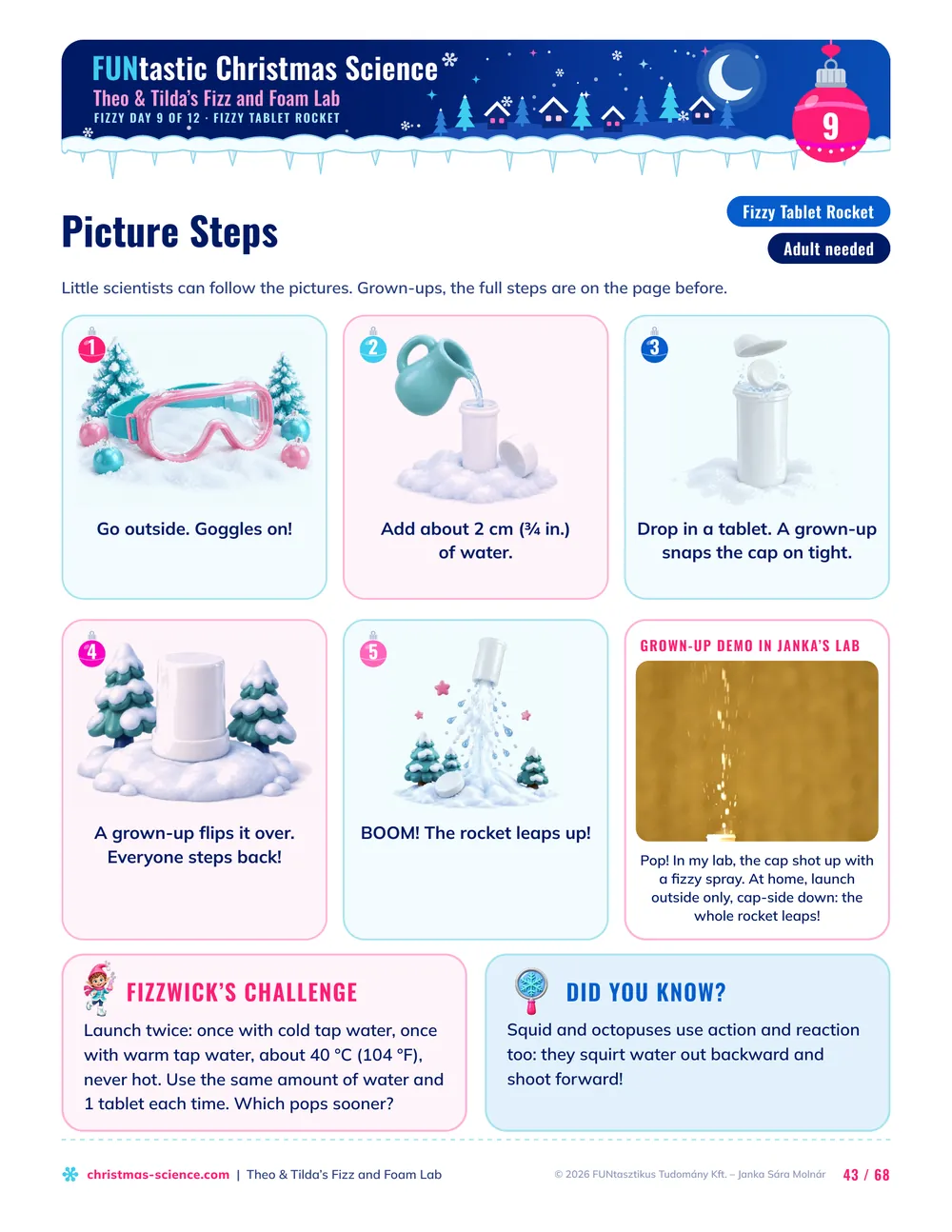
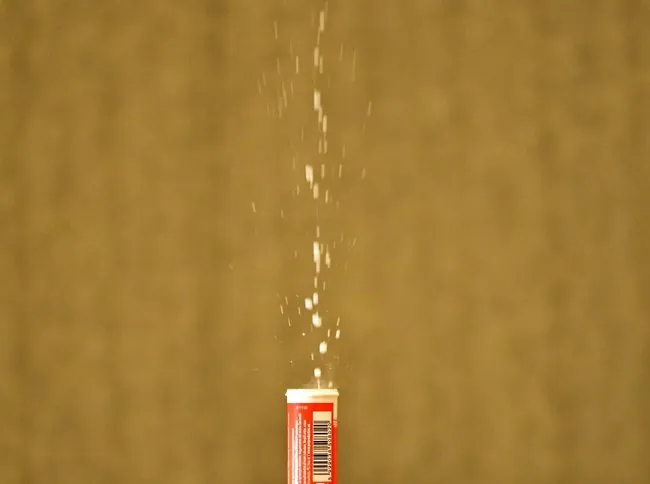
Launch twice: once with cold tap water, once with warm tap water, about 40 °C (104 °F), never hot. Use the same amount of water and 1 tablet each time. Which pops sooner? (Grown-ups: warm water usually speeds up the reaction.)
Foam Rocket and Cola Geyser: two more outdoor days
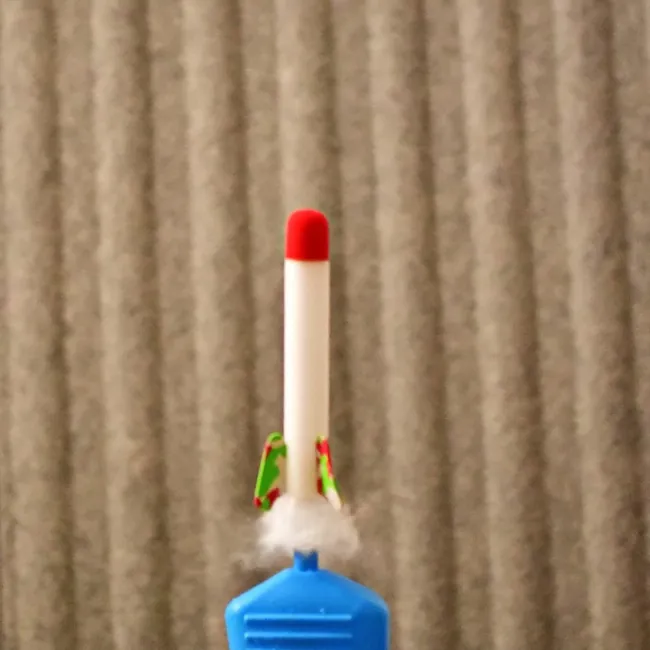
Foam Rocket (Fizzy Day 10): outside, goggles on, stand a plastic graduated cylinder (about 100 mL) on a tray and fill it halfway with vinegar, about 50 mL (3 tablespoons). Wrap about 1 teaspoon of baking soda in a small square of tissue and tuck the packet into the base of a small foam rocket that fits snugly in the cylinder’s mouth. A grown-up quickly pushes the rocket in, so the packet drops into the vinegar, then lets go and steps back. Children watch from at least 2 m (7 ft) away. The gas can’t escape, so the pressure builds until the rocket pops up.
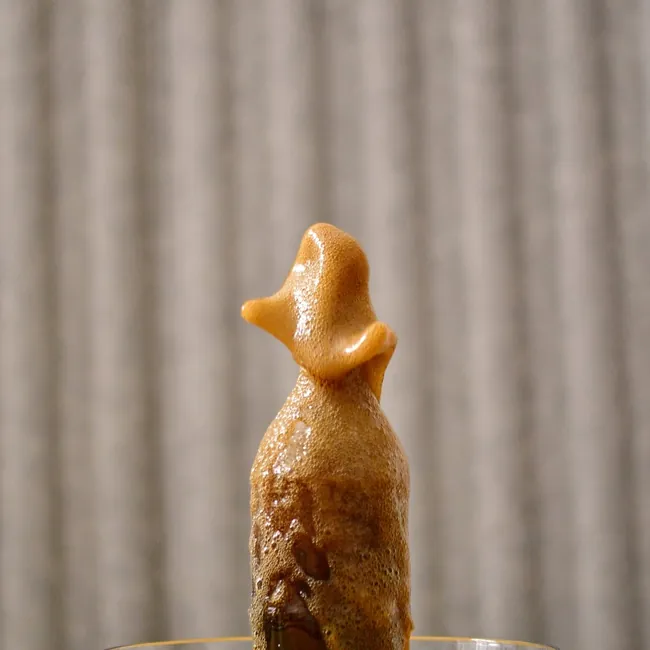
Cola Geyser (Fizzy Day 11): a grown-up picks a safe spot outside on flat, firm ground. Goggles on, unscrew a 2-liter bottle of cola, roll a sheet of paper into a narrow tube, stack a roll of mint Mentos inside, and drop them all in at once from arm’s length, without leaning over the bottle. Right away, turn and walk at least 3 m (10 ft) away. For children under 6, a grown-up drops the mints. Keep the cola indoors at room temperature until you start: cold cola makes a much smaller fountain. The mints’ bumpy surface gives the gas in the cola thousands of starting spots, so it rushes out all at once as a foam fountain. No chemical reaction, just a very fast escape of gas.
These twelve are experiments 2, 22, 42, 20, 43, 48, 31, 4, 7, 18, 1, and 35 from my big book of Christmas science experiments for kids, Theo & Tilda’s Christmas Science Adventure. In the Fizz and Foam Lab, their stories are retold with Fizzwick and Pip, and you also get picture steps, talk cards, a field journal, games, and collector cards. The big book has 51 stories and 51 experiments with real photos (39 more adventures beyond these twelve), a 24-day December plan, and an adventure map.
Start with the twelve fizzy days for $4.99, or go for all 51 Christmas experiments.
What’s inside the Fizz and Foam Lab?
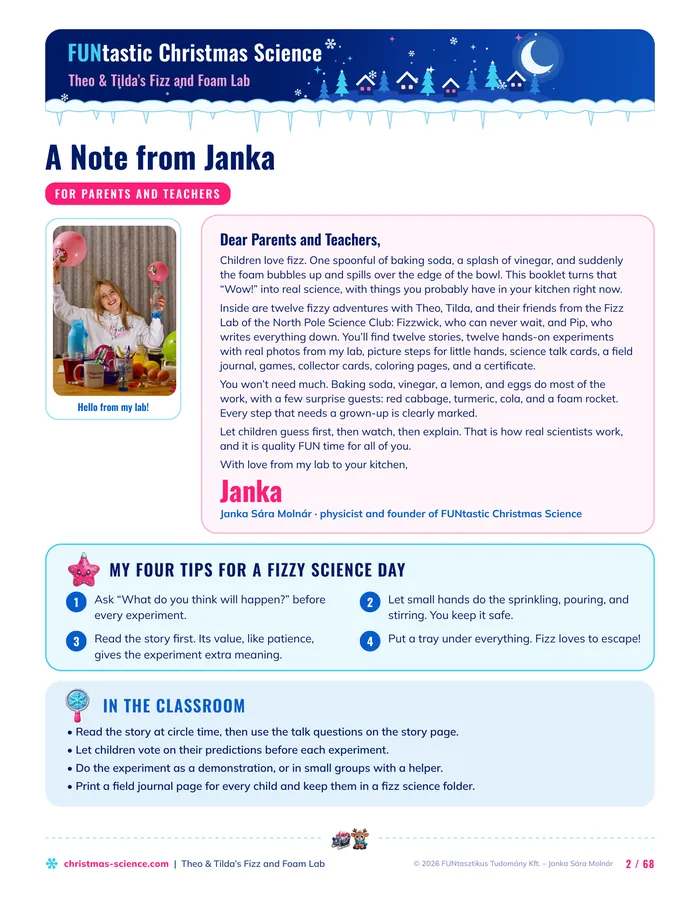
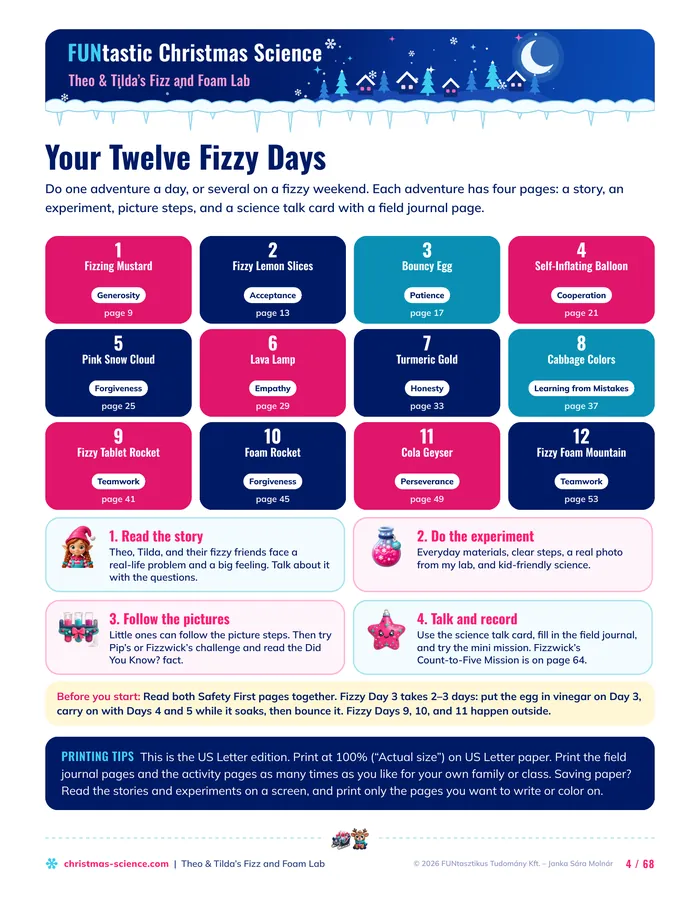
- 12 stories with Theo, Tilda, Fizzwick, and Pip, each with a value (generosity, acceptance, patience, cooperation, teamwork, forgiveness, empathy, honesty, learning from mistakes, perseverance) and talk questions
- 12 hands-on experiments with real photos from my lab and the science in kid-friendly words
- Picture steps for little hands, Pip’s and Fizzwick’s challenges, and Did You Know? facts
- Science talk cards and field journal pages
- Two fun facts pages, with the Dancing Raisins and the Bubble Spotting missions
- Games: Pip’s Fizz Detective Game, Fizzwick’s two-page Fizzy Quiz, and twelve Count-to-Five patience missions
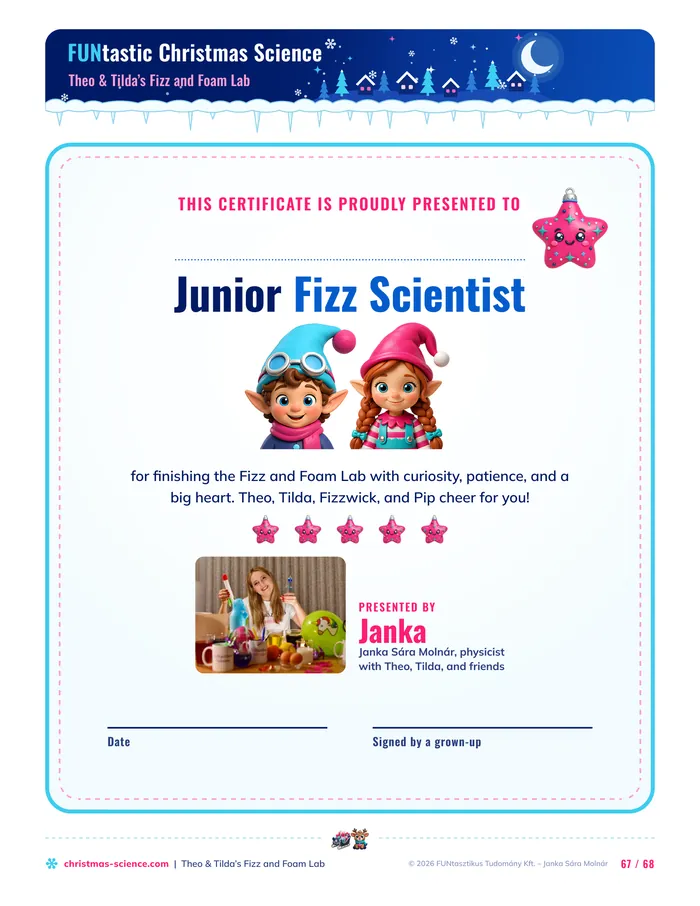
- Coloring pages, collector cards, Pip’s “I Noticed!” card, and a Junior Fizz Scientist certificate
- A two-page shopping list, two Safety First pages, and tips for the classroom
- 68 pages, in US Letter and A4, $4.99
One purchase covers one family, or one teacher with their own group or class.
68 pages of fizz, foam, stories, and games for ages 3–9. $4.99.
Shared Fizz Is the Best Fizz
She walked over. “There’s enough for both of us!” Zack smiled shyly.
After they ate, Theo the Science Elf put the leftover mustard in a bowl, and Fizzwick zoomed up with a spoonful of baking soda. “Fizz first!”
Pip caught his sleeve. “Wait! Who hasn’t had a turn yet?” Fizzwick looked at Zack and held out the spoon. “Goggles on! You sprinkle!”
The mustard began to fizz and foam, and Tilda and Zack giggled together. Pip wrote in her notebook: “Generous friends! Shared fizz is the best fizz.” From that day on, Zack sat next to Tilda at preschool every morning.
Mini mission for the week Share something with a friend: a toy, your snack, or a good idea!

Know a family who’d love this?
This week’s mini mission in the story is to share something with a friend. Sharing this post counts too! Send it to a family who’d love twelve fizzy days.
COPY THIS MESSAGE
Paste it into a parent group chat, or send it to a friend.
Look what I found! Twelve fizzy science experiments for kids 3–9 with things from the kitchen: a balloon that blows itself up, a lava lamp, color-changing cabbage juice, a cola geyser, and more. A physicist explains why each one fizzes. www.christmas-science.com/blog/fizzy-science-experiments-for-kids
Fizzy science experiments for kids: quick answers
What household liquids fizz with baking soda?
Liquids with enough acid in them. White vinegar, lemon juice, orange juice, and ketchup all fizz. Water, milk, cooking oil, and sugar water don’t. Mustard fizzes too, because most mustard contains vinegar.
Are fizzy science experiments OK for preschoolers?
Yes, done together with a grown-up. In the Fizz and Foam Lab, everyone wears safety goggles, indoor experiments happen on a tray, nobody tastes or sniffs anything, and every step that needs a grown-up is clearly marked: cutting the lemon and the cabbage, pouring hot water, handling the empty balloon, and the fizzy tablets. The two rockets and the cola geyser happen outside. For children under 6, use plastic cups instead of glass and keep tablets, caps, mints, and raisins away from mouths. Check for allergies first: Day 1 uses mustard, Days 3 and 5 use egg, Day 4 uses a balloon (latex), and Pip’s game and the Day 7 and 8 challenges use milk.
How long does the bouncy egg experiment take?
Two to three days. The egg sits in vinegar overnight, a grown-up swaps in fresh vinegar the next day, and after 1–2 more days the shell is gone.
Can I use baking powder instead of baking soda?
Use baking soda. Baking powder is baking soda mixed with a dry acid and starch, so a spoonful has less baking soda and gives a weaker fizz with vinegar. It even fizzes in plain water. It is made for baking: in wet batter it makes tiny gas bubbles, so muffins and cakes rise.
Which fizzy experiments should be done outside?
The Fizzy Tablet Rocket, the Foam Rocket, and the Cola Geyser (Fizzy Days 9, 10, and 11). Pick flat ground with lots of space, everyone wears goggles, nobody leans over a rocket or the bottle, and everyone moves back right away: at least 2 m (7 ft) from the rockets and 3 m (10 ft) from the geyser. For children under 6, a grown-up drops the mints into the cola.
What is in the Fizz and Foam Lab, and how much does it cost?
It is a 68-page printable booklet for ages 3–9, in US Letter and A4, for $4.99. It has 12 stories with Theo, Tilda, Fizzwick, and Pip, 12 experiments with real photos from Janka’s lab, picture steps, talk cards, a field journal, two fun facts pages, games, collector cards, coloring pages, and a certificate.