Candle Experiments for Kids: 11 Christmas Science Labs to Do with a Grown-Up
A physicist’s guide for parents: what to try, why it works, and the one rule that never changes.
Save it for a cozy December evening, or send it to a parent with a curious 10-year-old.
Tilda begged to see sugar turn into gold. Granny Glow promised to show her, then stepped out to the front door to meet the mail carrier. “Keep an eye on your sister!” she called to Theo the Science Elf.
Tilda pointed at the candle and the lighter on the table. “You do it! Granny will never know.”
Theo was tempted. Then Wick began his check: “Goggles on? Grown-up here?” He stopped. “No grown-up. So no go.”
What would you do if you were Theo? The end of the story is near the end of this post.
Know a parent whose kid keeps asking to light the candles? Send this to them. In every lab here, the lighter stays in a grown-up’s hand. Share it
1What are the best candle experiments for kids?
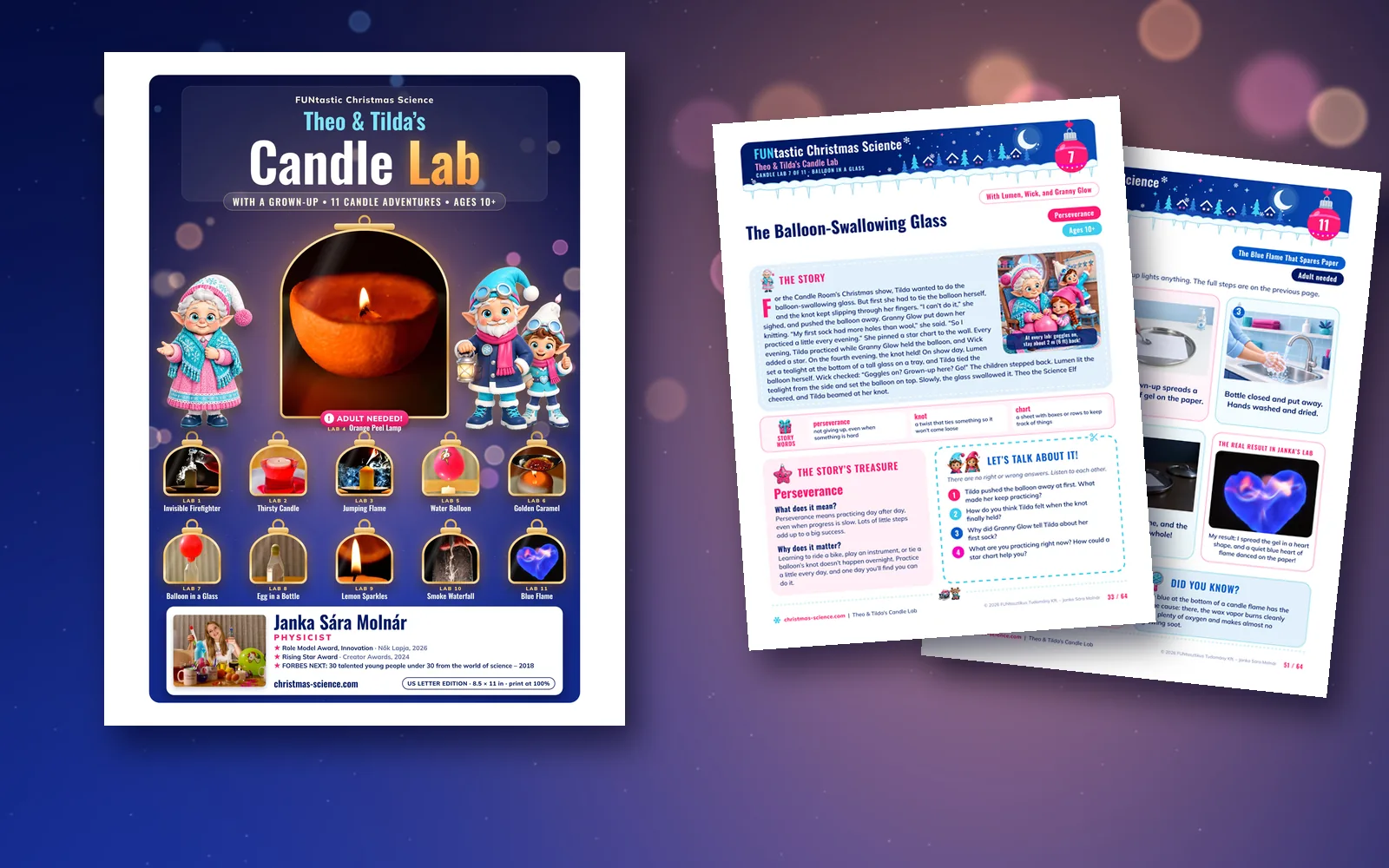
The best candle experiments for kids let children do the thinking while a grown-up handles the flame. My Candle Lab has eleven of them, for ages 10 and up: candles that go out with an invisible gas, water that climbs into a glass, a candle that relights through its smoke, an orange-peel lamp, a water balloon that won’t pop over a flame, sugar that turns into golden caramel, a glass that swallows a balloon, an egg that slides into a bottle, lemon juice that sparkles in a flame, smoke that pours like a waterfall, and a blue flame that leaves paper whole.
Most of what you need is already in your kitchen. In every lab, a grown-up lights, holds, and puts out the flame, and the children watch from about 2 m (6 ft) away. I’m a physicist, and I’ve run several hundred science shows for children and families. Children are fascinated by flames: the moment I light a candle, the whole room goes quiet. These eleven labs give that curiosity a safe place to grow.
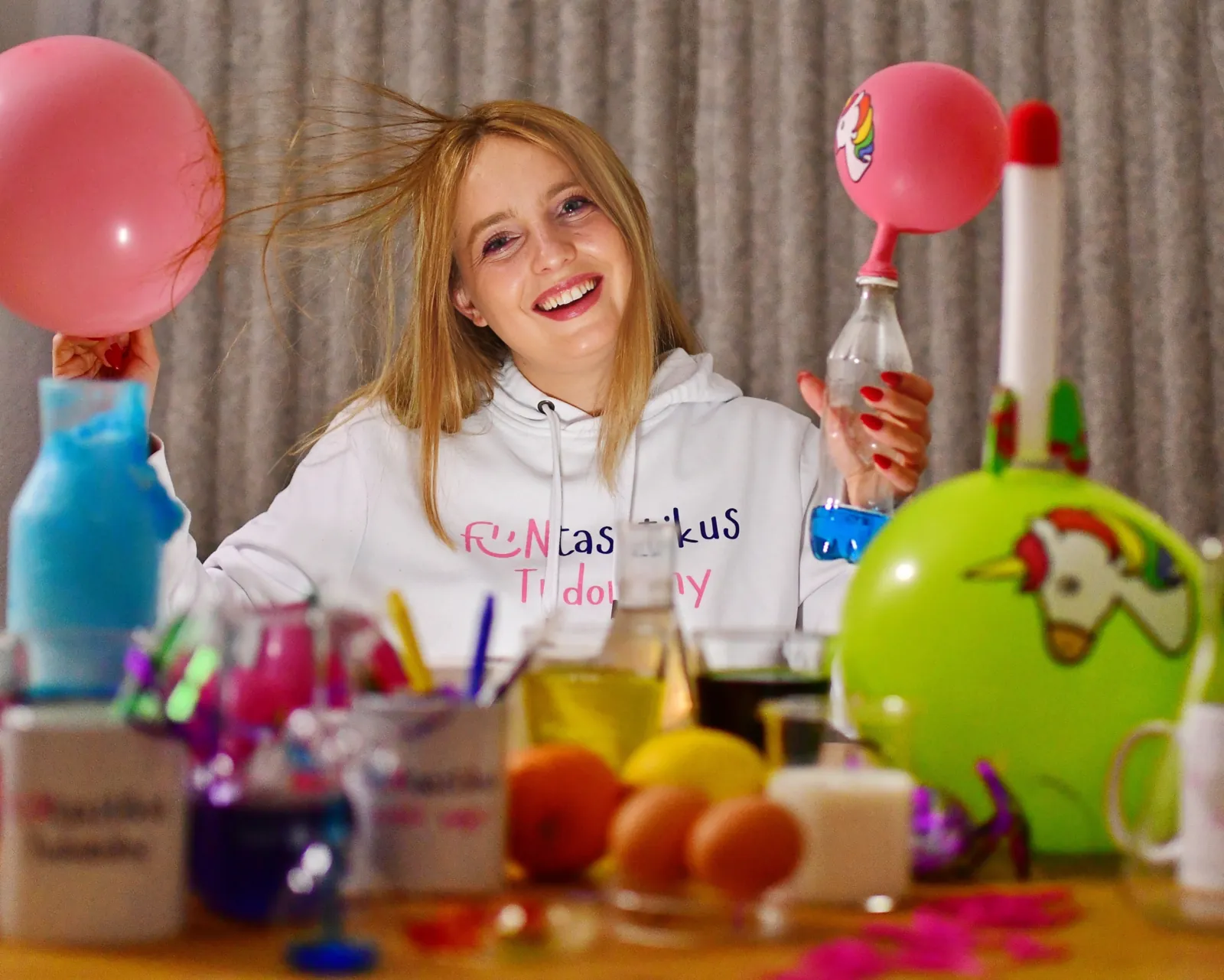
The Invisible Firefighter
Tealights go out one by one, and nobody blows. Baking soda and vinegar make carbon dioxide, which pours like an invisible liquid and pushes the oxygen away.
You need: 2 tsp baking soda, about 100 mL (a scant ½ cup) white vinegar, a tall glass, 3–4 tealights on a fireproof tray.
The Thirsty Christmas Candle
A glass goes over a candle, the flame goes out, and the water creeps up into the glass. The main reason is cooling gas and air pressure. Used-up oxygen is only a small part of the story.
You need: a short, thick candle, a deep plate, water, a sturdy glass at least 5 cm (2 in) taller than the candle.
The Flame’s Smoky Slide
A flame slides down a trail of white smoke and relights the candle. What burns in a candle is wax vapor, and fresh smoke is full of tiny wax droplets.
You need: a candle in a sturdy, fireproof holder on a ceramic plate, a long-reach lighter (grown-ups only).
Orange Lamp on the Table
Half an orange becomes a calm little oil lamp. The white strand in the middle soaks up oil by capillary action and works as a wick.
You need: 1 orange, 2–3 tbsp plain cooking oil, a ceramic plate, a metal lid wider than the orange, 1 sharp knife (grown-ups only).
The Balloon That Won’t Pop
An air balloon over a flame goes pop. A water balloon doesn’t, because the water soaks up the flame’s heat and the rubber never gets hot enough to pop.
You need: 2 latex balloons, about 100 mL (a scant ½ cup) water, a candle, a big metal tray.
Sugar Turns to Gold
A teaspoon of sugar melts, turns golden, then amber, and starts to smell like caramel. Heat makes hundreds of new substances: a real chemical change.
You need: 1 tsp granulated sugar, a metal tablespoon, a wooden clothespin, a candle.
The Balloon-Swallowing Glass
A tealight burns at the bottom of a tall glass. A balloon goes on top, the flame goes out, and the glass slowly swallows the balloon. The hot gas inside cools, and the air outside pushes the balloon in.
You need: 1 latex balloon, 1 tealight, a tall, sturdy glass at least 15 cm (6 in) tall, a fireproof tray.
An Egg Moves In
A peeled hard-boiled egg sits on a glass bottle and won’t go in. A burning paper strip drops inside, and soon the egg slides in all by itself. Air pressure does the pushing.
You need: 1 peeled hard-boiled egg, a glass bottle with a mouth a little smaller than the egg, a thin paper strip, long metal kitchen tongs.
Lemon Sparkles by Candlelight
A fine mist of lemon juice makes tiny orange sparks in a candle flame. The water boils away in a flash, and the bits of sugar, citric acid, and minerals left behind glow and burn.
You need: 1 lemon, a small strainer and a funnel, a small spray bottle that has only ever held water, a candle in a sturdy, fireproof holder, a fireproof tray.
Fog Falls on the Snowy Mountain
Smoke pours down a paper tube like a waterfall, then floats in a tall glass on a layer of invisible carbon dioxide.
You need: 1 tsp baking soda, 50 mL (about 3 tbsp) white vinegar, a tall glass, ½ sheet of thin paper, a ruler, a glass of water.
The Blue Flame That Spares Paper
A quiet, pale blue flame dances on paper, and the paper stays whole. Only the alcohol vapor burns, and the water in the gel keeps the paper too cool to catch fire. A grown-up does this whole lab.
You need: a palm-sized piece of paper, hand sanitizer gel with ethyl alcohol (grown-ups only), a metal tray, a metal lid.
Each lab has four pages in the booklet: a read-aloud story, the experiment, picture steps with my real photo, and a science talk card with a field journal page. Do one lab a day, or one each weekend.
2How do you do candle experiments safely with kids?
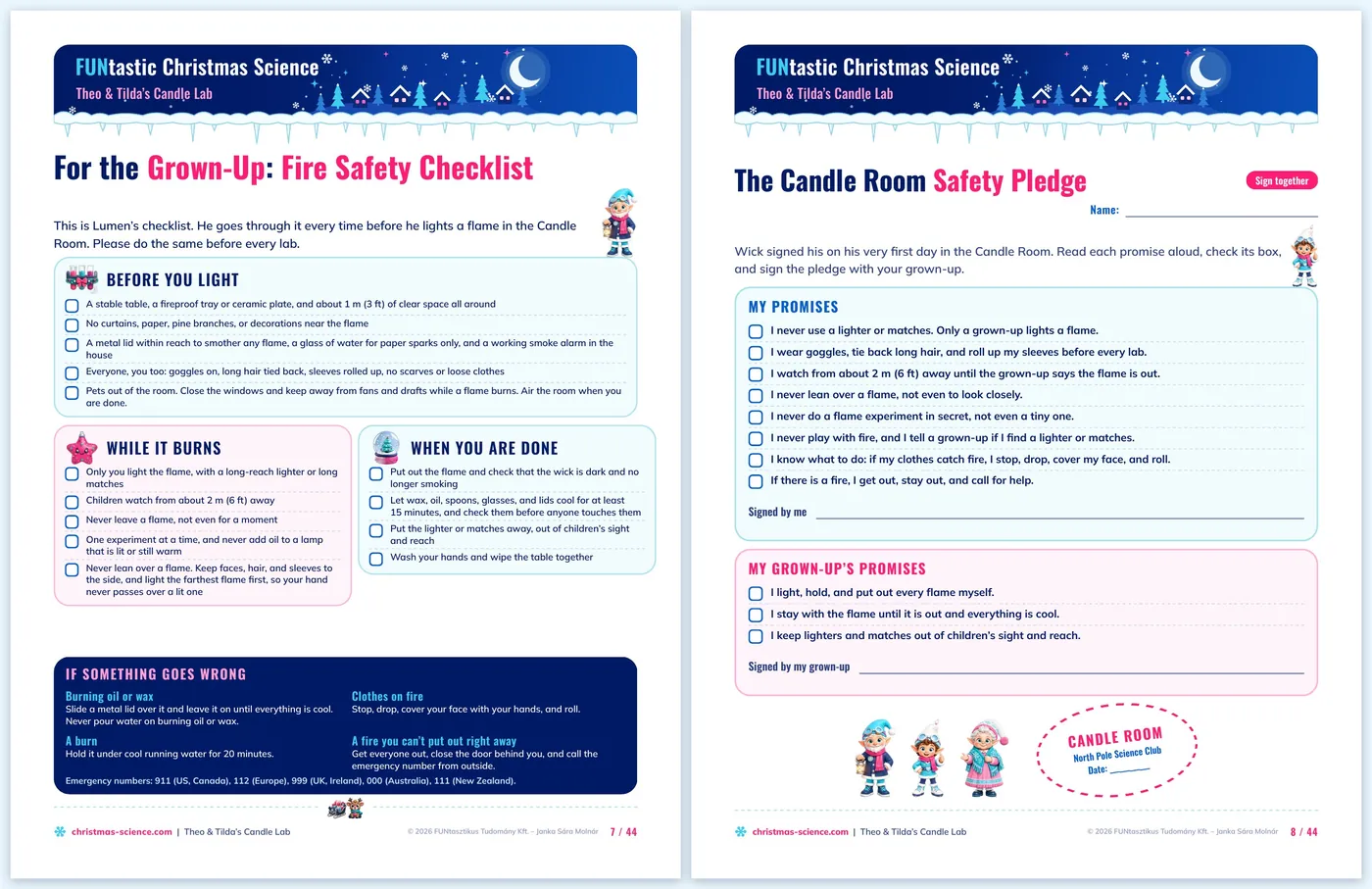
One rule runs through every page of my booklet, and it never changes: only a grown-up lights, holds, and puts out a flame. Children prepare, predict, watch from about 2 m (6 ft) away, and explain.
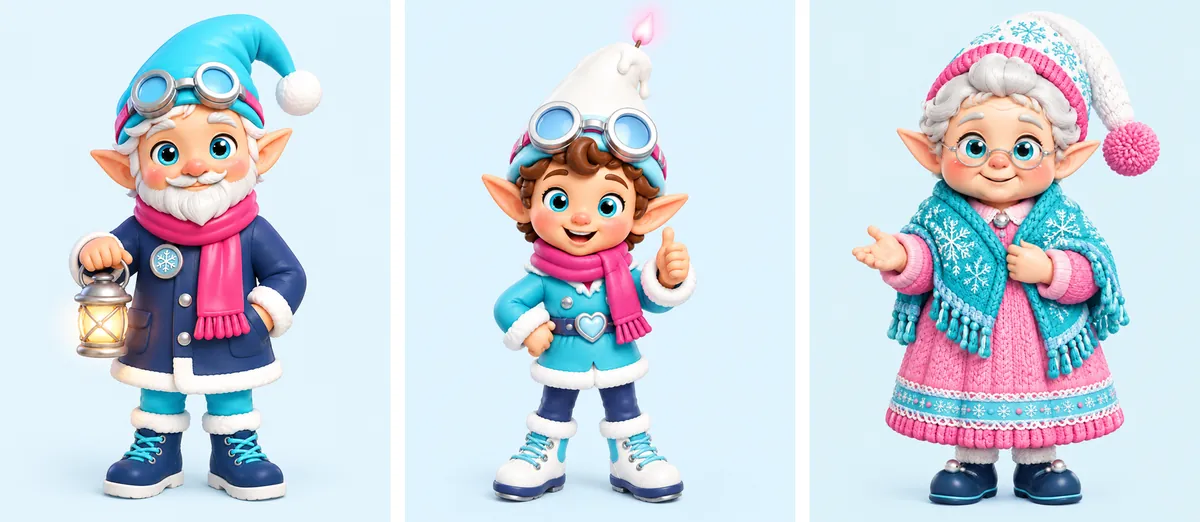
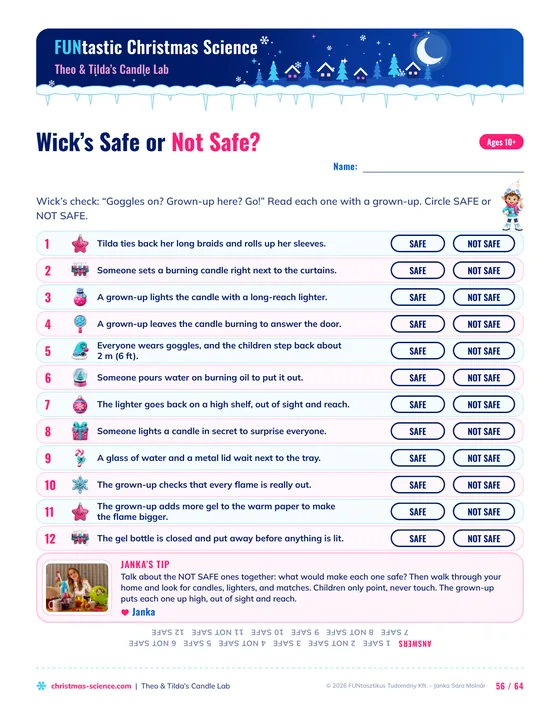
Before every lab, Wick, Lumen’s eager apprentice, runs his check: “Goggles on? Grown-up here? Go!” Teach it before the first lab. Then go through this list before you light anything:
- Build the safety corner first: a fireproof tray or ceramic plate, a metal lid big enough to cover the flame and its holder, and a glass of water. The water is only for a spark on paper. Never pour water on burning oil or wax: slide the lid over it and leave it on until everything is cool.
- Clear about 1 m (3 ft) around the flame: no curtains, paper, pine branches, or Christmas decorations. Pets out of the room, windows closed, no fans or drafts. Air the room when you’re done.
- Everyone, you too: goggles on, long hair tied back, sleeves rolled up, no scarves or loose clothes.
- Never lean over a flame. Keep faces, hair, and sleeves to the side, and light the farthest flame first, so your hand never passes over a lit one. Use a long-reach lighter or long matches.
- Never leave a flame, not even for a moment. Do one experiment at a time, and have a working smoke alarm in the house.
- Let it cool: wax, oil, spoons, glasses, and lids stay hot. Wait at least 15 minutes, and check them before anyone touches them.
- When you’re done, check that the wick is dark and no longer smoking. Then the lighter goes up high, out of children’s sight and reach.
After your first lab, walk through your home together and look for candles, lighters, and matches. Children only point, never touch. The grown-up puts each one up high. Then do Lumen’s home fire-safety mission: press the test button on your smoke alarm, find two ways out of every room, and choose a meeting place outside, like a tree or a mailbox.
Doing the labs with a partner or a grandparent? Send them this safety list first, so every grown-up knows the rules. Share it
3Why does the water rise in the candle and glass experiment?
Mainly because the gas in the glass cools. You may have heard that the candle “uses up the oxygen,” but that’s only a small part of the story. The flame swaps most of that oxygen for carbon dioxide and water vapor.
The flame heats the air in the glass. Warm air expands, so a little of it may bubble out as the glass goes down. The flame goes out when too little oxygen is left. Then the gas inside cools, its pressure drops, and water vapor from the flame condenses. The higher air pressure outside pushes water into the glass.
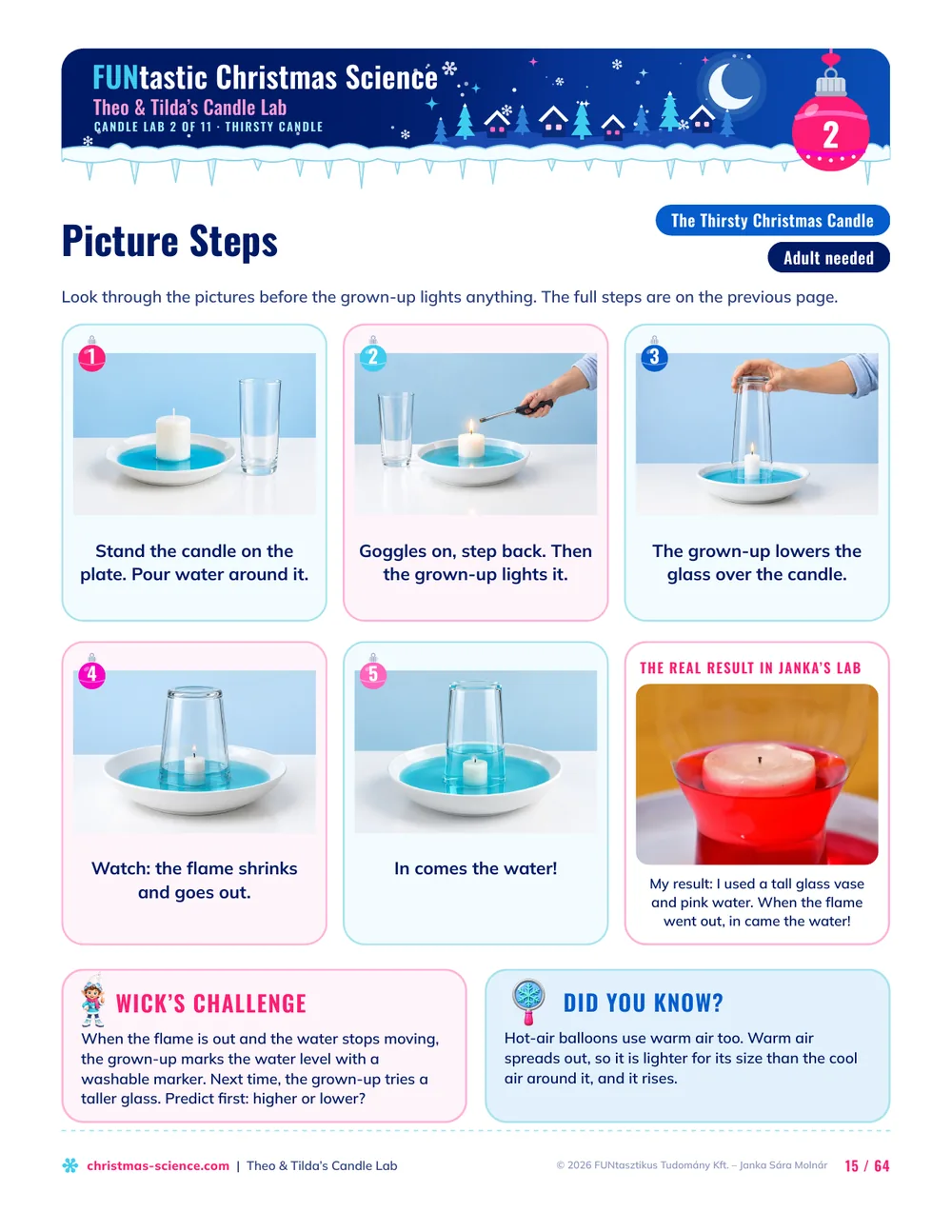
How to set it up: center a short, thick candle on a deep plate and pour water around it, 1–2 cm (⅜–¾ in) deep. A few drops of blue food coloring make it easy to see. Use a sturdy glass with no chips or cracks, at least 5 cm (2 in) taller than the candle. Work on a fireproof surface. Everyone puts on goggles, and children step back to about 2 m (6 ft). Then the grown-up lights the candle, holds the glass by its bottom, and slowly lowers it until the rim dips under the water. Let the glass cool for 15 minutes before anyone lifts it.
What to watch for: the flame shrinks and goes out, and in comes the water. You may see a faint mist inside the glass. That’s water the candle made.
Make it a real investigation with Wick’s challenge: when the flame is out and the water stops moving, the grown-up marks the level with a washable marker. Next time, the grown-up tries a taller glass. Predict first: higher or lower? And ask the question from the talk card: have you ever seen a jar lid stick tight after the hot food inside cooled down? Same physics.
Same physics: the egg in a bottle and the balloon in a glass
Two more labs in the booklet run on cooling air. In the egg in a bottle experiment, a grown-up holds a thin paper strip with long metal tongs, lights it beside the bottle, drops it in, and right away, coming in from the side, sets a peeled hard-boiled egg on the mouth, narrow end down. The egg wobbles while warm air escapes past it. The egg seals the bottle, the flame goes out, and the air inside cools. Its pressure drops, and the air outside pushes the egg in. The flame doesn’t “suck” the egg in.
In the balloon in a glass experiment, a tealight burns at the bottom of a tall glass, and the grown-up, holding it by its knot from the side, sets a balloon, a little bigger than the mouth of the glass, straight on top. The flame goes out, the gas cools, and the glass slowly swallows the balloon. Wait 15 minutes, until the grown-up says the glass is cool, then try to pull the balloon out. It’s stuck surprisingly tight.
Know a grown-up who loves a good “why” question? Send them this one. Share it
4Can you put out or relight a candle without touching it?
Yes: with an invisible gas, and with smoke. These two labs look like magic, and both have a clear physics answer.
Put out candles with baking soda and vinegar
Set 3–4 tealights in a row on a fireproof tray, about 5 cm (2 in) apart. Put 2 tsp baking soda in a tall glass, 400 mL (14 fl oz) or more, and pour in about 100 mL (a scant ½ cup) vinegar a little at a time, so the foam doesn’t spill over. Wait for the fizzing to die down. Now the glass is full of invisible carbon dioxide. Everyone puts on goggles, and children step back to about 2 m (6 ft). Then the grown-up lights the tealights, farthest first, and slowly tips the glass over the flames from the side, as if pouring the gas onto them. Don’t pour out the liquid! Finally, the grown-up checks that every tealight is really out.
Carbon dioxide is about 1.5 times denser than air, so it flows down, surrounds each flame, and pushes the oxygen away. The foam doesn’t put out the flames. The invisible gas does. Lumen’s challenge: ask the grown-up to pour very slowly. Do all the flames go out at once, or one after another? Which one goes out first?
Relight a candle through its smoke
Everyone puts on goggles, and children step back to about 2 m (6 ft). The grown-up lights a candle and lets it burn for at least half a minute, so the wax around the wick melts. Then they blow it out gently and evenly, so the hot wax doesn’t splatter, and right away hold a lighter’s flame in the white smoke, 2–3 finger-widths above the wick, not on it. If all goes well, the flame runs down the smoke and the candle relights. If not, the grown-up tries again.
Why? The wick soaks up melted wax, and the heat turns it into vapor. It’s the wax vapor that burns, not the solid wax. Right after the flame goes out, the hot wick still makes vapor, and the white “smoke” is tiny wax droplets that can catch fire. Wick’s challenge: how high can the flame jump? The grown-up tries 2, then 3, then 4 finger-widths above the wick. Which heights work?
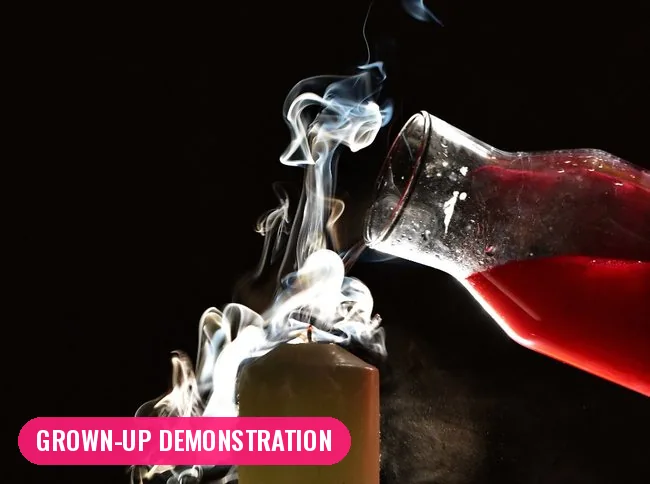
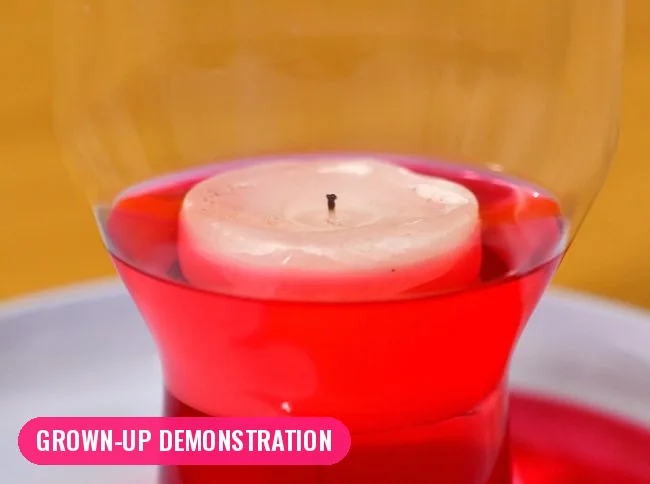
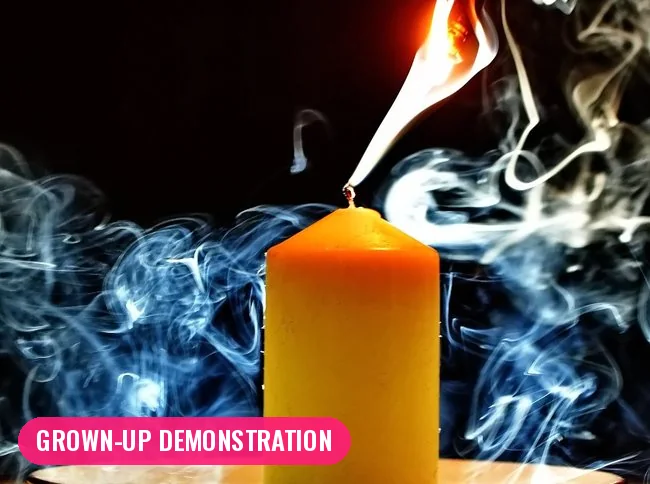
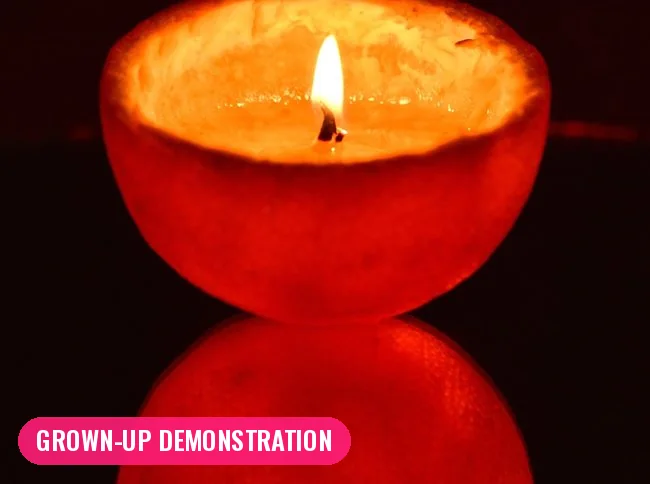
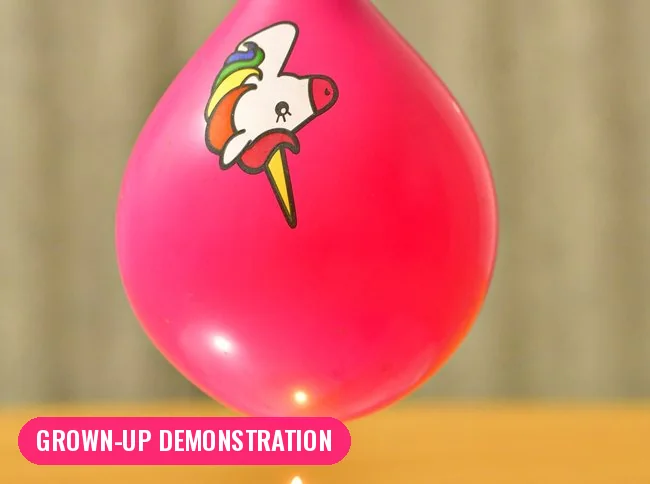
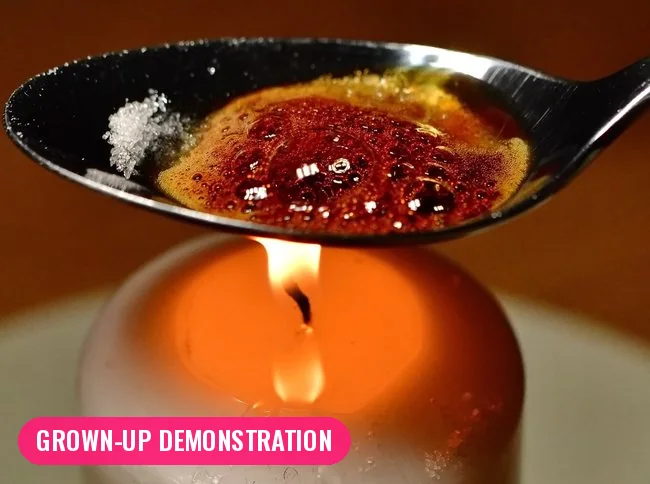
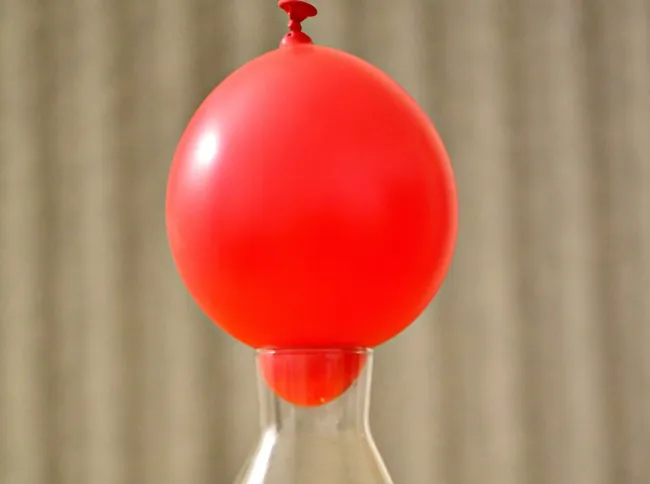
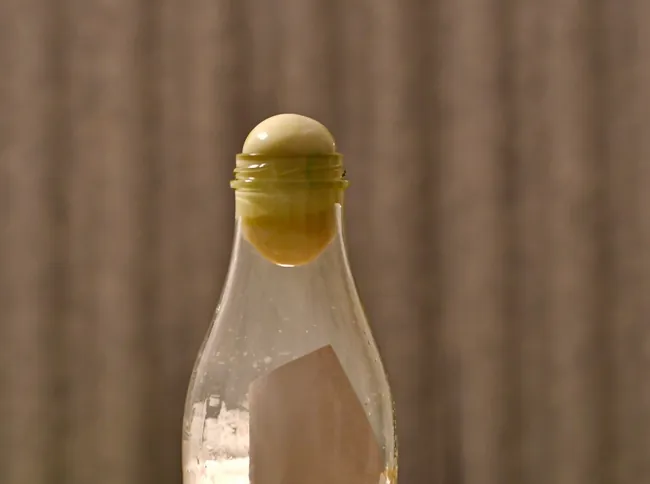
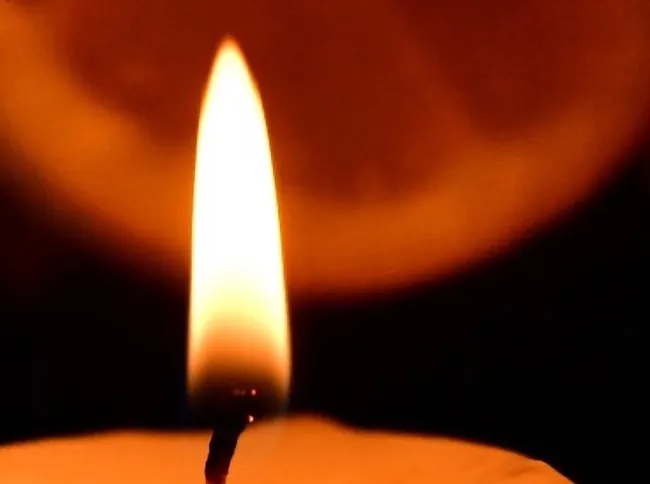
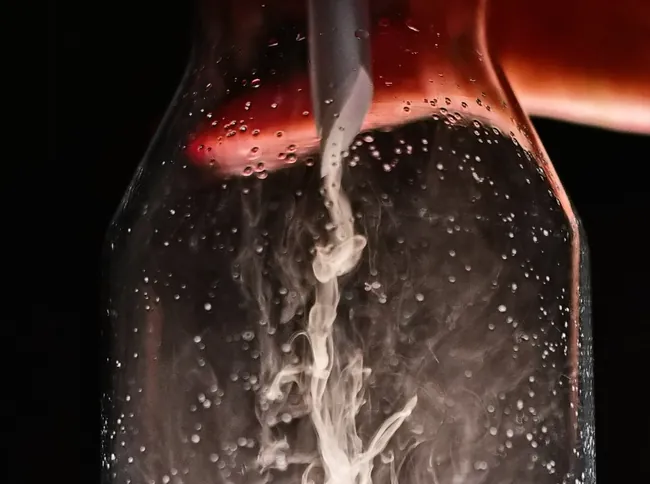
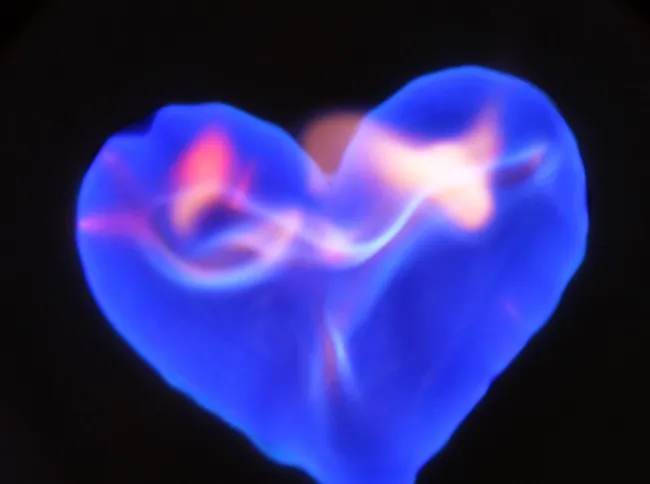
Real photos from my lab, one for every Candle Lab experiment. In the booklet, each sits beside the picture steps, so children see what the result should look like.
Orange lamp: only the metal lid puts out this flame. Why never water? It sinks under hot oil, turns to steam in a flash, and throws burning oil drops into the air. Never leave it, move it, or add oil while it burns or is still warm. Use plain cooking oil, never lamp oil, alcohol, or other fuels, and never squeeze the peel near a flame.
Water balloon: skip this lab if anyone has a latex allergy, and keep uninflated and broken balloons away from children under 8.
Golden caramel: the caramel is for looking, not eating, because soot gets into it. Only the grown-up holds the hot spoon, with a clothespin clipped to the far end of the handle. Tell the grown-up to take it off the flame as soon as it turns light brown.
Egg in a bottle: the grown-up holds the burning paper strip with long metal tongs, lights it beside the bottle, never above it, and drops it in at once. Then they set the egg on from the side, fingers beside the mouth, never above it. Afterward, the egg is not food.
Lemon sparkles: use a spray bottle that has only ever held water. The grown-up stands to the side, holds the bottle level with the flame, about 30 cm (1 ft) away, and sprays across it, never down onto the melted wax or toward anyone. Leftover juice goes down the sink.
Smoke waterfall: work in a spot with no drafts, don’t breathe in the smoke, and keep a glass of water ready. The grown-up holds the tube by its lower end, with the glowing end pointing up and away, and drops it into the water at the end, or at once if it flames up again. If a smoke alarm beeps, never switch it off: open a window.
Blue flame: a grown-up does this whole lab. Use a hand sanitizer gel that lists ethyl alcohol (also written ethanol, alcohol, or alcohol denat.), never methanol or isopropyl alcohol. Close the bottle and put it and the spoon away before anything is lit, and dim the lights, because the flame is hard to see. It can burn on unseen, so treat the paper as burning until no flame or shimmer shows for a whole minute. Keep the metal lid ready, and never add gel to warm or burning paper.
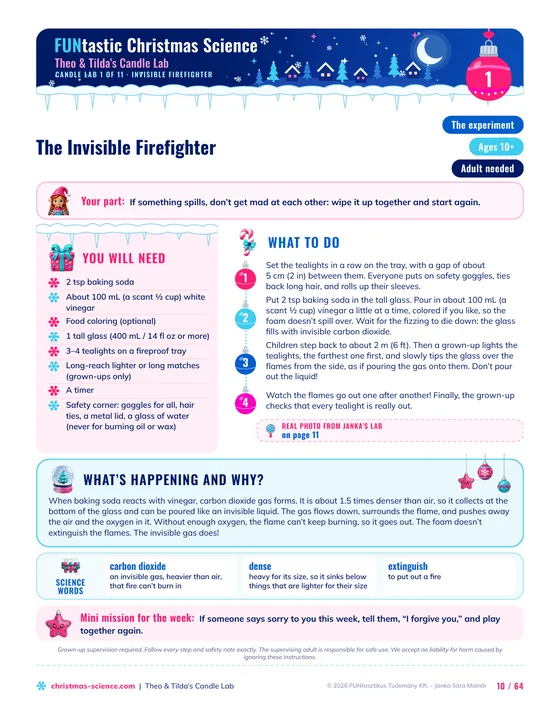
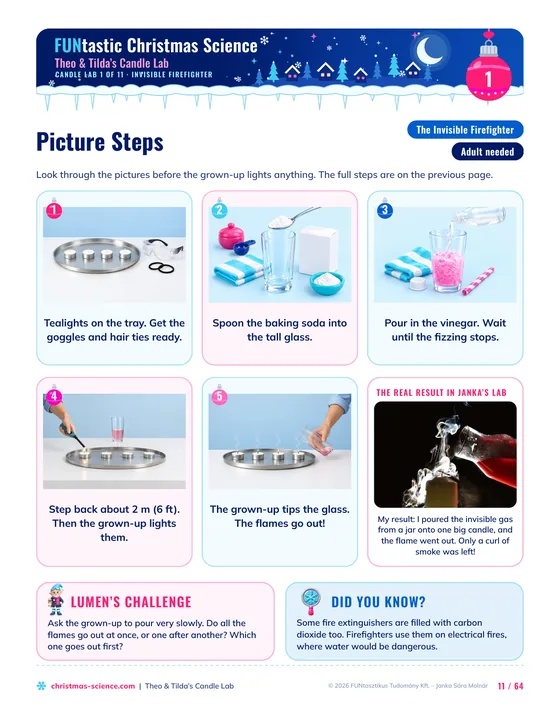
One full lab from the booklet: the experiment page and its picture steps.
5What else do kids learn from candle experiments?
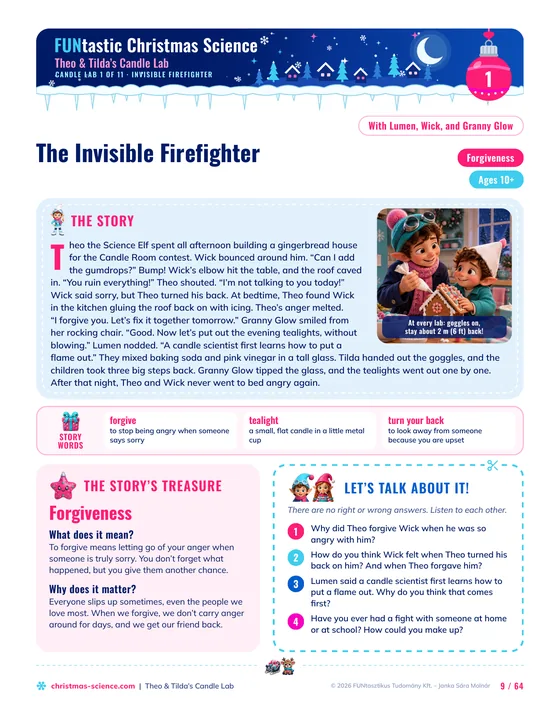
Values, too. Every lab starts with a read-aloud story in which Theo, Tilda, and the Candle Room friends deal with a real-life problem and big feelings. Each story has a value: forgiveness, gratitude, honesty, helpfulness, courage, responsibility, perseverance, patience, or teamwork.
The story’s value gives the experiment extra meaning, and each one comes with a small mission for the week. After the Invisible Firefighter: “If someone says sorry to you this week, tell them, ‘I forgive you,’ and play together again.” After the Balloon That Won’t Pop: ask a question in class when something doesn’t make sense.
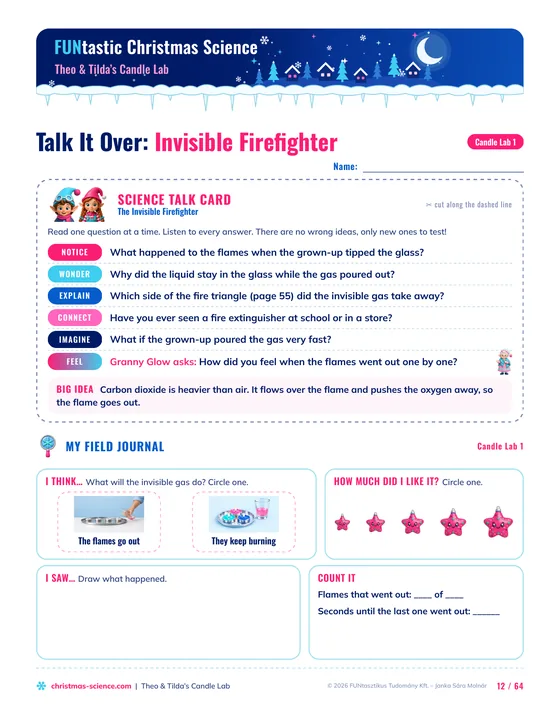
After each experiment comes a science talk card with six questions: Notice, Wonder, Explain, Connect, Imagine, Feel. Read one question at a time and listen to every answer. There are no wrong ideas, only new ones to test. Then the field journal: kids predict first, draw what they saw, and count or measure, like how many seconds it took until the last flame went out.
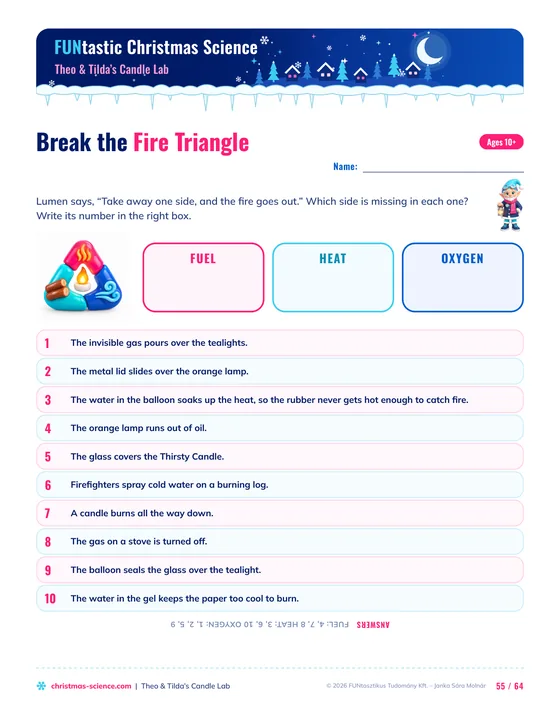
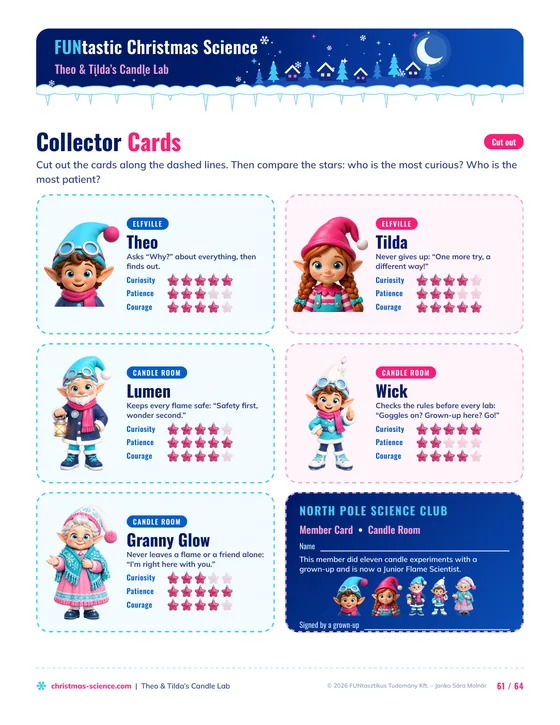
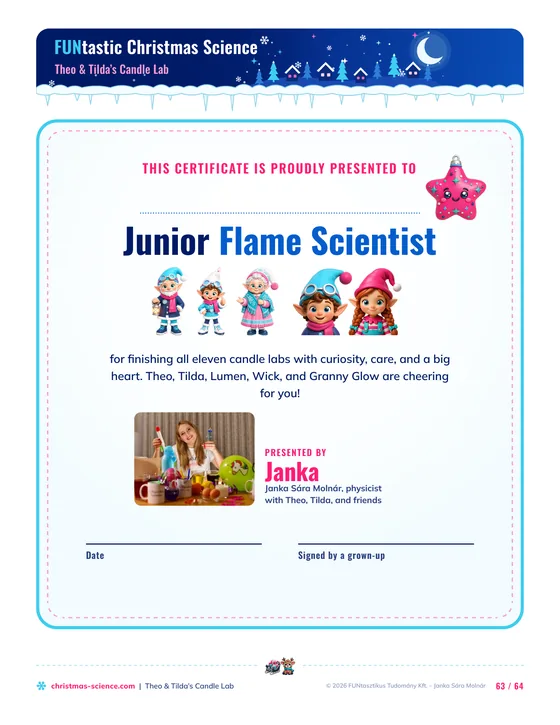
At the end of the booklet: Fire Science fun facts, Lumen’s Word Lantern with 22 science words, Break the Fire Triangle, Wick’s Safe or Not Safe, Granny Glow’s Candle Quiz, two coloring pages, Lumen’s Lantern Mission, collector cards, a candle card to make and give, and a Junior Flame Scientist certificate.
Whatever your child circles in the quiz, ask, “How do we know?” Most answers are on the experiment pages, and the last one is the most important kitchen rule of all: never pour water on burning oil. A grown-up slides a metal lid over it.
Michael Faraday began his famous Christmas lectures about a single candle (1860–61) by saying that there is no better door into science than a burning candle. More than 160 years later, children around the world still read his lectures. A few tealights at your kitchen table open the same door.
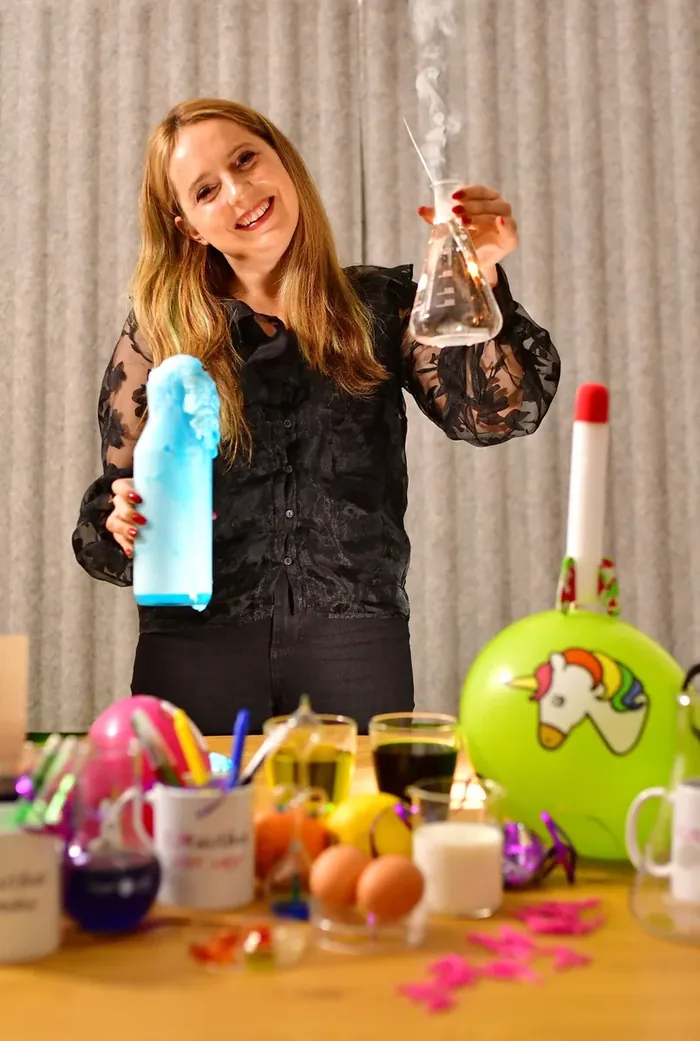
Hi, I’m Janka!
I’m a physicist and science communicator from Hungary, and the founder of FUNtastic Christmas Science. As a high school student, I spent years building particle detectors and took them to CERN several times. Since then, I’ve run several hundred science shows, from big, smoky stage experiments to tiny kitchen ones.
Every experiment in the Candle Lab was done for real in my lab, and you’ll find a real photo of it on every Picture Steps page.
Rising Star Award, Creator Awards 2024 · Role Model Award, Innovation, Nők Lapja 2026 · Women of Excellence Award, Szakmai Elit 2026 · Winner of A Híd (The Bridge), HBO Max 2023 · Juhari Zsuzsanna Blog of the Year Award, Hungarian Academy of Sciences 2023 · FORBES NEXT: 30 talented young people under 30 from the world of science – 2018
Have little ones, too?
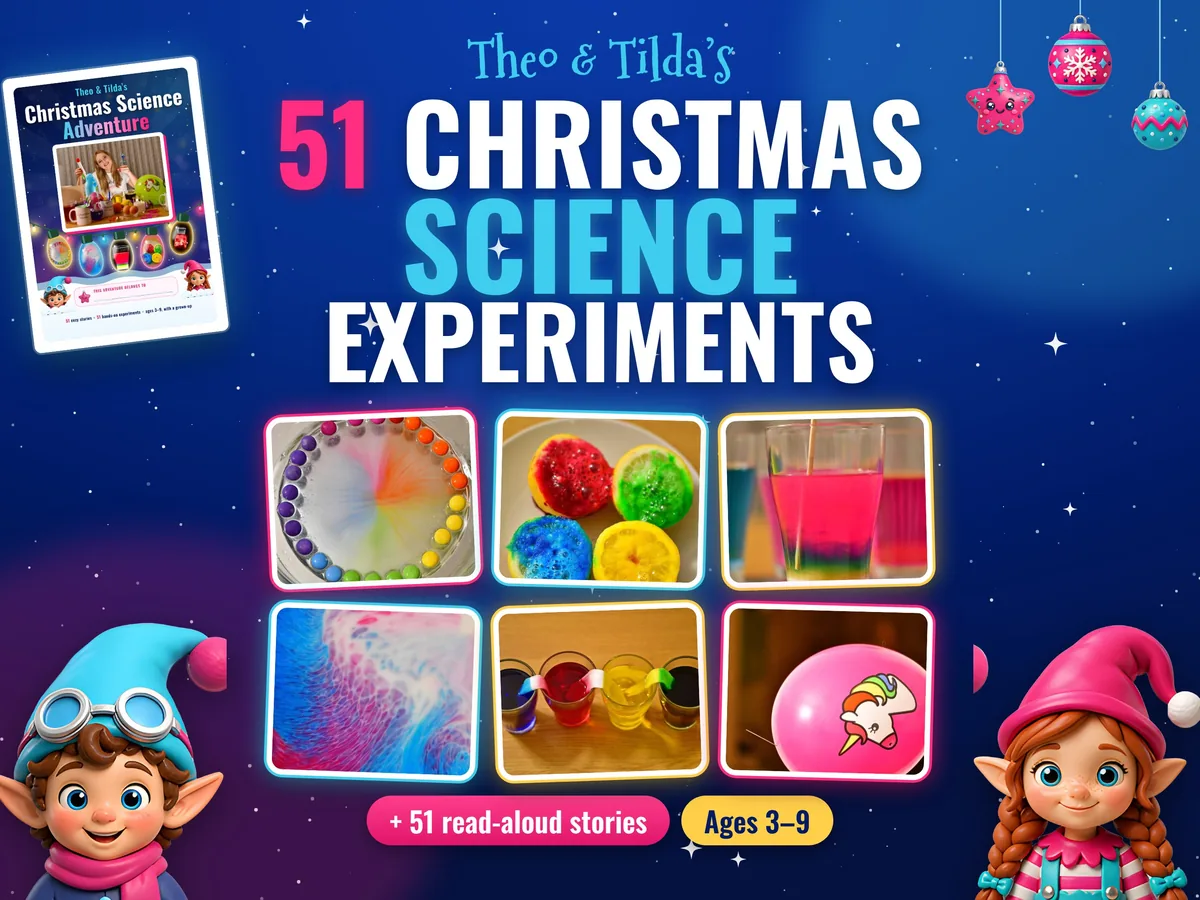
Theo and Tilda’s big book, Theo & Tilda’s Christmas Science Adventure, has 51 read-aloud stories, 51 kitchen experiments with real photos, an adventure map, and a 24-day December plan with no flames at all. The book is for ages 3–9.
Already have it? The eleven Candle Lab experiments are numbers 38, 13, 19, 32, 49, 9, 40, 6, 26, 15, and 47 in the big book. The booklet retells their stories with Lumen, Wick, and Granny Glow, and adds picture steps, talk cards, a field journal, safety pages, games, and collector cards.
Theo saw Tilda watching his every move. “If I light it in secret, tomorrow she’ll want to try too,” he thought. Out loud he said, “We don’t touch the lighter. We’ll wait for Granny.”
When Granny Glow returned, Theo told her about the lighter. “Oh dear, that belongs on the top shelf,” she said, and put it away.
Wick finished his check: “Goggles on? Grown-up here? Go!” Granny Glow lit the candle, and from a safe distance the children watched the sugar melt into golden caramel. Lumen peeked in. “Safety first, wonder second.”
Know a family who’d love this?
Share this post with a family who loves December evenings by candlelight. As Lumen says, safety first, wonder second.
COPY THIS MESSAGE
Paste it into a parent group chat, or send it to a friend.
Look what I found for a December evening! Eleven candle experiments for kids 10+, like an egg that slides into a bottle and a flame that slides down smoke to relight a candle. A physicist explains why each one works, and a grown-up handles the flame every time. www.christmas-science.com/blog/candle-experiments-for-kids
Candle experiments for kids: questions parents ask
What age are candle experiments for?
The Candle Lab is for ages 10 and up, and only a grown-up lights, holds, and puts out the flame. Children prepare, predict, watch from about 2 m (6 ft) away, and explain. Ages are a guide, never permission to handle fire. For younger children, choose flame-free experiments, like the 24-day December plan in Theo & Tilda’s Christmas Science Adventure.
Why does the water rise when you put a glass over a candle?
Mainly because the gas in the glass cools after the flame goes out. Its pressure drops, water vapor from the flame condenses, and the higher air pressure outside pushes water into the glass. Used-up oxygen is only a small part of the story, because the flame swaps most of it for carbon dioxide and water vapor.
How do you relight a candle with its smoke?
Everyone puts on goggles, and children step back to about 2 m (6 ft). A grown-up lets the candle burn for at least half a minute, blows it out gently, and right away holds the flame of a long-reach lighter in the white smoke, 2–3 finger-widths above the wick, not on it. The smoke is full of tiny wax droplets, so the flame runs down it and relights the wick.
How do baking soda and vinegar put out a candle?
Baking soda and vinegar make carbon dioxide, a gas about 1.5 times denser than air. Children watch from about 2 m (6 ft) away while a grown-up slowly tips the glass over the flame from the side. The gas flows down and pushes away the oxygen, so the flame goes out. The grown-up pours only the gas, never the liquid.
How does the egg in a bottle experiment work?
A burning paper strip heats the air in the bottle, and some of it escapes past the egg, which is why the egg wobbles. The egg seals the bottle, the flame goes out, and the air inside cools. Its pressure drops, so the higher air pressure outside pushes the egg in. A grown-up handles the flame, and children watch from about 2 m (6 ft) away.
Is the hand sanitizer blue flame experiment safe for kids?
Only as a grown-up demonstration. In the Candle Lab, a grown-up does the whole lab on a metal tray with a metal lid ready, using a gel with ethyl alcohol, never methanol or isopropyl alcohol. The flame is hard to see in daylight, so dim the lights, and no one touches the tray. Children watch from about 2 m (6 ft) away.
What is in the Candle Lab booklet?
Theo & Tilda’s Candle Lab has 11 candle labs for ages 10+ in 64 printable pages, in US Letter and A4, for $3.99. Every lab has a read-aloud story, the experiment, picture steps with a real photo, and a talk card with a field journal, plus safety pages, games, collector cards, and a certificate.