Christmas Activities for 2-Year-Olds: 10 Tiny Science Moments With Things You Already Have
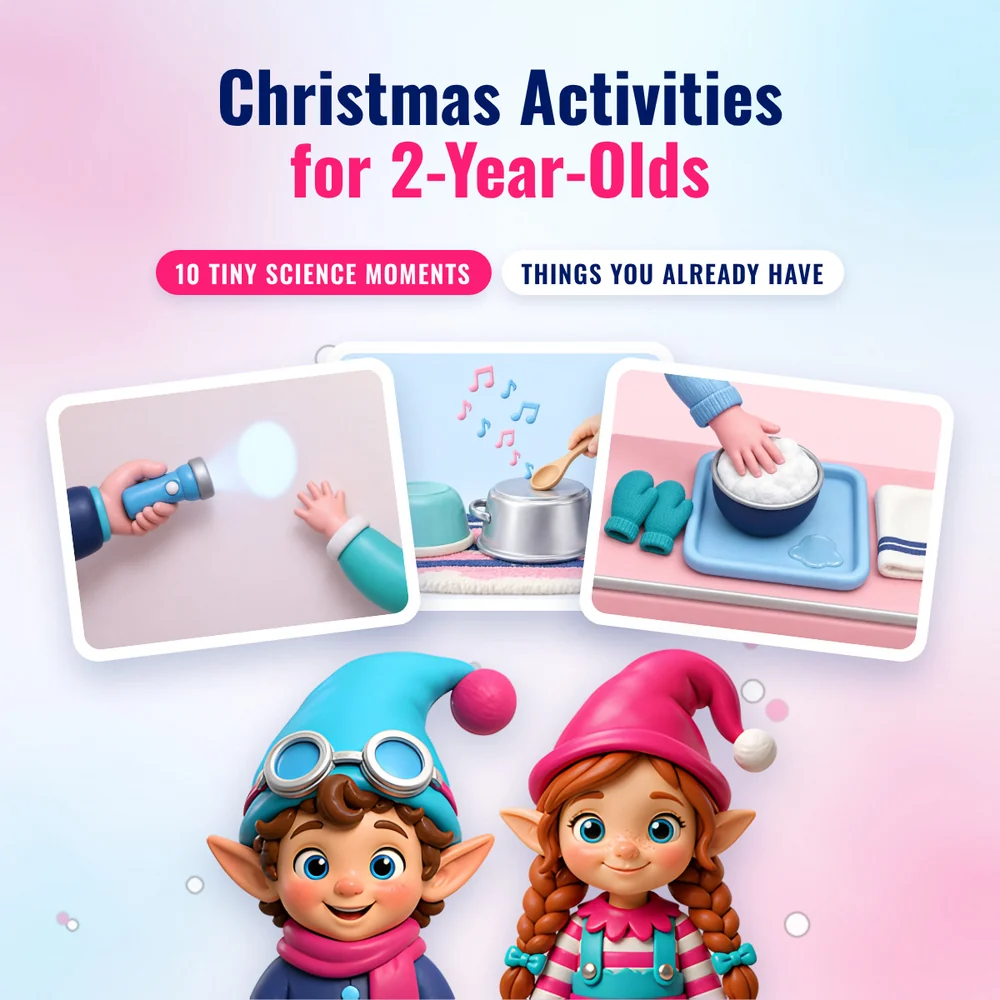
The best Christmas activities for 2-year-olds are short, hands-on, and full of little surprises: snow that turns into water, a hand that makes a shadow, a pot that rings louder than a bowl. Here are 10 of them, made with things you already have, and the tiny science behind each one.
- 10 activities
- For 2-year-olds
- A few minutes each
- Things you already have
Save this for a cozy December afternoon, or send it to a friend with a 2-year-old.
A note for you
Little ones want to do what we do. They carry, push, climb, copy, point, and say “Again!” These 24 days are built around that. Each one takes a few minutes and uses big, everyday things most homes already have: socks, boxes, a pot, a wooden spoon, a teddy bear.
There are no small things in this calendar. That’s on purpose. Toddlers still explore by putting things in their mouths, so we left out rice, beads, buttons, stickers, and balloons.
Do each one together, and let your little one repeat it as many times as they like.
I hope these moments together give you a slower, calmer December and lots of shared FUN.
Know a parent of a 2-year-old who’s looking for easy Christmas ideas? Send them these ten. Share it
What Christmas activities can a 2-year-old do?
A 2-year-old can do short, hands-on activities with big, safe things: touching snow on a tray, painting with water, chasing a flashlight spot, drumming on a pot, rolling a ball, and building a box tower. Keep each one to a few minutes, stay right next to your child, and let them repeat it as often as they like.
I’m a physicist, and I see tiny experiments everywhere a toddler plays. When a 2-year-old drops a sock snowball into a basket, watches snow turn into water, or bangs a pot and then a bowl, they are doing what scientists do: they try something, watch what happens, and try it again.
You don’t have to explain the science. Just play together, and when your toddler is curious, you’ll find a short, true answer under each activity. All ten come from my Toddler Christmas Advent Calendar, and each one uses things you already have at home.
Snow and water activities for 2-year-olds
Snow, water, and soap bubbles are perfect for little scientists, because they change right in front of your eyes.
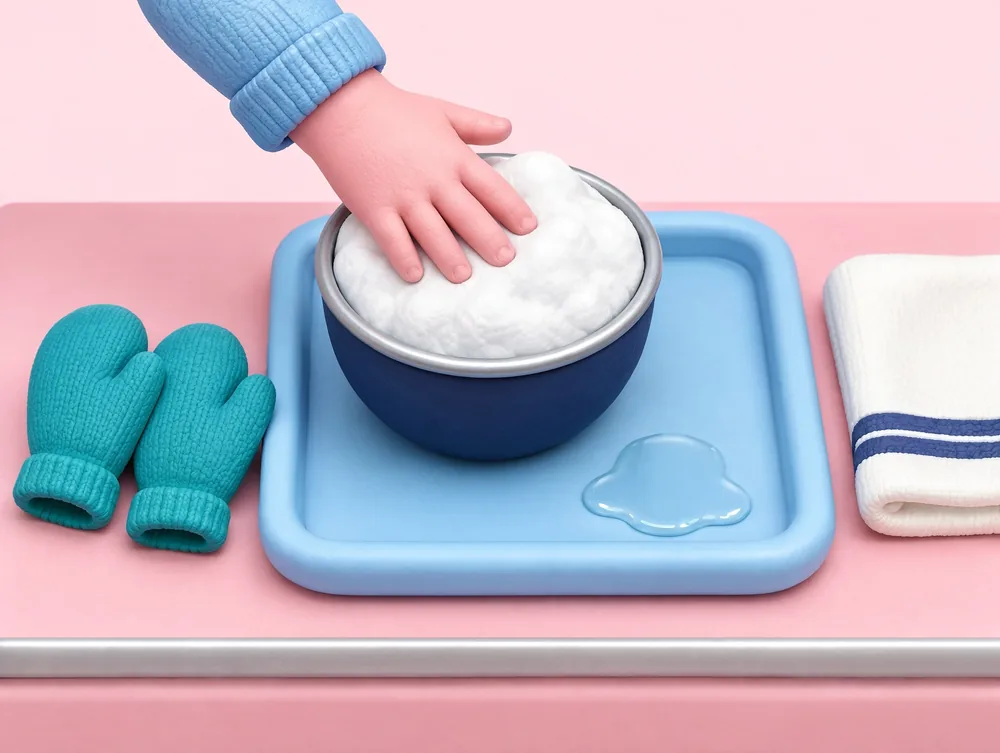
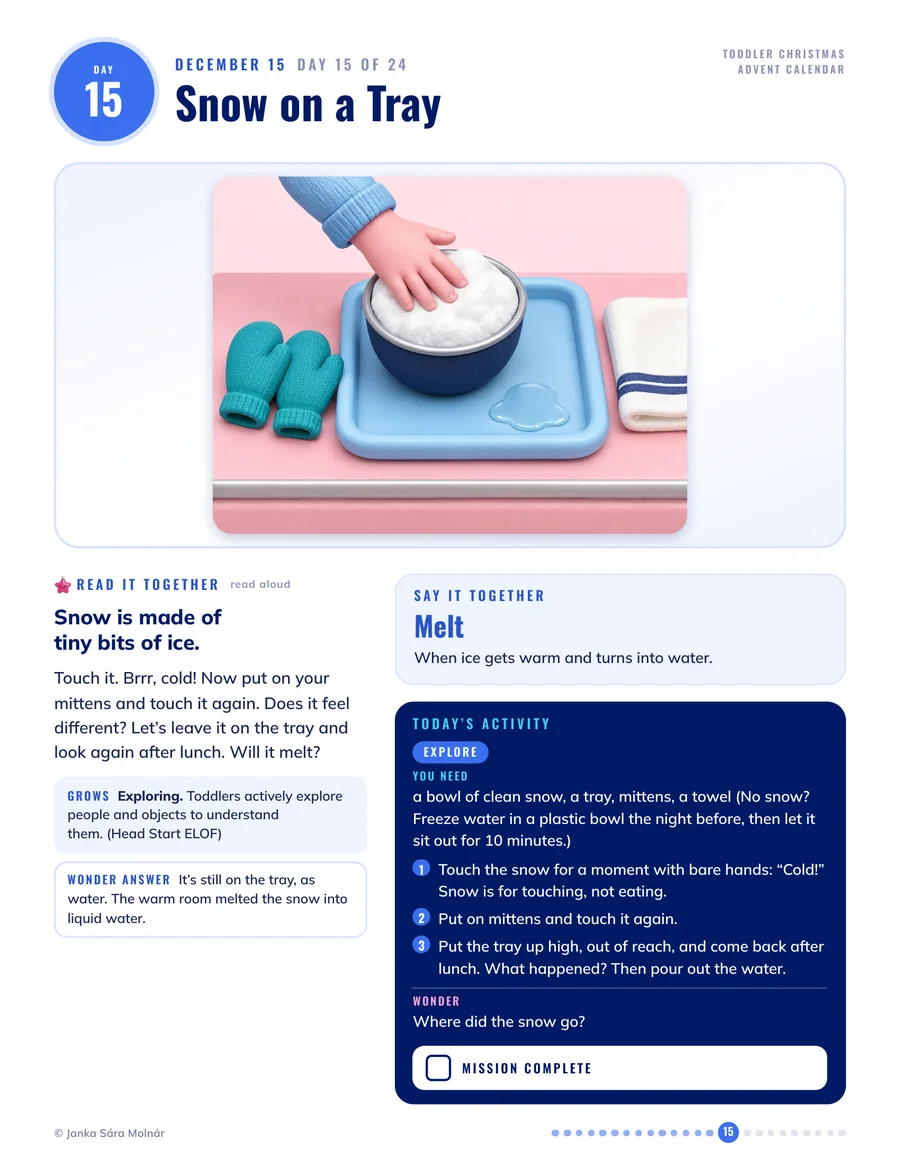
Day 15: Snow on a Tray
READ IT TOGETHER · DAY 15
Snow is made of tiny bits of ice.
Touch it. Brrr, cold! Now put on your mittens and touch it again. Does it feel different? Let’s leave it on the tray and look again after lunch. Will it melt?
TODAY’S ACTIVITY · EXPLORE
You need: a bowl of clean snow, a tray, mittens, a towel (No snow? Freeze water in a plastic bowl the night before, then let it sit out for 10 minutes.)
- Touch the snow for a moment with bare hands: “Cold!” Snow is for touching, not eating.
- Put on mittens and touch it again.
- Put the tray up high, out of reach, and come back after lunch. What happened? Then pour out the water.
Wonder: Where did the snow go?
THE TINY SCIENCE
In a warm room, the ice takes in heat and melts. The snow doesn’t disappear. It just changes from solid to liquid.
Where did the snow go? It’s still on the tray, as water. The warm room melted the snow into liquid water.
Grows: Exploring. Toddlers actively explore people and objects to understand them. (Head Start ELOF)
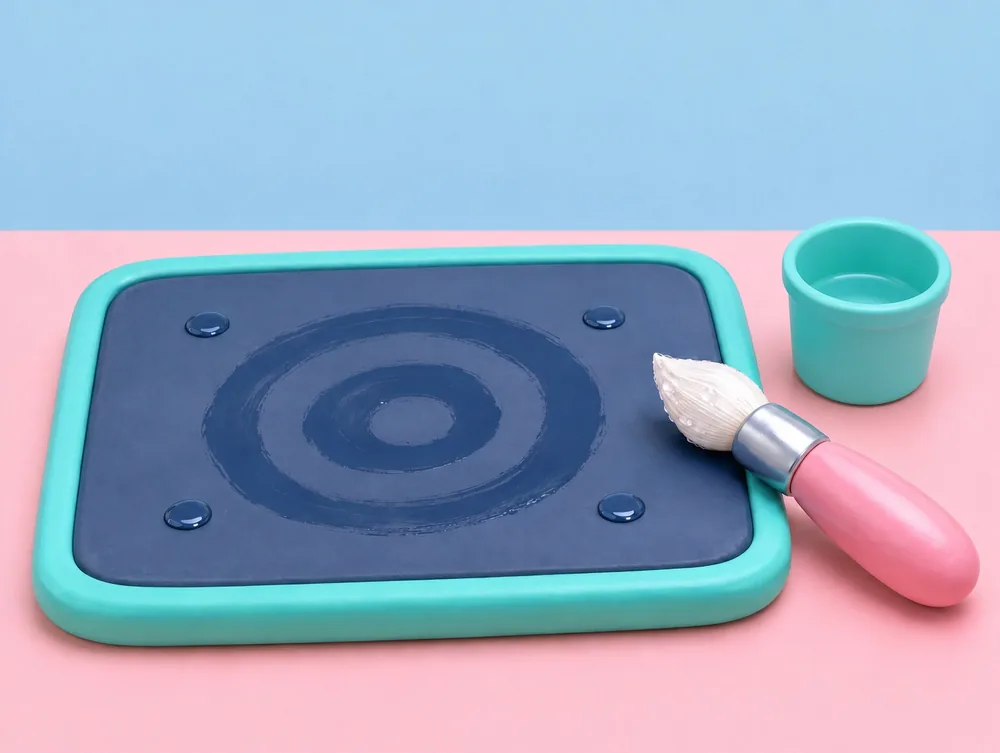
Day 19: Water Painting
READ IT TOGETHER · DAY 19
Water pictures disappear all by themselves.
Dip the brush. Swish, a big wet line. Dot, dot, dot, little wet snowflakes. Now watch. Slowly, the water goes into the air. The picture is gone. All dry!
TODAY’S ACTIVITY · EXPLORE
You need: a cup with a little water, a thick paintbrush, a chalkboard or a piece of dark cardboard (or a dry sidewalk on a mild, above-freezing day)
- Dip the brush.
- Paint big lines, dots, and swirls. Call them snowflakes!
- Watch them fade away. Pour out the water when you finish.
Wonder: Which disappears first, a big wet line or a tiny dot?
THE TINY SCIENCE
Water doesn’t vanish. Little by little, it leaves the board and mixes into the air.
Which disappears first, a big wet line or a tiny dot? Usually the tiny dot, because thin, small wet spots dry first. Thick, wet spots take longer. The water turns into invisible water vapor in the air. This is called evaporation.
Grows: Cause and effect. Toddlers use what they understand about cause and effect to make things happen. (Head Start ELOF)
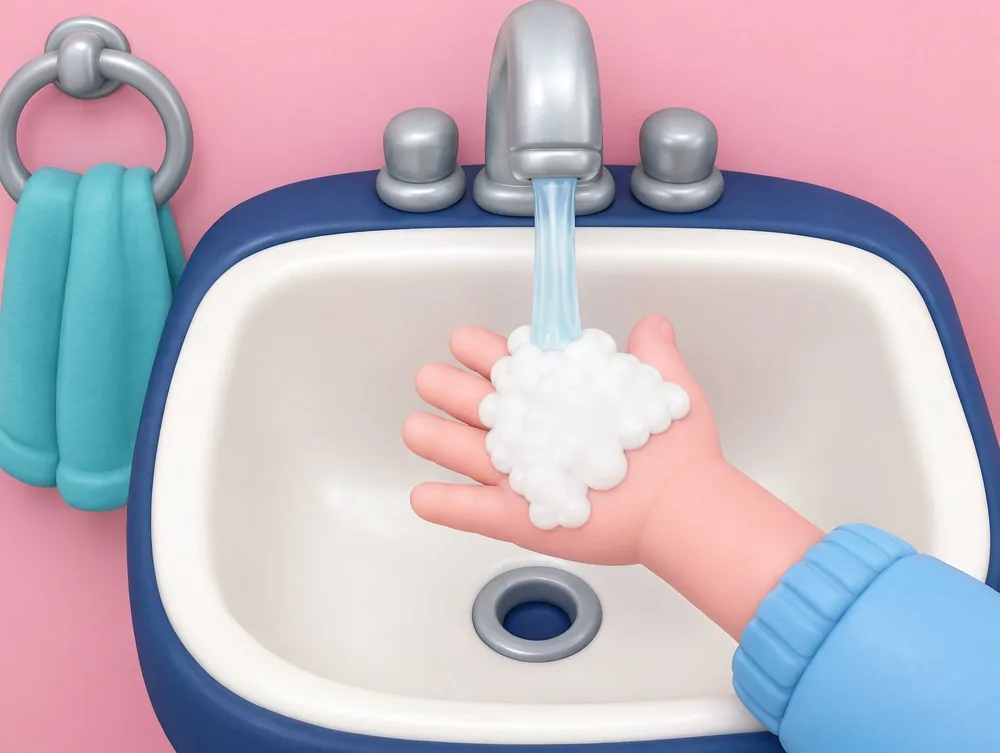
Day 3: Snowy Soap Hands
READ IT TOGETHER · DAY 3
Rub, rub, rub, and white bubbles pile up like snow.
Each bubble is air inside a thin skin of soapy water. Bubbles on your palms, bubbles between your fingers. Now rinse them away, and pat your hands dry.
TODAY’S ACTIVITY · BIG HELPER
You need: liquid soap, a towel, a sturdy step stool (stay right beside your child)
- Keep the drain open. A grown-up turns on the faucet and tests the water on the wrist: lukewarm, not hot.
- A grown-up pumps the soap, then puts the bottle away. Rub it into white “snow” bubbles: palms, backs of hands, and between the fingers.
- Rinse and dry, one hand at a time.
Try this: Say “Rub, rub, rub!” while you scrub.
THE TINY SCIENCE
Rubbing your hands mixes air into the soapy water. Lots of tiny bubbles together look white, like snow.
Grows: A healthy routine. By 18 months, most children hold out their hands for you to wash them. (CDC)
Light and sound activities for 2-year-olds
Your toddler can’t hold light or sound, but they can chase a light spot, make a shadow, and hear the difference between a pot and a bowl.
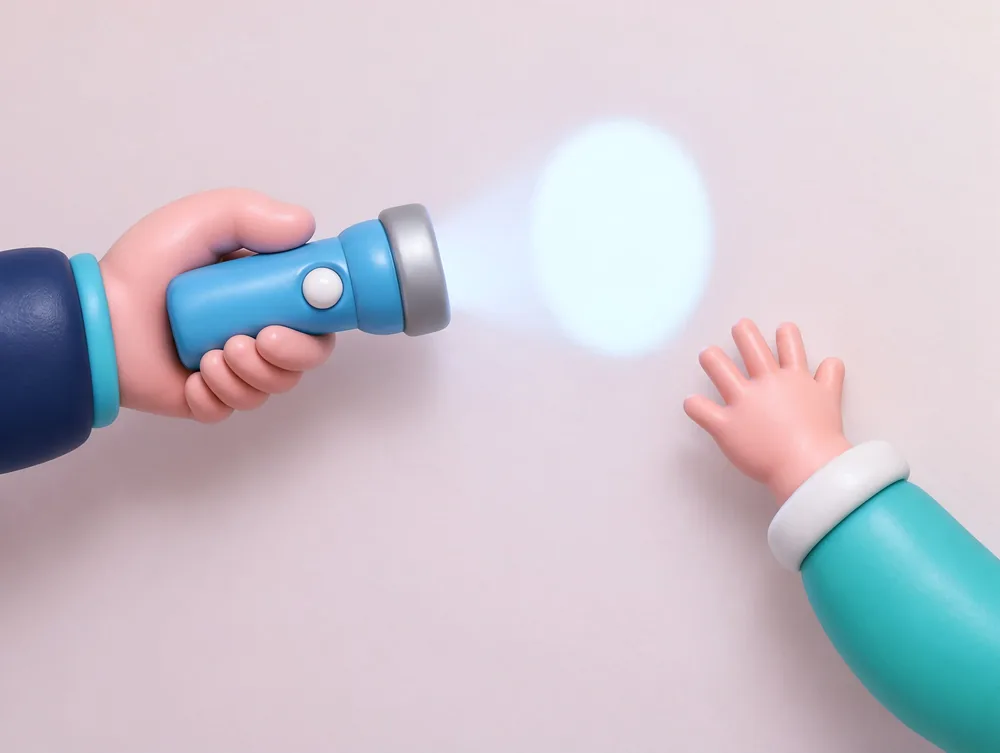
Day 5: Flashlight Spots
READ IT TOGETHER · DAY 5
Light travels in straight lines, so the spot lands wherever the flashlight points.
Click. Up goes the spot, down goes the spot. Can you catch it? Can you point to it? Now make a hand shadow.
TODAY’S ACTIVITY · EXPLORE
You need: a flashlight with a screwed-shut battery cover (a grown-up holds it and puts it away after)
- Dim the lights (not pitch dark), clear the floor, and shine a spot on the wall. Never shine it into eyes.
- Move it slowly: up, down, round and round.
- Your child chases the spot and points to it.
Wonder: Can you make a shadow with your hand?
THE TINY SCIENCE
Light from a flashlight goes out in straight lines. That’s why the shadow shows the outline of your hand.
Can you make a shadow with your hand? Yes. Your hand blocks the light, and the dark shape on the wall is its shadow.
Grows: Sharing what they see. By 18 months, most children point to show you something interesting. (CDC)
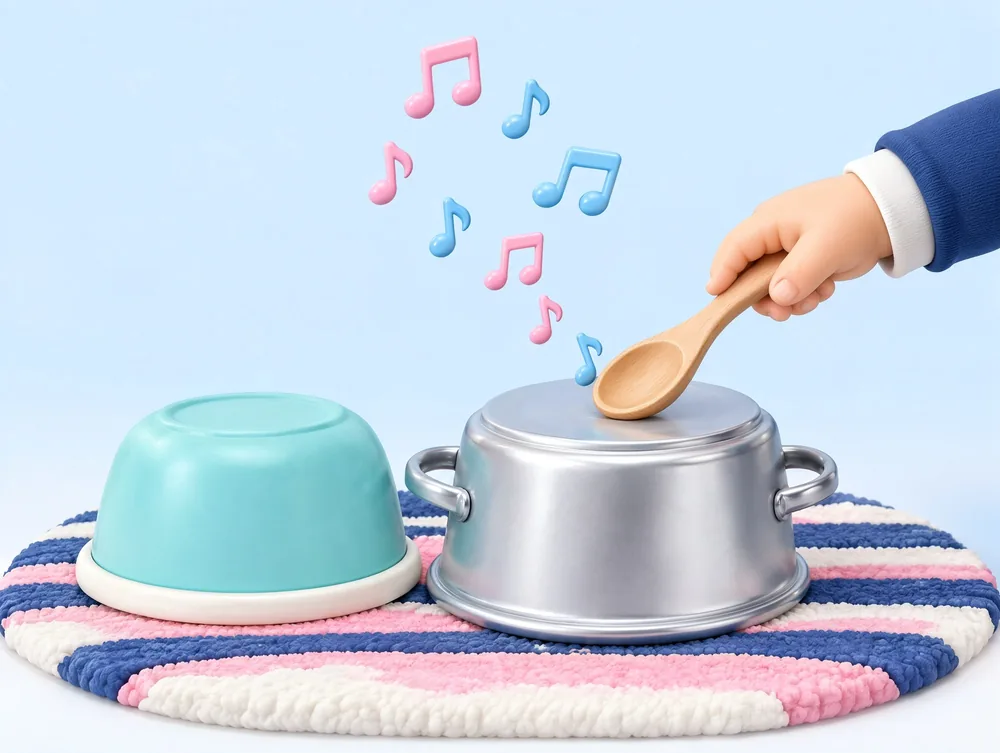
Day 10: Loud and Quiet Drums
READ IT TOGETHER · DAY 10
Bang, bang, bang goes the loud drum.
Tap, tap, tap goes the quiet drum. Now fast, fast, fast. Now slow… slow. When the song stops, the drums stop, too. Shhh.
TODAY’S ACTIVITY · EXPLORE
You need: a cool, empty pot and a plastic bowl (upside down), a wooden spoon, a Christmas song
- Sit down and drum along with the song.
- Play LOUD, then very, very quiet.
- Play fast, then slow. Stop when the song stops.
Wonder: Which sounds louder to you, the pot or the bowl?
THE TINY SCIENCE
Sound starts with a vibration. When the spoon hits the pot, the metal shakes back and forth very fast, and the shaking travels through the air to our ears.
Which sounds louder to you, the pot or the bowl? Usually the pot. Metal rings louder and longer than plastic. Listen together and compare.
Grows: Self-control. Song games where children start and stop, or speed up and slow down, are good practice. (Harvard Center on the Developing Child)
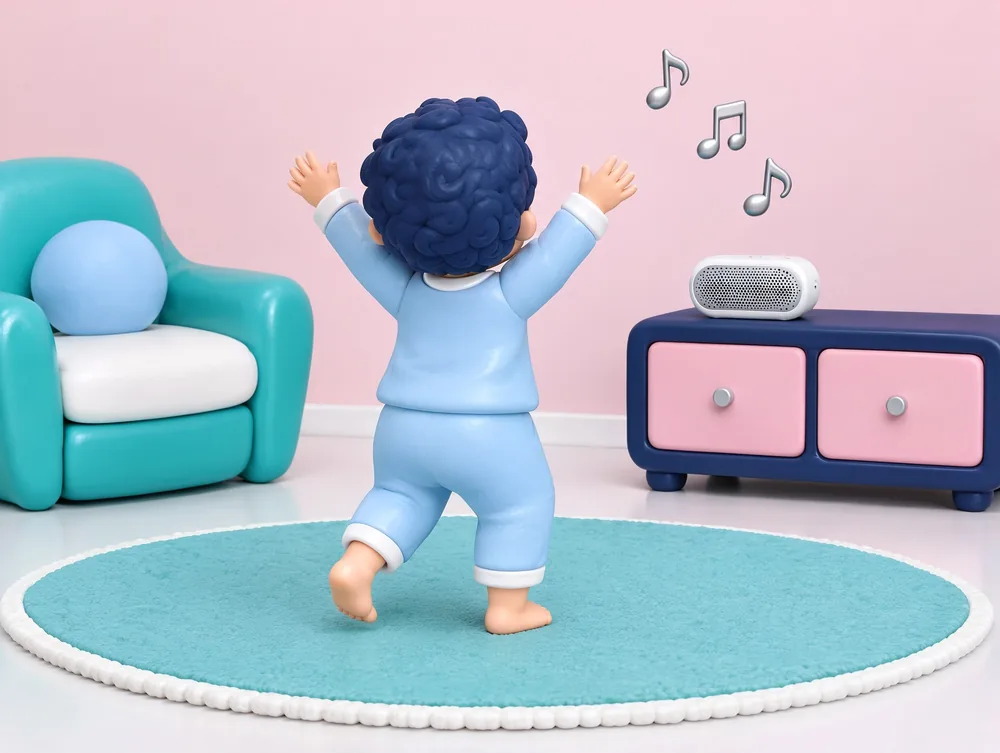
Day 16: Freeze Dance
READ IT TOGETHER · DAY 16
Music on: wiggle, jiggle, dance, dance, dance.
Music off: freeze like a snowman. Stay still, still, still. Music on again, and melt back into dancing. Wobbly snowmen count, too!
TODAY’S ACTIVITY · MOVE IT
You need: Christmas music, a little room to move (bare feet or non-slip socks)
- Dance while the music plays.
- Stop the music: everyone freezes like a snowman (a wobbly freeze counts!).
- Start the music again and melt back into dancing.
Try this: Freeze in a funny shape.
THE TINY SCIENCE
Freeze dance is a listening game. Your toddler hears the music stop and stops their body on purpose, which takes a lot of self-control at this age.
Grows: Stopping on purpose. Freeze dance is a playful way to practice self-control while moving. (Harvard Center on the Developing Child)
Moving and building activities for 2-year-olds
Rolling, pushing, throwing, and stacking are a toddler’s first experiments with motion and balance.
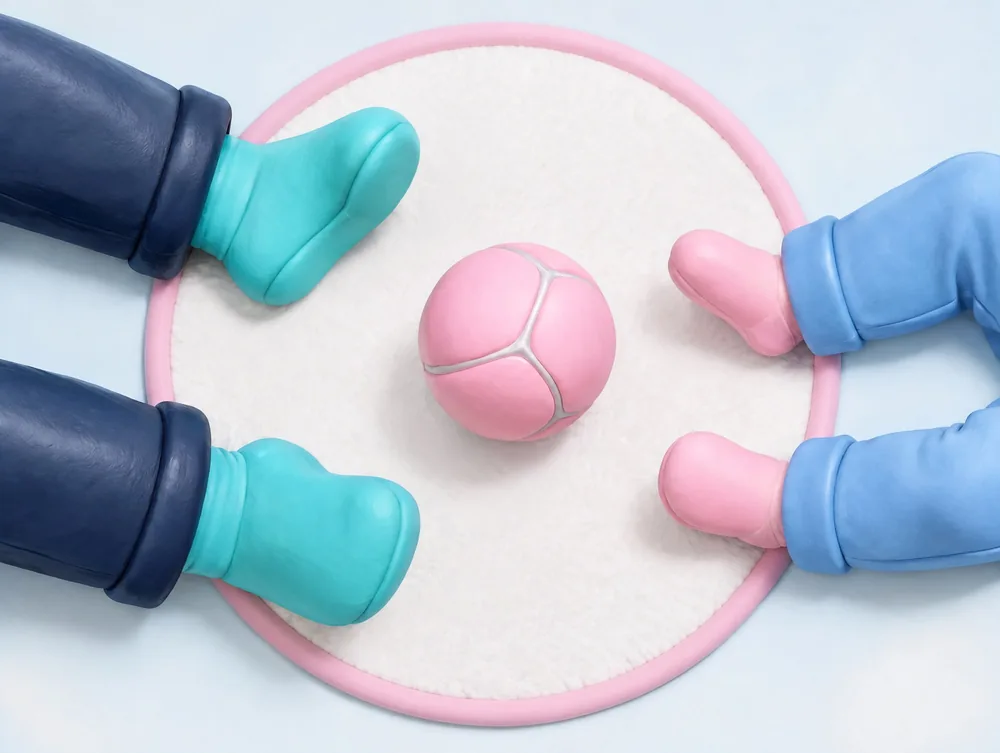
Day 14: Roll It Back
READ IT TOGETHER · DAY 14
Sit down, legs wide, like a big letter V.
Here comes the ball, rolling to you. Now roll it back to me. To you, to me, to you, to me. Can it roll slowly? Can it roll fast?
TODAY’S ACTIVITY · PLAY TOGETHER
You need: a big fabric or rubber ball (not foam)
- Sit on the floor facing each other, legs wide.
- Roll the ball: “To you!”
- Wait for it to come back: “To me!”
Try this: Roll it slowly, then fast.
THE TINY SCIENCE
A ball rolls because it is round, and it keeps going until the floor and the air slow it down. A harder push makes it roll faster and farther.
Grows: Taking turns. Rolling a ball back and forth is one of the CDC’s play ideas at 18 months.
Day 20: Push the Sleigh
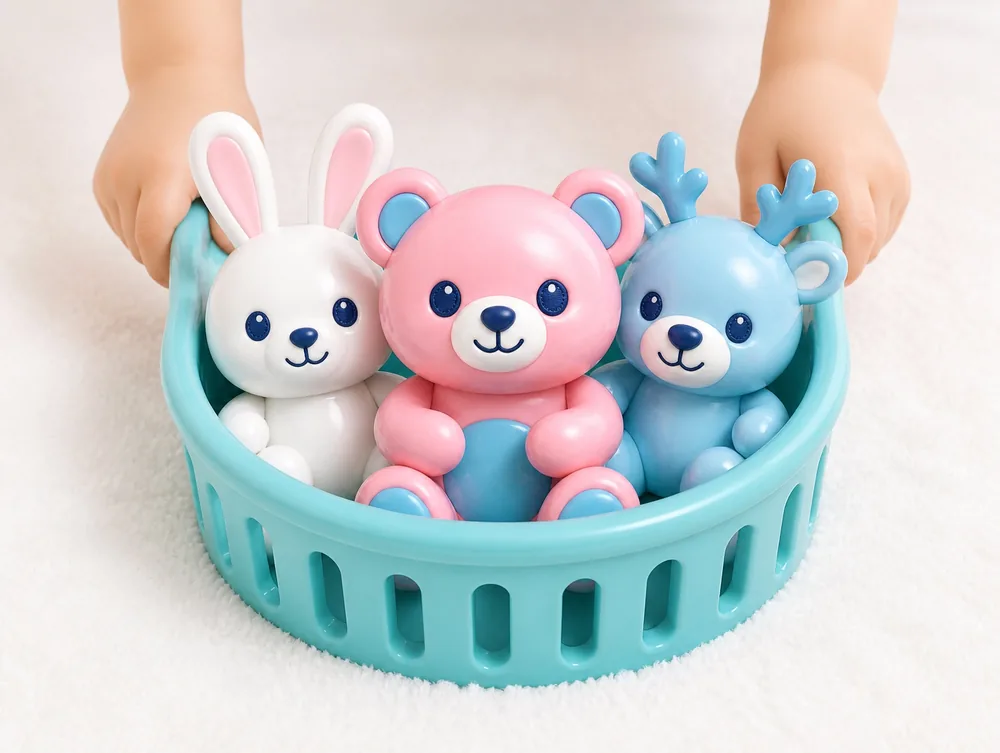
READ IT TOGETHER · DAY 20
Today, the laundry basket is a sleigh.
In goes Teddy. In goes Bunny. Now push, push, push across the rug. Where are we going? To Grandma’s house. Stop, everyone out!
TODAY’S ACTIVITY · MOVE IT
You need: a laundry basket, 2 or 3 stuffed animals
- Your child carries the stuffed animals to the “sleigh.”
- Your child pushes the sleigh across a rug.
- Unload at “Grandma’s house” (the couch).
Try this: Count the stuffed animals as they climb in.
THE TINY SCIENCE
A full basket is harder to get moving than an empty one. The more stuffed animals ride in the sleigh, the harder your toddler has to push.
Grows: Moving with a job to do. Carrying a big toy, or several toys, while walking is a milestone for 2-year-olds. (AAP)
Day 6: Sock Snowball Toss
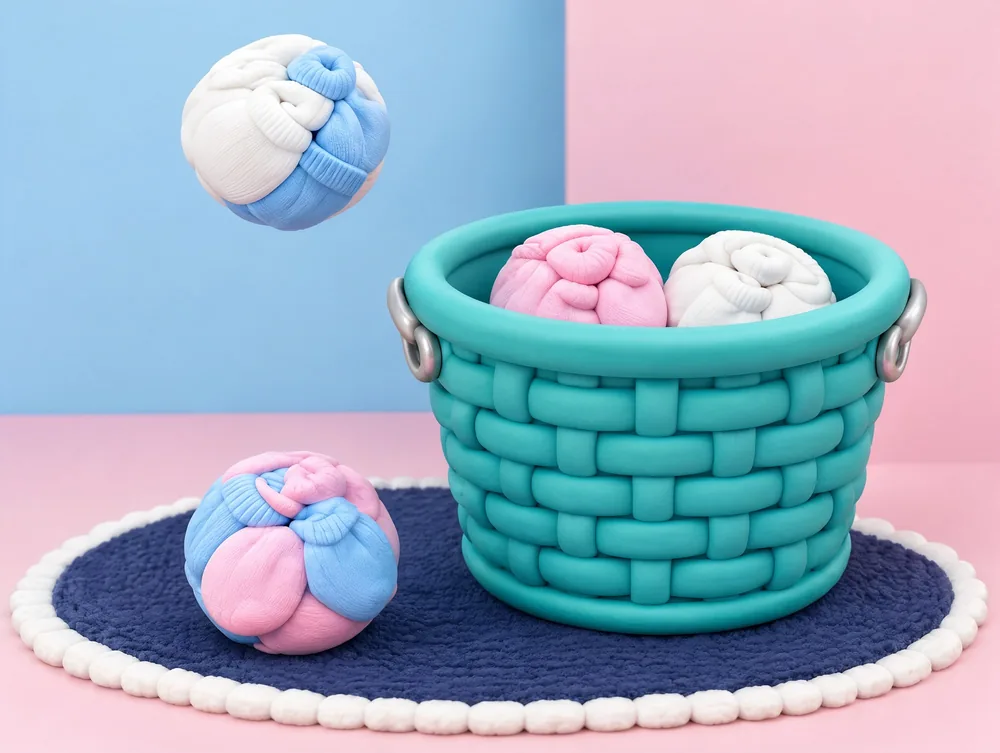
READ IT TOGETHER · DAY 6
Roll up a pair of socks, and you’ve made a soft snowball.
Throw it into the basket. Plop, in it goes! Now take one big step back. Can you still throw it in? Let’s count how many go in.
TODAY’S ACTIVITY · MOVE IT
You need: 5 pairs of grown-up socks, a laundry basket
- Together, roll each pair of socks into a “snowball.”
- Stand close to the basket and throw.
- Take one step back and throw again.
Try this: Kick a sock snowball across the room.
THE TINY SCIENCE
A thrown sock snowball always comes back down, because gravity pulls everything toward the ground. Stepping back means it has to fly farther before it lands.
Grows: Throwing. The CDC suggests giving 2-year-olds balls to kick, roll, and throw.
Day 9: Box Tower
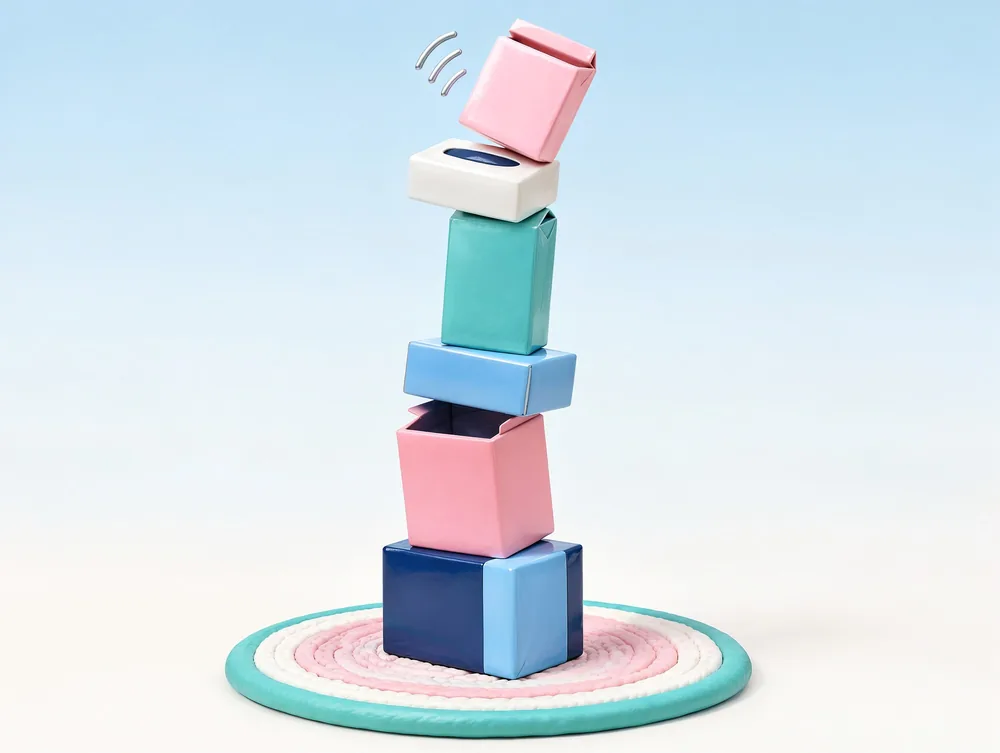
READ IT TOGETHER · DAY 9
One box, two boxes, three boxes, four.
Up, up, up goes the tower. Is it wobbly? Gentle hands. Now… crash! Down it tumbles. Let’s build it again, even taller.
TODAY’S ACTIVITY · PLAY TOGETHER
You need: 5 to 8 empty boxes (cereal, cracker, or tissue boxes), with inner bags and plastic film removed
- Build a tower together: you add a box, then your child does.
- Count out loud as it gets taller.
- Knock it down: “Crash!” Then build again.
Try this: A grown-up wraps the boxes in paper to make a present tower (no bows, ribbon, or loose tape).
THE TINY SCIENCE
A tower stays up as long as its weight stays balanced over the boxes below. If it leans too far to one side, gravity pulls it over. Crash!
Grows: Careful hands. Building a tower of four blocks or more is a milestone for 2-year-olds. (AAP)
How do you keep Christmas activities safe for a 2-year-old?
Stay right next to your child, use only big, everyday things, and put everything away when you finish. Small parts are a choking hazard for children under 3 (CPSC), and young children can drown in as little as an inch or two of water (AAP). So empty every cup, bowl, and tray right away, and keep snow for touching, not eating.
Where can I find more Christmas activities for toddlers?
You’ll find 14 more in Theo & Tilda’s Toddler Christmas Advent Calendar, the printable PDF these ten come from. It has 24 screen-free activity pages for ages 18 months to 3 years, one for each day from December 1 to 24.
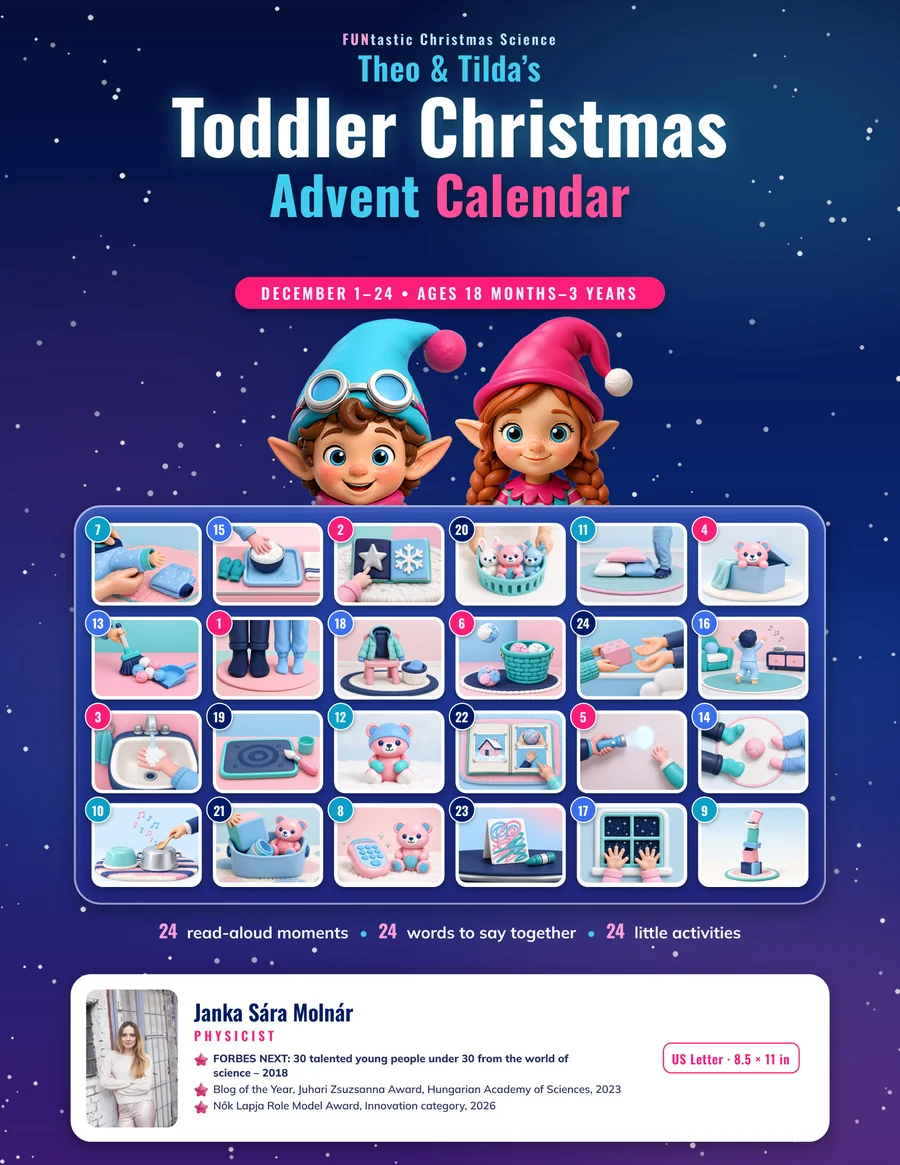
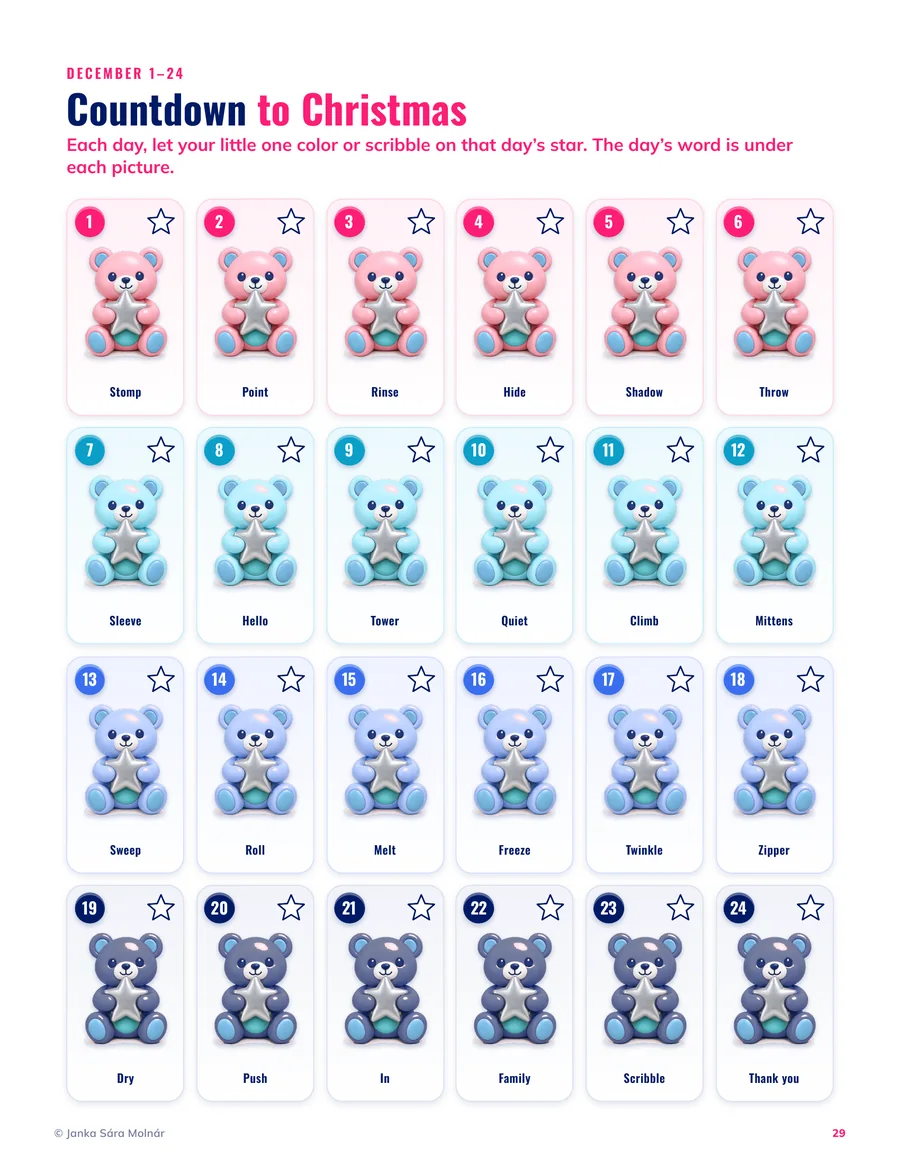
- Cover with Theo and Tilda, our two Science Elves
- A note from Janka
- How to use it: print one page a day, or read it on a tablet or phone
- Safety page and a weekly list of household things to gather
- 24 daily pages: a big picture, a short read-aloud, a word to say together, what you need, 3 easy steps, the skills it helps grow, and a “Try this” or “Wonder” idea
- Color-in countdown page
- December 24 certificate

You don’t need to know every answer. It’s fine to say, “I don’t know. Let’s find out.” Scientists say it all the time.
Every “Grows” line in the calendar is based on the CDC’s developmental milestones and tips, the American Academy of Pediatrics, Harvard’s Center on the Developing Child, or the Head Start Early Learning Outcomes Framework. These organizations are cited as sources only and do not endorse this product.
Looking for one activity for every day from December 1 to 24? Read “24 Advent Calendar Activities for Toddlers.” And here are all my printable advent calendars for kids.
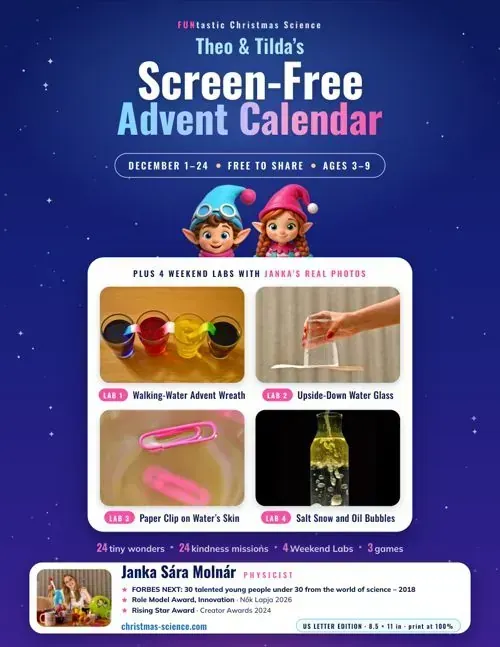
Theo & Tilda’s Screen-Free Advent Calendar
A free printable for ages 3 to 9: 24 tiny wonders and 24 kindness missions, one of each for every day from December 1 to 24.
This calendar is free to share. Print it as often as you like for your family or class, and pass it on to friends, families, and teachers. Please don’t sell it or change it.
Know a family with a 2-year-old?
Send them this page. All ten activities are free to read here, and each one takes a few minutes.
COPY THIS MESSAGE
Paste it into a family group chat, or send it to a friend.
I found 10 easy Christmas activities for 2-year-olds: snow on a tray, water painting, a flashlight shadow game, and pot drums. Each one has a tiny bit of science behind it. www.christmas-science.com/blog/christmas-activities-for-2-year-olds
Quick answers about Christmas activities for 2-year-olds
What can a 2-year-old do for Christmas?
Short, hands-on activities with big, safe things: dance and freeze, drum on a pot, roll a ball, build a box tower, touch snow on a tray, and help deliver presents. Stay right next to your child, and keep small items out of reach.
How do I keep Christmas activities safe for a 2-year-old?
Use only big, everyday things, with no small parts, cords, or balloons. Small parts are a choking hazard for children under 3 (CPSC). Stay within arm’s reach around water, and pour out every cup, bowl, and tray as soon as you finish.
Do I need to explain the science to my toddler?
No. Play first. If your toddler asks, or if you’re curious yourself, each activity above has a short, true answer you can share.
What if there’s no snow where we live?
Freeze water in a plastic bowl the night before, then let it sit out for 10 minutes. It melts more slowly than snow, but it turns into water on the tray the same way.
Where can I find all 24 activities?
They are in Theo & Tilda’s Toddler Christmas Advent Calendar, a printable PDF for ages 18 months to 3 years, with one page for every day from December 1 to 24.

About Janka
Janka Sára Molnár is a physicist and award-winning science communicator from Hungary, and the founder of FUNtastic Christmas Science. As a high school student, she built particle detectors and took them to CERN several times, where she presented them in its teacher program. She graduated from Eötvös Loránd University (ELTE) in Budapest, and for almost 15 years she has run several hundred science shows for children and families.
- FORBES NEXT: 30 talented young people under 30 from the world of science – 2018
- Nők Lapja Role Model Award, Innovation category, 2026
- Women of Excellence Award, 2026
- Creator Awards, Rising Star, 2024
- Blog of the Year, Juhari Zsuzsanna Award, Hungarian Academy of Sciences, 2023
- Winner of the HBO Max reality show A Híd
The illustrations and the pictures of Theo, Tilda, and their world were created with AI-assisted tools (Canva) and edited by our team. Physicist Janka Sára Molnár checked every fact in this post against trusted sources. The photos of Janka are real photos.
Keep reading
More Christmas science ideas from Theo, Tilda, and me.
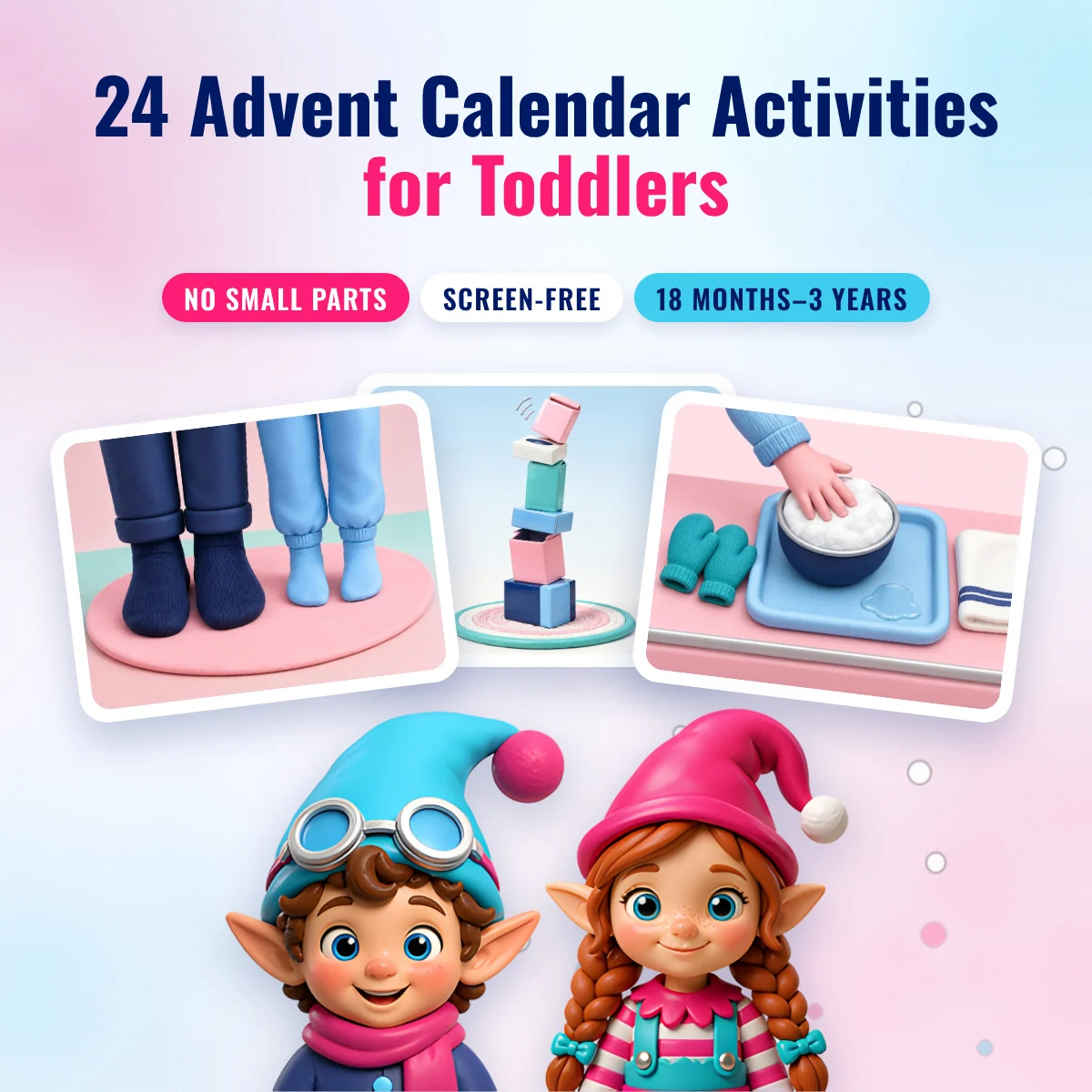 For parents · Toddlers24 Advent Calendar Activities for Toddlers: Screen-Free Ideas With No Small Parts24 screen-free advent calendar activities for toddlers, ages 18 months to 3 years: a few minutes a day with big, everyday things and no small parts.Read the post →
 For parents · 20 min read8 Montessori Christmas Activities for Preschoolers (Ages 3–6)Montessori Christmas activities for preschoolers: 8 calm Practical Life jobs with simple things from home, each with a short read-aloud.Read the post →
 For parents · 21 min read8 Christmas Sensory Activities for Preschoolers, No Messy BinChristmas sensory activities for preschoolers without a messy bin: 8 calm ideas with pine cones, spices, and sound boxes.Read the post →
© 2026 FUNtasztikus Tudomány Kft. – Janka Sára Molnár